Detecting Invisible Cross-Layer and Cross-Protocol Attacks in IoMT Using Resource-Aware Machine Learning
Published in Social Sciences, Electrical & Electronic Engineering, and Computational Sciences



Behind the Paper: Detecting the “Invisible” Attacks in the Internet of Medical Things (IoMT)
Healthcare systems are rapidly becoming smarter, more connected, and increasingly dependent on the Internet of Medical Things (IoMT). From wearable sensors and smart infusion pumps to remote patient monitoring systems and intelligent hospital networks, these technologies are transforming healthcare delivery and improving patient outcomes. However, this transformation also introduces new cybersecurity risks that traditional defense mechanisms are often unable to detect.
Our recent publication, “Resource-aware ML framework for multi-level cross-layer and cross-protocol attack detection in IoMT,” published in the Journal of Supercomputing, explores one of the emerging and overlooked cybersecurity threats in IoMT environments: Cross-Protocol (CP) and Cross-Layer (CL) attacks. Springer Article
Why We Started This Research
Most intrusion detection systems (IDS) are designed around isolated protocol analysis. In practice, this means they inspect traffic at a single network layer or focus on one communication protocol at a time. While this approach can detect many traditional attacks, modern attackers have become far more sophisticated.
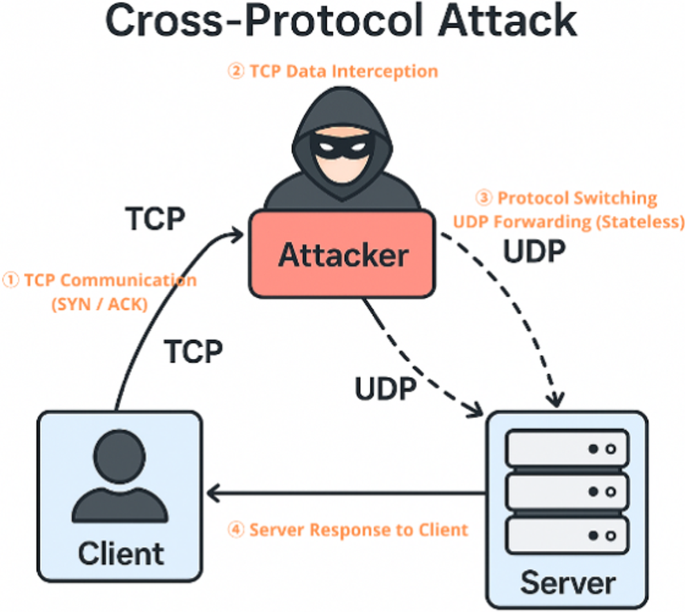
Cross-Protocol and Cross-Layer attacks exploit interactions between multiple protocols and layers simultaneously. Instead of attacking a system directly, adversaries manipulate the relationships between communication layers or tunnel malicious traffic through unexpected protocols. This allows malicious activity to bypass conventional security monitoring tools.
In healthcare environments, such attacks can be extremely dangerous. Imagine a malicious actor manipulating communication between wearable sensors and hospital monitoring systems, delaying alerts, or disrupting medical data transmission. Even a small delay or misclassification could affect patient safety.
Despite the growing importance of IoMT security, we found that most existing research focused primarily on binary attack detection or conventional multi-class classification. Very little attention had been given to CP and CL attacks, especially under resource constraints typical in IoMT systems.
This gap motivated us to design a lightweight yet highly effective machine learning framework capable of detecting these advanced attack patterns in real time.
The Core Challenge
IoMT devices are fundamentally different from traditional computing systems. They are often resource-constrained, with limited memory, processing power, and energy availability. This means that many computationally expensive deep learning solutions may not be practical for real-world healthcare deployment.
The challenge was therefore twofold:
-
Develop a detection framework capable of identifying sophisticated CP and CL attacks.
-
Ensure the framework remains lightweight and efficient enough for deployment in practical IoMT settings.
Balancing security effectiveness with computational efficiency was a central theme of this work.
Building the Framework
To address this challenge, we designed a resource-aware intrusion detection framework using machine learning techniques. We evaluated it on the CICIoMT2024 dataset, which contains realistic Wi-Fi and MQTT traffic for IoMT environments. (researchgate.net)
Our framework included several important stages:
-
Standardized preprocessing for stable and fair evaluation.
-
Hierarchical balancing to handle data imbalance across labels and categories.
-
Feature clustering and dimensionality reduction using Principal Component Analysis (PCA).
-
Comparative evaluation of multiple machine learning models.
We intentionally explored both PCA and non-PCA configurations because dimensionality reduction can significantly influence model stability and computational cost.
One particularly interesting finding involved the Multi-Layer Perceptron (MLP) model. Without PCA, the MLP struggled significantly in CP detection. However, after applying PCA, its performance improved dramatically. This highlighted how preprocessing decisions can heavily impact the effectiveness of machine learning in cybersecurity applications.
At the same time, Random Forest consistently delivered the best balance between accuracy, stability, and efficiency.
What We Found
Among all evaluated models, Random Forest without PCA achieved the most reliable and consistent performance. The framework achieved accuracy values above 99% and F1-scores reaching 0.9951 for Cross-Protocol attacks and 0.9926 for Cross-Layer attacks. (researchgate.net)
Equally important, the framework demonstrated very low computational overhead:
-
Approximately 0.02 seconds per test instance.
-
Less than 1 MiB memory usage.
These results are highly significant because IoMT environments require low-latency and lightweight security solutions. In healthcare systems, delayed detection may directly lead to delayed medical decisions.
Our results demonstrated that high detection performance does not necessarily require extremely heavy deep learning architectures. Carefully designed resource-aware machine learning solutions can still provide strong protection while remaining deployable in constrained environments.
Beyond Accuracy Metrics
One lesson we learned from this work is that cybersecurity research should not focus solely on accuracy percentages. In many publications, very high accuracy values are reported without considering whether the proposed systems can realistically operate in constrained real-world environments.
For healthcare applications, deployability matters as much as detection capability.
This is why we emphasized resource awareness throughout the paper. A practical IDS for IoMT should not only detect attacks accurately but also
-
Operate with minimal latency.
-
Consume limited memory and computational resources.
-
Adapt to heterogeneous communication protocols.
-
Maintain reliability under realistic traffic conditions.
Future cybersecurity research should increasingly evaluate models from this operational perspective.
The Human Side of the Project
This work was also a rewarding collaborative effort between researchers and students working on advanced cybersecurity challenges in emerging healthcare technologies. One of the exciting aspects of the project was exploring how relatively classical machine learning techniques could still outperform more complex methods when combined with proper preprocessing, balancing, and evaluation strategies.
Another rewarding aspect was working with realistic IoMT traffic rather than overly simplified benchmark datasets. Real healthcare communication environments are noisy, heterogeneous, and dynamic, making the problem substantially more challenging.
Throughout the project, we repeatedly refined preprocessing pipelines, experimented with balancing strategies, and analyzed why certain models failed under specific attack scenarios. Many of the final insights emerged only after extensive iterative experimentation.
Looking Ahead
Cross-Protocol and Cross-Layer attacks are likely to become increasingly common as interconnected healthcare ecosystems continue to grow. Future IoMT systems will integrate AI-driven diagnostics, cloud-assisted healthcare, edge computing, wearable devices, and autonomous medical systems, all communicating through diverse protocols and layers.
This increasing complexity will inevitably expand the attack surface.
Future research directions may include:
-
Federated and privacy-preserving intrusion detection for distributed healthcare systems.
-
Explainable AI techniques for interpretable medical cybersecurity decisions.
-
Real-time adaptive IDS frameworks capable of evolving with new attack patterns.
-
Hybrid edge-cloud architectures for scalable IoMT security.
-
Integration of post-quantum cryptographic protection with intelligent intrusion detection.
We hope this work contributes toward building more secure and trustworthy healthcare infrastructures.
Final Thoughts
Cybersecurity in healthcare is no longer optional. As medical systems become smarter and more interconnected, attackers are also becoming more creative and adaptive.
Our goal with this research was not only to improve attack-detection performance but also to demonstrate that practical, lightweight, and deployable security solutions are achievable in IoMT environments.
Ultimately, protecting digital healthcare systems means protecting patients themselves.
We are excited to continue exploring intelligent and resource-aware cybersecurity solutions for next-generation cyber-physical and healthcare systems.
Published article:
“Resource-aware ML framework for multi-level cross-layer and cross-protocol attack detection in IoMT” in The Journal of Supercomputing. (researchgate.net)

Dr. Qasem Abu Al-Haija is Chair of the Cybersecurity Department at Jordan University of Science & Technology (JUST), Irbid, Jordan. He received his Ph.D. in Computer Engineering from Tennessee State University (USA). He has been recognized as one of Stanford/Elsevier’s Top 2% Scientists worldwide (2023–2025). Dr. Abu Al-Haija has authored and co-authored more than 300 scientific publications, including journal articles, conference papers, books, and book chapters. His research interests span cybersecurity, artificial intelligence, Internet of Things (IoT), cyber-physical systems (CPS), machine learning, cryptography, smart systems, and secure digital transformation. He serves as a guest editor, reviewer, keynote speaker, technical program committee member, and organizer for international journals and conferences in AI and cybersecurity.
Follow the Topic
-
The Journal of Supercomputing
The Journal of Supercomputing publishes papers on the technology, architecture and systems, algorithms, languages and programs, performance measures and methods, and applications of all aspects of supercomputing.

Related Collections
With Collections, you can get published faster and increase your visibility.
Special Issue on New Challenges for Heterogeneous Computing with Emerging HPC Devices
Call for Papers
High-Performance Computing (HPC) has traditionally embraced heterogeneity through the integration of multi-core CPUs, GPUs, and FPGAs within parallel and distributed computing systems. This established landscape is now being enriched by emerging technologies that further diversify the computational ecosystem: from specialized AI accelerators such as Tensor Processing Units (TPUs) and Neural Processing Units (NPUs) that bring unprecedented efficiency for machine learning workloads, to RISC-V processors that introduce open-source, customizable architectures that enable new design possibilities across the computing spectrum, up to low-power devices for edge computing aimed to extend HPC capabilities to resource-constrained environments at the network edge.
The fundamental challenge in this increasingly diverse landscape is the integration of multiple forms of parallelism. Achieving high performance and energy efficiency requires seamlessly combining and orchestrating different parallelism paradigms. Each hardware component operates optimally under different parallelism strategies, presenting distinct memory hierarchies, programming models, instruction sets, and performance characteristics. Successfully exploiting this heterogeneity demands methodologies, algorithms and software tools that can intelligently integrate these diverse parallelism forms into unified, efficient execution strategies. Achieving effective integration across highly heterogeneous HPC systems encompasses several critical issues, as it involves several deeply interconnected challenges. At the most fundamental level, managing large-scale parallelism across millions of heterogeneous computing units demands sophisticated coordination mechanisms that are both robust and scalable. Closely related to this is the need to carefully orchestrate data movement and communication across diverse memory systems and interconnects, since even minor inefficiencies in this regard can quickly become severe performance bottlenecks.
The situation is further complicated by workload balancing, which grows increasingly difficult when the computing elements involved exhibit widely varying capabilities and performance profiles. At the same time, any solution must ensure performance portability across different hardware configurations, and this must be achieved without compromising the energy efficiency that originally motivated the adoption of specialized hardware. Finally, and perhaps most critically from a usability standpoint, programming abstractions must be designed to shield application developers from the underlying complexity of the system, while still preserving the ability to exploit hardware-specific optimizations whenever the situation demands it.
Topics of Interest
We welcome submissions that address the integration and combination of multiple forms of parallelism in heterogeneous HPC systems. Topics include, but are not limited to:
• Hybrid and hierarchical parallel algorithms combining distributed, shared-memory, and accelerator-based parallelism
• Architecture-aware algorithm design and auto-tuning techniques exploiting multiple parallelism paradigms
• Mixed precision algorithms and adaptive precision techniques for heterogeneous accelerators
• Task scheduling, load balancing, and workflow orchestration integrating different types of computing elements
• Performance analysis, scalability models, and performance portability across heterogeneous platforms
• GPU computing, AI accelerators (TPUs, NPUs), and FPGA-based acceleration integrated with traditional computing
• RISC-V architectures, algorithms, software, and applications in heterogeneous systems
• Edge computing devices and edge-cloud continuum architectures with integrated heterogeneous resources
• Programming environments, tools, compiler techniques and frameworks for unified exploitation of heterogeneous resources
• Resource management, virtualization, and synchronization mechanisms across different parallelism paradigms
• Multi-level cache management, memory hierarchy optimization, and data movement coordination
• Fault tolerance, power management, and energy-efficient computing in heterogeneous systems
• Scientific workflow parallelization and execution on heterogeneous architectures
• Scientific computing, AI/ML workloads, and real-time applications on heterogeneous HPC platforms
• Large-scale simulations and computational science applications leveraging heterogeneous accelerators
Submission Guidelines
This special issue aims to collect extended papers from the 8th Workshop on Models, Algorithms and Methodologies for Hybrid Parallelism in new HPC Systems (MAMHYP-26), held in Poznań, Poland, from August 30th to September 3rd, 2026, jointly with the Parallel Processing and Applied Mathematics (PPAM 2026) conference, as well as other original contributions spanning the HPC spectrum and relevant to the topics of the special issue.
Furthermore, submissions must follow these guidelines:
• All papers will be peer-reviewed and accepted based on their scientific merit, novelty, and relevance to the special issue topics. At least one of the guest editors will review primarily the submissions.
• Submissions should present original research that has not been published or under review at another journal or conference at any time during the review process elsewhere.
• Extended versions of conference papers are welcome, provided that the journal submission contains at least 50% new material compared to the conference version, for example in the form of novel algorithms, additional experiments, or qualitative and quantitative comparisons. Authors should clearly describe the new contributions
• Manuscripts should be prepared according to the journal's author’s guidelines (formatting, structure, length requirements).
• Submit your manuscript through the journal's online submission system, clearly indicating that it is for this special issue.
Important Dates
• Submission deadline: January 2027
• First review round: March 2027
• Submission deadline for revised manuscripts: April 2027
• Final decision: May 2027
• Expected publication: Summer 2027
Publishing Model: Hybrid
Deadline: Jan 31, 2027
Section - Architectures, Systems and Hardware Security
All aspects of high-performance hardware and architectures, including optimizing and evaluating processors, systems issues, and security, especially at the hardware level and sustainability of systems.
Topics include but not limited to the following:
T
• Architectural support for programming languages or software development.
• Architectures to support extremely heterogeneous composable systems (e.g., chiplets)
• Design-space exploration/performance projection for future systems
• Evaluation and measurement on testbed or production hardware systems
• Hardware acceleration of containerization and virtualization mechanisms for HPC
• Interconnect technologies, topology, switch architecture
• I/O architecture/hardware and emerging storage technologies
• Memory systems: caches, memory technology, non-volatile memory, memory system architecture (to include address translation for cores and accelerators)
• Multi-processor architecture and micro-architecture (e.g., reconfigurable, vector, stream, dataflow, GPUs, and custom/novel architecture)
• Sustainable design aspects, including power and energy efficiency and power-management strategies
• Resilience, error correction, high availability architectures
• Scalable and composable coherence (for cores and accelerators)
• Secure architectures, side-channel attacks, and mitigation, covering all attack vectors, including all forms of side-channel attacks, piracy, reverse engineering, tampering, and hardware Trojan attacks, including countermeasures at different stages of system design - i.e., architecture definition, design, validation, and deployment
• The security of hardware and system security at all levels of abstraction
• Interactions between hardware and systems, and between hardware and firmware/software, including in the context of security and trust
• Software/hardware co-design, domain-specific language support
• Interactions among architectures, compilers, programming languages, and operating systems
Architectures, Systems and Hardware Security research relates to multiple United Nations Sustainable Development Goals (SDGs) through advances in health care, education, and energy, among other fields. This Section particularly welcomes submissions related to SDG 9 “Industry, Innovation, And Infrastructure.”
An essential aspect of supercomputing involves solving computer-intensive problems. Paper submissions are expected to address problems that require significant computational resources.
Publishing Model: Hybrid
Deadline: Ongoing