
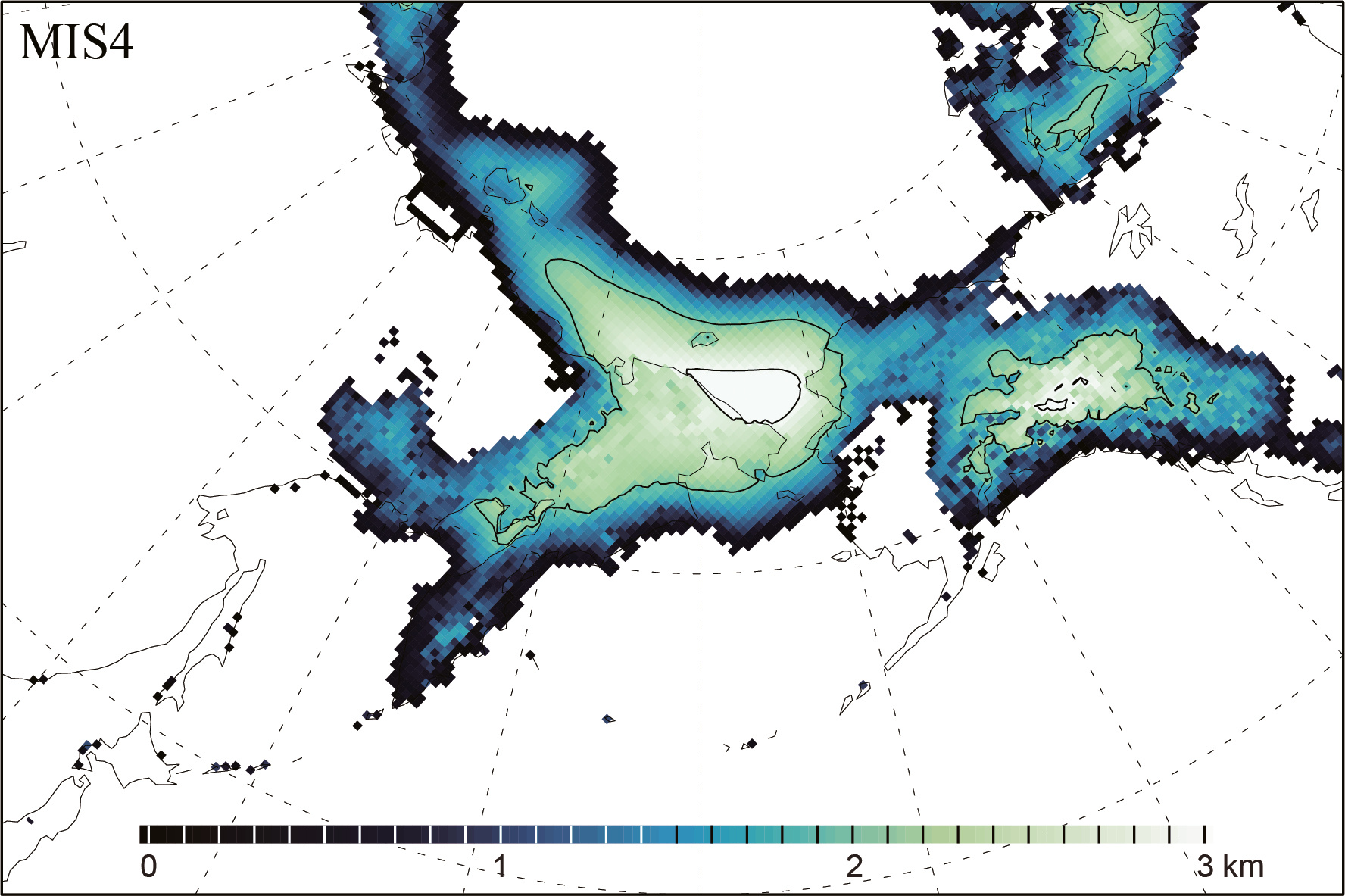
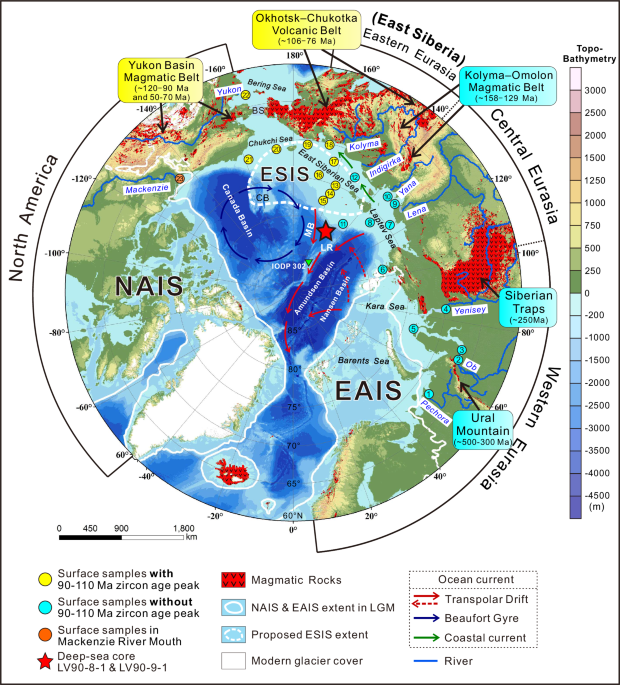

The existence of a Beringian ice sheet (also known as an East Siberian ice sheet) has been a subject of scientific debate since the 1960s-70s. Resolving this issue is crucial for understanding the Quaternary glacial climate evolution, particularly with regard to human migration into the Americas via the Bering Land Bridge.
For a long time, the debate seemed to have subsided, especially after compelling evidence suggested that Wrangel Island remained ice-free during the Last Glacial Maximum. This was used to exclude the possibility of a Beringian ice sheet. Today, it is widely accepted that, during most Northern Hemisphere glaciations, only the Laurentide and Eurasian ice sheets expanded significantly, while Northeast Siberia and Beringia remained largely ice-sheet-free. A common explanation for this is that the region experienced dry climatic conditions with limited snowfall during glacial periods, making the formation of a Beringian ice sheet unlikely.
However, climate dynamics in the Northeast Siberian-Beringian region are far more complex than previously thought. Studies have shown that the Beringian ice sheet would have been highly unstable, as indicated by modelling studies (Zhang et al., 2018, 2020). When the ice sheet formed, it would have affected atmospheric long waves, leading to local temperature increases that could trigger its rapid melting. This instability is likely one reason why direct evidence for the ice sheet has been difficult to preserve. Without direct evidence of a Beringian ice sheet, these modelling results were not accepted.
Recently, ice-rafted debris deposits in the Arctic Ocean (Feng et al., 2025) have provided key evidence supporting the existence of the Beringian ice sheet. Zircon U-Pb dating of these deposits indicates that the material could only have originated from East Siberia, ruling out transport via sea ice. More importantly, the presence of multiple layers of ice-rafted debris during the last glacial-interglacial cycle suggests that the Beringian ice sheet formed and collapsed repeatedly. This pattern closely aligns with the instability predicted by earlier simulation studies.
Zhang, Z., et al., Instability of Northeast Siberian ice sheet during glacials. Clim. Past Discuss. [preprint], https://doi.org/10.5194/cp-2018-79, 2018.
https://cp.copernicus.org/preprints/cp-2018-79/
Zhang, Z., et al., Rapid waxing and waning of Beringian ice sheet reconcile glacial climate records from around North Pacific. Clim. Past Discuss. [preprint], https://doi.org/10.5194/cp-2020-38, 2020.
https://cp.copernicus.org/preprints/cp-2020-38/
Feng, H., et al., Arctic zircon U-Pb ages reveal multiphase glaciations in East Siberia during the late Quaternary. Nat. Commun. 16, 7511 (2025). https://doi.org/10.1038/s41467-025-62499-y
Follow the Topic
-
Nature Communications
An open access, multidisciplinary journal dedicated to publishing high-quality research in all areas of the biological, health, physical, chemical and Earth sciences.

Related Collections
With Collections, you can get published faster and increase your visibility.
Women's Health
Publishing Model: Hybrid
Deadline: Ongoing
Healthy Aging
Publishing Model: Open Access
Deadline: Dec 31, 2026
