Do El Niño and La Niña balance Earth's freshwater storage?
Published in Earth & Environment







Understanding the hydrological response to ENSO
The El Niño–Southern Oscillation (ENSO) is one of the main drivers of year-to-year climate variability, influencing rainfall, droughts, and floods across much of the globe. Because El Niño and La Niña represent opposite phases of the same climate oscillation, their hydrological impacts are often expected to compensate for each other over time. In this study, we investigated whether this assumption holds using a long-term record of terrestrial water storage.
To investigate this question, we used GRAiCE, a machine learning-based reconstruction of global terrestrial water storage anomalies extending back to 1984. GRAiCE was originally developed to overcome the short observational record of the GRACE satellites and provide a continuous view of how water stored on land has changed over the past four decades.
As part of the validation, we evaluated whether GRAiCE could reproduce the hydrological effects of major climate events such as ENSO. The dataset faithfully captured the characteristic water-storage changes associated with some of the largest El Niño and La Niña events.
These findings led to a broader question: do the hydrological effects of opposite ENSO phases compensate for each other over time? If El Niño dries a region and the following La Niña wets it, does the system simply return to its previous state, or does one phase leave a stronger imprint on freshwater storage?
Looking beyond precipitation
Most studies investigate ENSO through precipitation or temperature anomalies. We wanted to look at something different: terrestrial water storage. Water stored in soil, groundwater, rivers, lakes and snow represents the integrated response of the hydrological system. Unlike rainfall, terrestrial water storage carries memory. It tells us not only how much rain has fallen, but also how long that water remains stored within the landscape.
As we began exploring nearly forty years of reconstructed water-storage anomalies, we realized that it was easy to compare maps visually, but much harder to quantify whether opposite ENSO phases compensated for each other. To address this question, we developed a simple Asymmetry Index that quantifies whether, after experiencing both El Niño and La Niña, a region returns approximately to its initial state or whether one phase leaves a stronger hydrological imprint than the other.
Our results demonstrated that although El Niño and La Niña are often presented as opposite phases of the same climate oscillation, their hydrological impacts are far from being simple mirror images. We found that ENSO’s hydrological footprint extends well beyond the tropics (Figure 1). La Niña affects about 20% more land area than El Niño and is responsible for the most widespread wet and dry responses. This illustrates the complexity of ENSO teleconnections and highlights that regional hydrological responses depend on much more than whether the Pacific Ocean is in its warm or cold phase.
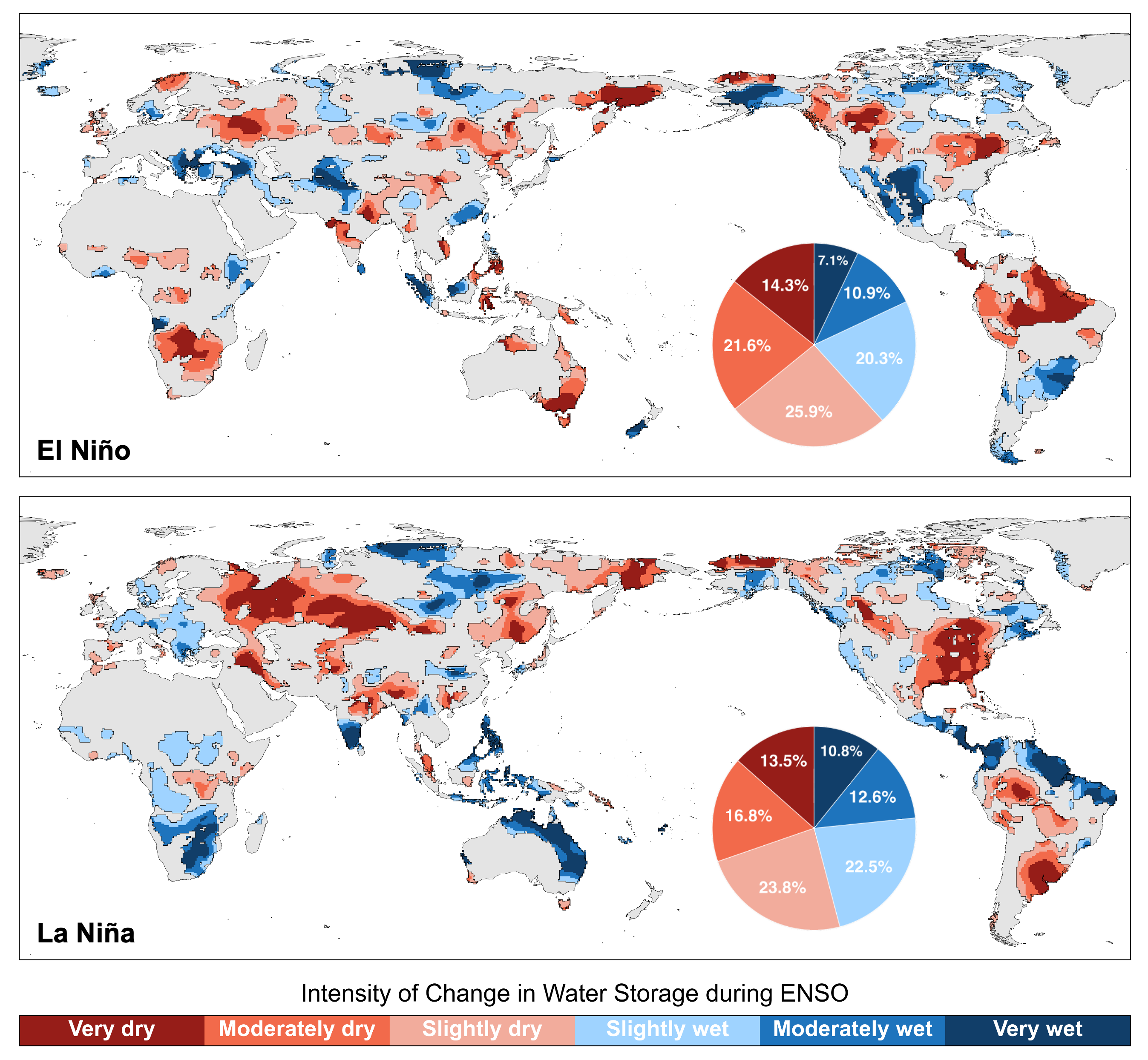
Figure 1. Map of land areas showing significant changes in water storage during El Niño (top) and La Niña (bottom) compared to neutral years (years without El Niño or La Niña conditions). Red shades indicate drying conditions, while blue shades indicate wetter conditions, with the color intensity reflecting the strength of the shift (from slight to very strong). The inset pie charts display the share of the total affected area belonging to each of these intensity levels.
Quantifying hydrological asymmetry
We then focused on regions where El Niño and La Niña have opposite hydrological effects (Figure 2). These are areas that become wetter during one ENSO phase and drier during the other, making them ideal for assessing whether the effects of opposite phases ultimately balance each other. The upward and downward triangles in Figure 2 highlight regions where this compensation does not occur, indicating an overall accumulation or depletion of freshwater despite the opposing ENSO impacts. In several regions, particularly across parts of South America, Africa and Australia, the water gained during La Niña exceeded the water lost during El Niño, resulting in a net accumulation of terrestrial water storage rather than a return to previous conditions.
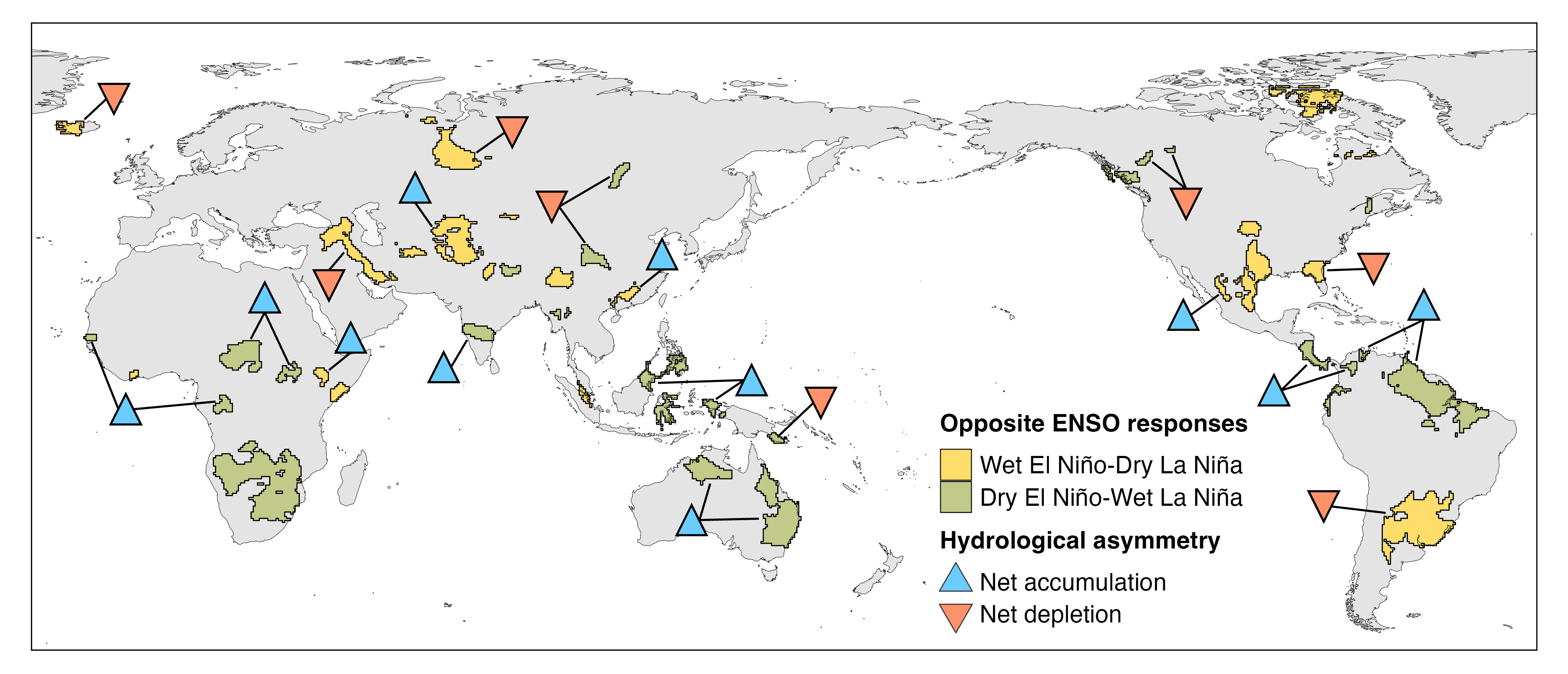
Figure 2. Regions where El Niño and La Niña produce opposite hydrological responses. Yellow indicates Wet El Niño–Dry La Niña regions, while green indicates Dry El Niño–Wet La Niña regions. Upward (▲) and downward (▼) triangles identify clusters where the effects of the two ENSO phases do not balance, resulting in an overall accumulation or depletion of freshwater storage, respectively.
Understanding why opposite ENSO phases do not always balance each other requires looking beyond atmospheric circulation alone. Different landscapes respond differently to climate forcing. Some release water rapidly after rainfall decreases, while others retain moisture for months because of groundwater storage, soil characteristics, vegetation, or other forms of hydrological memory. As a result, a wet phase does not necessarily offset the effects of a preceding dry phase, helping explain why neighbouring regions can exhibit very different long-term freshwater responses to the same ENSO event.
Looking ahead
This study also illustrates how datasets developed for one purpose can provide opportunities to address scientific questions well beyond their original scope. By extending the terrestrial water storage record back to 1984, GRAiCE made it possible to investigate long-term ENSO-driven hydrological responses that could not be assessed using the relatively short satellite record alone.
Our results show that Earth's freshwater system does not always respond symmetrically to opposite ENSO phases. Instead, El Niño and La Niña often leave a net gain or loss of water storage rather than balancing each other out. These imbalances reflect the complex interactions between climate forcing and hydrological processes and have important implications for understanding how freshwater resources respond to climate variability.
At the same time, these findings raise new questions about how these hydrological asymmetries may evolve in a changing climate, particularly if future ENSO events become more frequent or more intense. Understanding these imbalances will become increasingly important for anticipating future water availability, droughts, and floods, and for improving our ability to manage water resources in a changing world.
Follow the Topic
-
Communications Earth & Environment
An open access journal from Nature Portfolio that publishes high-quality research, reviews and commentary in the Earth, environmental and planetary sciences.

Related Collections
With Collections, you can get published faster and increase your visibility.
Ecological resistance and resilience under global change
Publishing Model: Open Access
Deadline: Apr 07, 2027
Hazards in Mountain Regions
Publishing Model: Open Access
Deadline: Nov 02, 2026