Dynamic Radiative Cooling: Mechanisms, Strategies, and Applications for Smart Thermal Management
Published in Materials and Mechanical Engineering
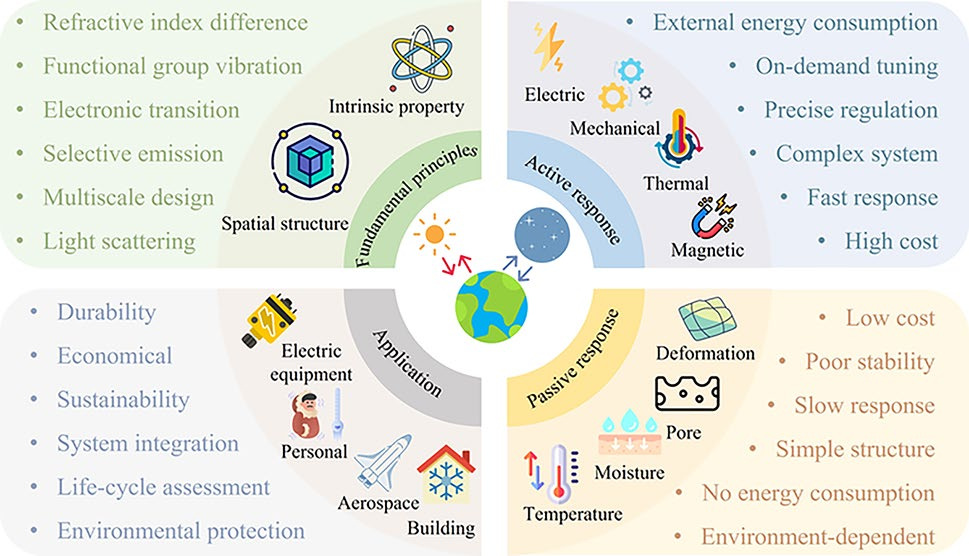
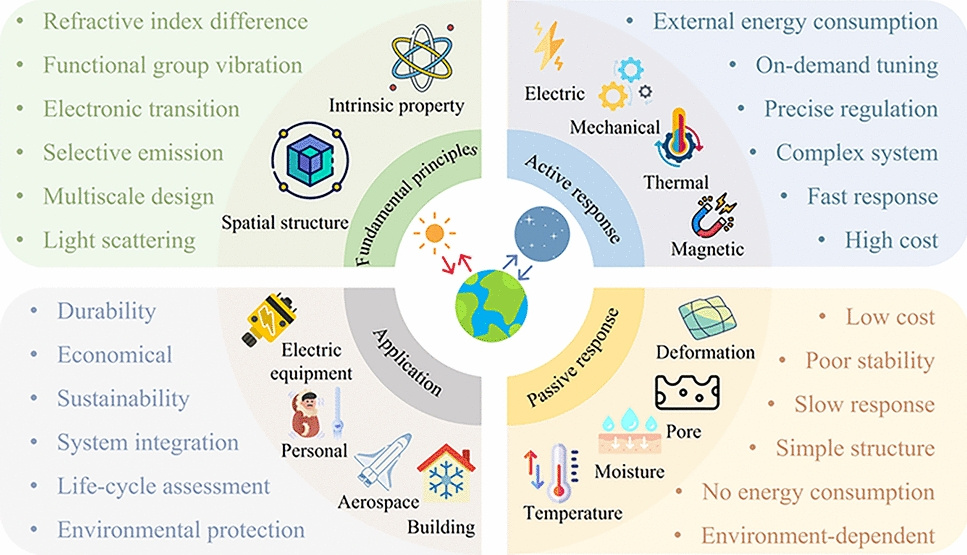

As an emerging thermal management strategy, dynamic radiative cooling (DRC) technology enables dynamic modulation of spectral radiation properties under varying environmental conditions through the directional design of material spectral characteristics. However, a comprehensive review of the basic physical mechanisms of radiative heat transfer in DRC materials and various design principles involved in dynamic radiative thermal regulation is still lacking. This review systematically summarizes recent advances in this field, spanning from fundamental physical principles to intrinsic molecular and electronic mechanisms, and further to representative material systems and multi-band regulation strategies, highlighting the interdisciplinary research achievements and technological innovations. This work outlines the core mechanisms governing the regulation of different spectral bands during radiative heat transfer processes. Then, the main categories of DRC materials are systematically reviewed, including actively responsive structures, passively responsive structures, and multi-stimuli-responsive materials. Furthermore, the challenges faced by current DRC technology and future development trends are summarized and discussed, providing valuable reference and guidance for further research in this field. Although DRC technologies still face significant challenges in material stability, manufacturing processes, and system integration, the continuous advances in related areas and multifunctional materials are expected to broaden the application prospects of DRC in the future.

Editor of Nano-Micro Letters, which is an Open-Access, peer-reviewed journal reported papers that have at least one dimension ranging from a few sub-nanometers to a few hundreds of micrometers. The journal is published by Springer Nature and indexed by SCI, EI, SCOPUS, Pubmed, etc. The 2025 JCR Impact Factor is 38.5. The 2025 CiteScore is 58.9.
Follow the Topic
-
Nano-Micro Letters
Nano-Micro Letters is a peer-reviewed, international, interdisciplinary and open-access journal that focus on science, experiments, engineering, technologies and applications of nano- or microscale structure and system in physics, chemistry, biology, material science, and pharmacy.