Ecohydraulics
Published in Ecology & Evolution, Civil Engineering, and Mathematical & Computational Engineering Applications

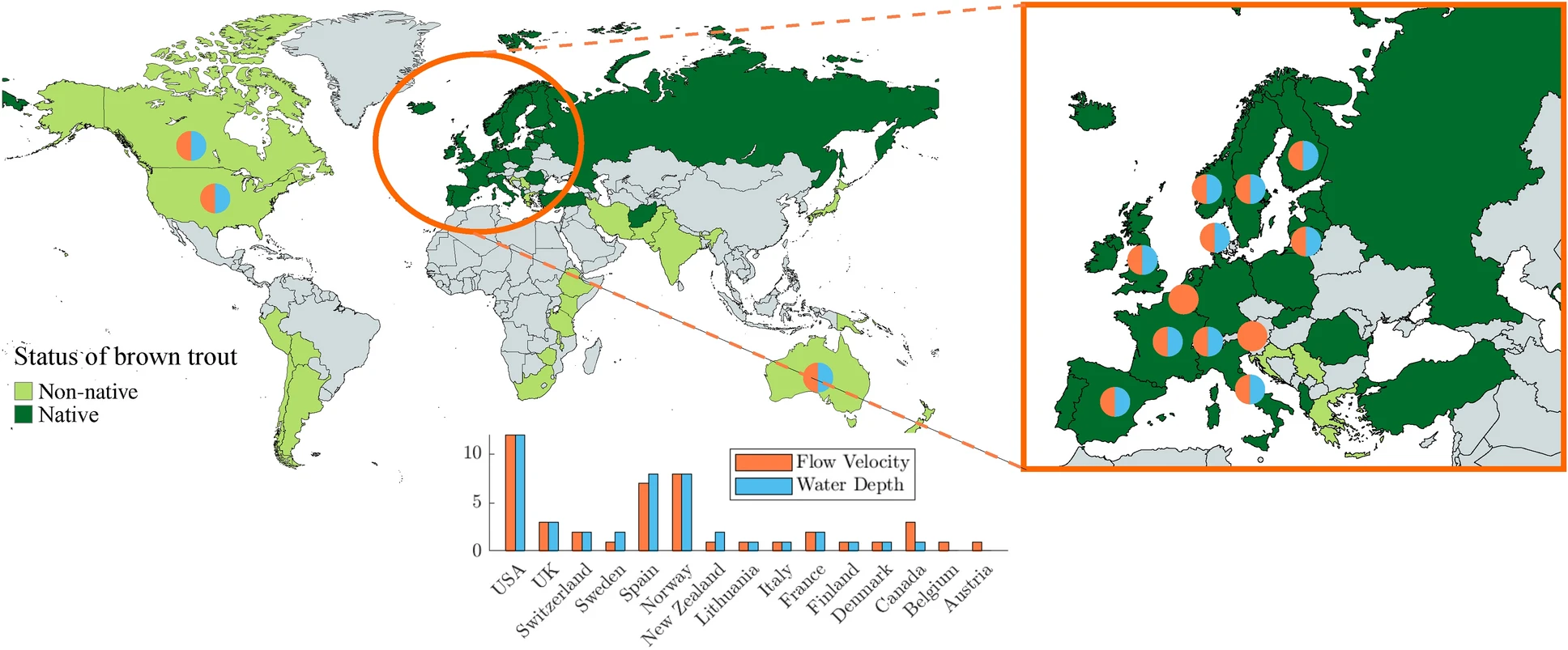



A recent Scientific Reports Collection on ecohydraulics in river and coastal restoration highlights the growing importance of this interdisciplinary field in addressing major environmental challenges, including climate change, habitat degradation, and biodiversity loss. As emphasized in the editorial by Baki and Mossa (2026), ecohydraulics sits at the intersection of fluid mechanics and ecological function, providing tools to design restoration strategies that are both hydraulically effective and environmentally sustainable. See the following link: https://www.nature.com/collections/fbcfjgjbag
Ecohydraulics is fundamentally about understanding how physical processes—flow, turbulence, sediment transport, and wave dynamics—interact with ecological systems. This coupling enables a shift from traditional engineering approaches, often focused solely on control and stability, toward nature-based solutions that enhance resilience and ecosystem functioning over the long term.
The Collection brings together eight studies that illustrate how experimental, numerical, and data-driven approaches can be combined to address complex riverine and coastal problems. What makes this body of work particularly compelling is not only the diversity of applications, but also the shared goal of linking process-based understanding with practical design.
A first group of contributions focuses on subsurface and catchment-scale hydrological processes, which are essential for water quality and ecosystem health. For example, one study investigates groundwater flow and contaminant transport in a fault-controlled karst system, showing how geological structures strongly influence flow paths and pollutant dispersion. By combining hydrochemical analysis with numerical modeling, the authors demonstrate that fault permeability and hydraulic gradients govern the evolution of pollution plumes over time, providing a basis for improved groundwater management and ecological protection.
This type of work highlights an often overlooked aspect of ecohydraulics: the need to understand not only surface flows, but also the hidden subsurface dynamics that sustain aquatic ecosystems.
A second set of studies addresses flow–ecology interactions and habitat processes, a core theme in ecohydraulics. Several contributions examine how flow conditions influence habitat complexity, organism behavior, and ecological functioning. For instance, research on fish movement and behavior explores how hydraulic conditions—such as velocity fields and turbulence—affect migration and exploratory dynamics. These insights are crucial for designing fish passages and ensuring connectivity in regulated rivers, where hydraulic structures can otherwise act as barriers.
Complementary studies investigate how flow interacts with vegetation and geomorphic features, influencing sediment dynamics, bank stability, and habitat heterogeneity. Together, these works reinforce the idea that habitat is not a static entity, but an emergent property of coupled physical and biological processes.
In coastal environments, the Collection includes contributions on wave–ecosystem interactions and coastal resilience. Studies on wave attenuation by vegetation show how natural systems such as seagrass or marshes can dissipate wave energy, reducing erosion and enhancing coastal protection. These findings are particularly relevant in the context of climate change and sea-level rise, where nature-based solutions are increasingly recognized as viable alternatives—or complements—to traditional “grey” infrastructure.
Another important theme emerging from the Collection is the growing role of advanced modeling and data-driven approaches. Ecohydraulics has traditionally relied on laboratory experiments and numerical simulations, but recent advances in artificial intelligence and data science are opening new possibilities.
For example, data-driven models are being used to predict ecological responses to hydrodynamic forcing, improving our ability to simulate complex systems and support decision-making. More broadly, the integration of hydrodynamic models with ecological and statistical tools allows for a more comprehensive representation of real-world systems, where multiple processes interact across scales.
This methodological diversity is one of the strengths of ecohydraulics. Experimental studies provide detailed process understanding under controlled conditions; numerical models allow exploration of scenarios and scaling to larger systems; and data-driven approaches enable pattern recognition and prediction in complex datasets. Together, these tools form a powerful framework for addressing environmental challenges.
What emerges clearly from the Collection is that ecohydraulics is not just about understanding systems—it is about informing design and management. Whether the goal is restoring a river reach, mitigating flood risk, or protecting a coastline, ecohydraulic principles can guide the development of interventions that align engineering performance with ecological objectives.
At the same time, several challenges remain. One of the most important is scaling: translating insights from laboratory or site-specific studies to larger, more complex systems. This requires improved integration between models, field data, and monitoring technologies. Another challenge is dealing with uncertainty, particularly under changing climatic conditions, where future flow regimes and ecosystem responses may differ significantly from historical patterns.
However, the Collection also points to significant opportunities. Advances in high-resolution monitoring, numerical modeling, and artificial intelligence are enabling more accurate predictions and more adaptive management strategies. In particular, the ability to couple hydrodynamic processes with ecological responses in a predictive framework represents a major step forward for sustainable water management.
Ultimately, this Collection reflects a broader shift in how we approach environmental engineering: from controlling nature to working with it. Ecohydraulics provides the scientific foundation for this transition, helping to design systems that are not only functional, but also resilient, adaptive, and ecologically meaningful.
The individual papers included in the Collection offer detailed insights into specific processes and applications, from groundwater flow and pollutant transport to habitat dynamics, wave attenuation, and ecological modeling. Readers interested in these aspects are encouraged to explore the original articles and the editorial, where the full scope of the Collection is presented.
Follow the Topic
-
Scientific Reports
An open access journal publishing original research from across all areas of the natural sciences, psychology, medicine and engineering.

Related Collections
With Collections, you can get published faster and increase your visibility.
Cancer Prevention and Control
Publishing Model: Hybrid
Deadline: Feb 19, 2027
Healthy Aging
Publishing Model: Open Access
Deadline: Dec 31, 2026