Educating for Translation
Published in Biomedical Research and Education



 Like many people working in biomedical research and medical education, I have spent years hearing variations of the same concern: despite extraordinary scientific progress, too many discoveries fail to meaningfully change patient care. Translational medicine emerged in part as a response to this problem. It attempted to bridge the gaps between scientific discovery, clinical testing, implementation, regulation, industry, health systems and society.
What became increasingly apparent to me, however, was that many discussions about translational failure focused on infrastructure, funding, regulation or technology, while paying comparatively less attention to education itself.
How are researchers actually being prepared to think about translation?
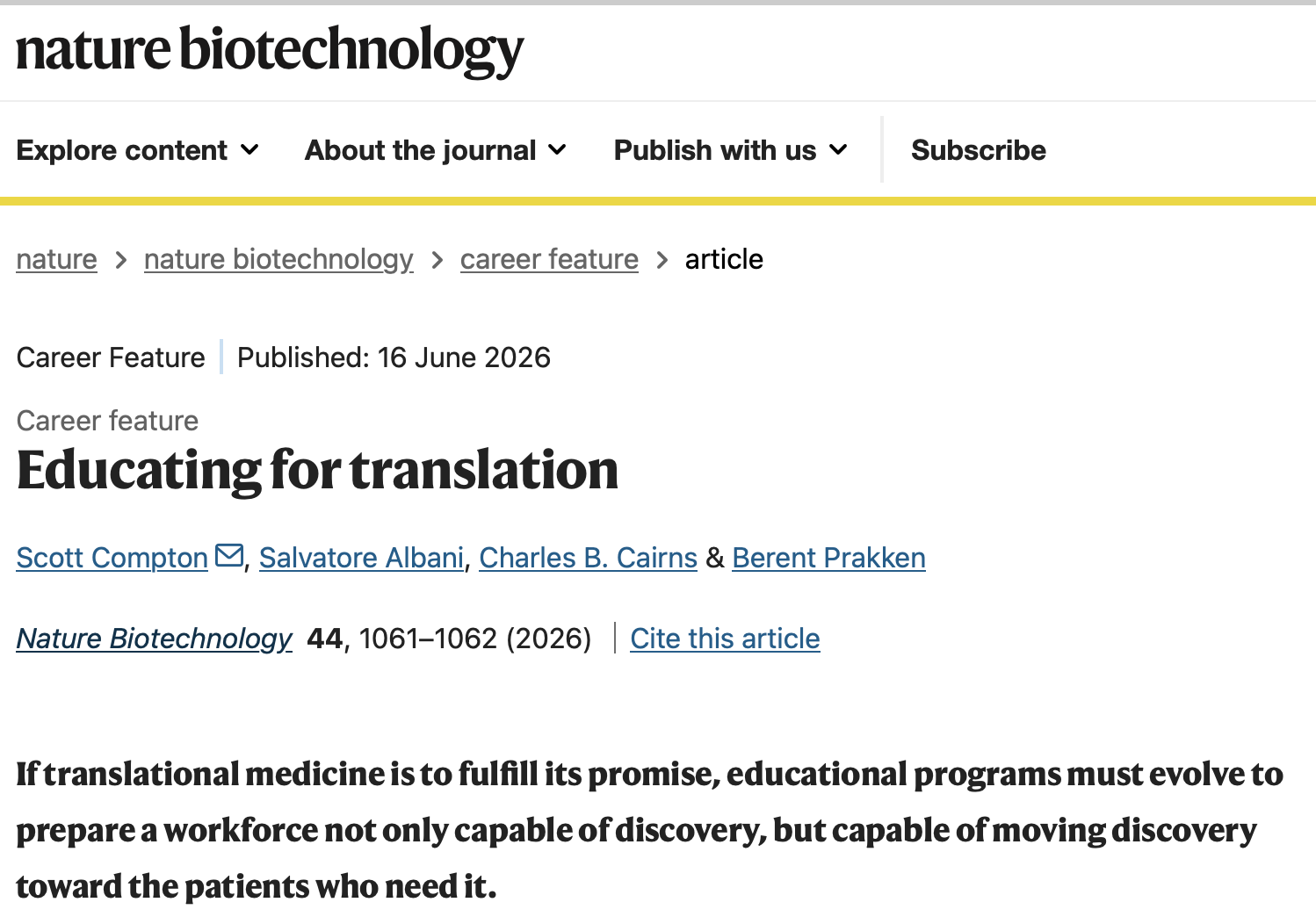
That question became one of the intellectual starting points for our article, “Educating for Translation.” The paper argues that biomedical education should not stop at teaching people how to generate discoveries. It should also help researchers understand the broader translational pathways through which discoveries either succeed, stall or disappear.
The idea did not emerge from a single study or moment. It developed gradually through conversations across multiple settings, including Duke-NUS Medical School in Singapore and the Eureka Institute for Translational Medicine, an international network focused on translational capacity building. Across these environments, I repeatedly encountered scientists, clinicians and trainees who were highly capable within their own domains, yet often described having only a partial understanding of the broader systems through which biomedical discoveries move toward impact.
What struck me most was that this gap was not simply technical. It was conceptual.
Many researchers had been trained to think of publication as the natural endpoint of scientific work. The educational system around them reinforced that view. Grants, promotions, metrics and academic prestige all tended to prioritize discovery and publication far more visibly than implementation, systems integration or downstream clinical adoption. Translation was often discussed as important, but educationally positioned as peripheral or someone else’s responsibility.
Over time, I began thinking about this less as a problem of missing skills and more as a problem of mindset.
A translational mindset is not merely knowing that translational pathways exist. It is a way of thinking that continually asks broader questions about the relationship between scientific work and human impact. Who ultimately benefits from this discovery? What barriers stand between evidence and implementation? What expertise, partnerships and systems are required for translation to occur responsibly? What happens after publication?
Importantly, this does not mean every scientist must become an entrepreneur, regulator or implementation scientist. Nor does it diminish the importance of curiosity-driven research. Rather, it reflects the idea that researchers should understand where their work exists within a larger translational ecosystem and recognize that scientific discovery alone does not guarantee societal benefit.
In many ways, the issue feels even more urgent today than when we first began discussing these ideas. Artificial intelligence, computational biology and digital platforms are dramatically accelerating the generation and dissemination of scientific knowledge. Yet the ability to generate information is not the same as the ability to translate it responsibly into practice. If anything, the rapid expansion of scientific and technological capability increases the need for researchers who can think across systems, disciplines and societal contexts.
This realization also reshaped how I began thinking about education itself.
Education is often treated as a support function within academic medicine: important, but secondary to “real” scientific or clinical work. Yet educational systems quietly shape how professionals understand their responsibilities, how they define success and what kinds of outcomes they learn to value. In that sense, education is not separate from translation. It may be one of the most upstream determinants of whether translation happens at all.
The challenge, therefore, is not simply to add more content about commercialization, regulation or implementation into existing curricula. It is to cultivate ways of thinking that encourage researchers and clinicians to see discovery as part of a longer continuum of responsibility.
For me, this became the deeper meaning behind “Educating for Translation.” The central question is no longer only how we produce discoveries, but how we prepare people to steward discoveries toward meaningful impact in an increasingly complex world.
Follow the Topic
-
Nature Biotechnology
A monthly journal covering the science and business of biotechnology, with new concepts in technology/methodology of relevance to the biological, biomedical, agricultural and environmental sciences.