How TiO₂ Coatings Can Clean University Air
Published in Earth & Environment and Materials




The Problem: Why University Air is Dangerous
Egyptian universities near industrial zones face severe indoor air pollution. Students spend 6-8 hours daily in lecture halls breathing:
• PM₂.₅ & PM₁₀ from traffic and factories
• Formaldehyde (HCHO) from furniture/paint
• NO₂ from vehicle exhaust
• TVOCs from cleaning products
Poor ventilation makes it worse. My question: Can photocatalytic paint offer a passive solution?
My Experiment: 3 Classroom Models Tested
Setup: Three scaled models simulating real university lecture halls with different interior finishes.
Method: Applied 10% water-based TiO₂ suspension manually to all surfaces, activated with UV-LED lamps.
8-hour measurements (no external airflow):
• PM₂.₅, PM₁₀ (particulates)
• NO₂ (nitrogen dioxide)
• HCHO (formaldehyde)
• TVOCs (chemical vapors)
• CO₂ (ventilation control)
Results: Dramatic Reductions Confirmed
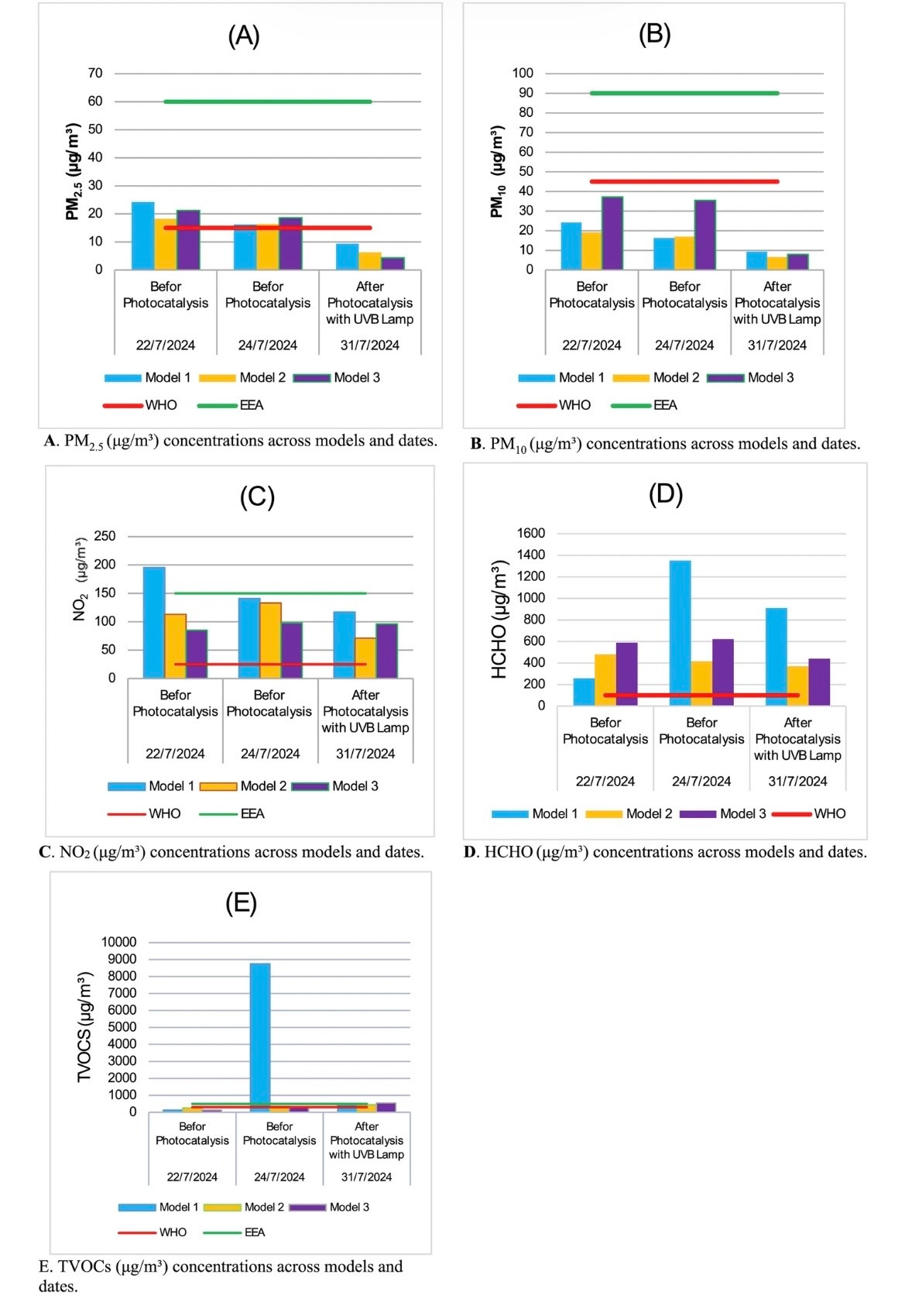
SPSS statistical analysis across all models showed:
Pollutant Reductions:
• PM₂.₅: 55-61% ↓
• PM₁₀: 65-73% ↓
• NO₂: Up to 46% ↓
• HCHO: 29-32% ↓ (finish-dependent)
• TVOCs: Temporary increase then stabilized
![]()
![]()
Real-World Challenges
Lab success ≠ classroom reality. Key limitations:
• Human occupancy (breathing/movement)
• Dynamic ventilation patterns
• Long-term coating durability
• UV lighting requirements
Recommendations for Egyptian Universities
Practical next steps:
1. Pilot installations in high-pollution lecture halls
2. UV lighting in existing fixtures
3. 6-12 month monitoring
4. Cost vs. HVAC comparison
Join the Discussion!
Have you tested photocatalytic materials?
What air quality challenges do your institutions face?
Full paper: https://doi.org/10.1186/s44147-025-00870-y
#IndoorAirQuality #TiO2 #Photocatalysis #UniversityHealth #CleanAir

Follow the Topic
-
Journal of Engineering and Applied Science
This is an open access platform publishing fundamental and applied research across various engineering disciplines.

Related Collections
With Collections, you can get published faster and increase your visibility.
Call for papers: 4th International Architecture & Design Conference
The 4th International Architecture & Design Conference aims to provide a comprehensive platform for discussing innovative ideas and advancements in the fields of architectural engineering, urban planning, and environmental design. As urban areas continue to expand and evolve, the integration of sustainable practices and modern technologies in architectural practices becomes paramount. This Collection invites researchers to explore a wide range of topics that address the challenges and opportunities in the built environment, focusing on the intersection of design, technology, and community needs.
Advances in architectural engineering and environmental design have been pivotal in shaping sustainable urban landscapes. Recent developments in energy-efficient building systems, smart urban planning, and innovative housing solutions highlight the importance of collaboration among architects, engineers, and city planners. Understanding the impact of these advancements on urban communities is essential for fostering resilience and promoting well-being. By sharing knowledge and insights, we can contribute to creating sustainable, livable environments that meet the needs of future generations.
As research in architecture and design progresses, we can anticipate exciting innovations that will redefine our understanding of sustainable living. Future studies may lead to the development of cutting-edge building materials, adaptive reuse strategies, and integrated energy systems that not only enhance the aesthetic appeal of urban environments but also significantly reduce their environmental footprint. The potential for interdisciplinary collaboration among architects, engineers, and environmental scientists may yield transformative solutions that address the pressing challenges of urbanization.
Topics of interest includes (but not limited to):
- Innovations in architectural engineering
- Sustainable urban design practices
- Energy-efficient building systems
- Advances in environmental design
- Housing solutions for urban communities
This Collection supports and amplifies research related to SDG 11 (Sustainable Cities and Communities) and SDG 7 (Affordable and Clean Energy).
Publishing Model: Open Access
Deadline: Dec 31, 2026
AI and Digital Twins for Energy Storage Systems
The rapid evolution of energy storage systems (ESS) is pivotal in facilitating the transition towards sustainable energy solutions and enhancing grid reliability. As the global energy landscape shifts towards renewable sources, the integration of artificial intelligence (AI) and digital twins within these systems has emerged as a transformative force. This Collection aims to shed light on the critical advancements in this field and explore new horizons for future research.
Over the past few years, there have been notable advances in this area, particularly concerning battery management systems (BMS). AI algorithms have improved the accuracy of predictive maintenance, reducing downtime and extending the life cycle of storage units. By leveraging machine learning techniques, BMS can now anticipate potential failures and optimize charging and discharging cycles based on real-time data. Moreover, advances in energy forecasting powered by AI have enabled more accurate predictions of energy demands, facilitating better integration of renewable sources into the grid.
Looking ahead, the potential for future advancements in AI and digital twins presents exciting possibilities. We may soon witness the development of fully autonomous energy storage systems capable of self-optimisation and adaptation to fluctuating energy demands. Such systems could seamlessly integrate with smart grids, enabling a more resilient and responsive energy infrastructure. Furthermore, as machine learning techniques become more advanced, they may allow for even greater predictive capabilities, potentially leading to breakthroughs in energy efficiency and sustainability.
As we embark on this journey towards a more sustainable energy future, we encourage researchers, scholars, and industry professionals to contribute to this special Collection.
Topics of interest include but are not limited to:
- AI-driven predictive maintenance strategies
- Digital twin applications in energy storage
- Advances in battery management systems
- Smart grid integration techniques
- Energy forecasting methodologies
- Impact of AI on system reliability
- Data analytics in energy storage modelling
- Environmental implications of energy storage systems
Publishing Model: Open Access
Deadline: Apr 23, 2027