Efficiency roll-off in TADF OLEDs
Published in Materials
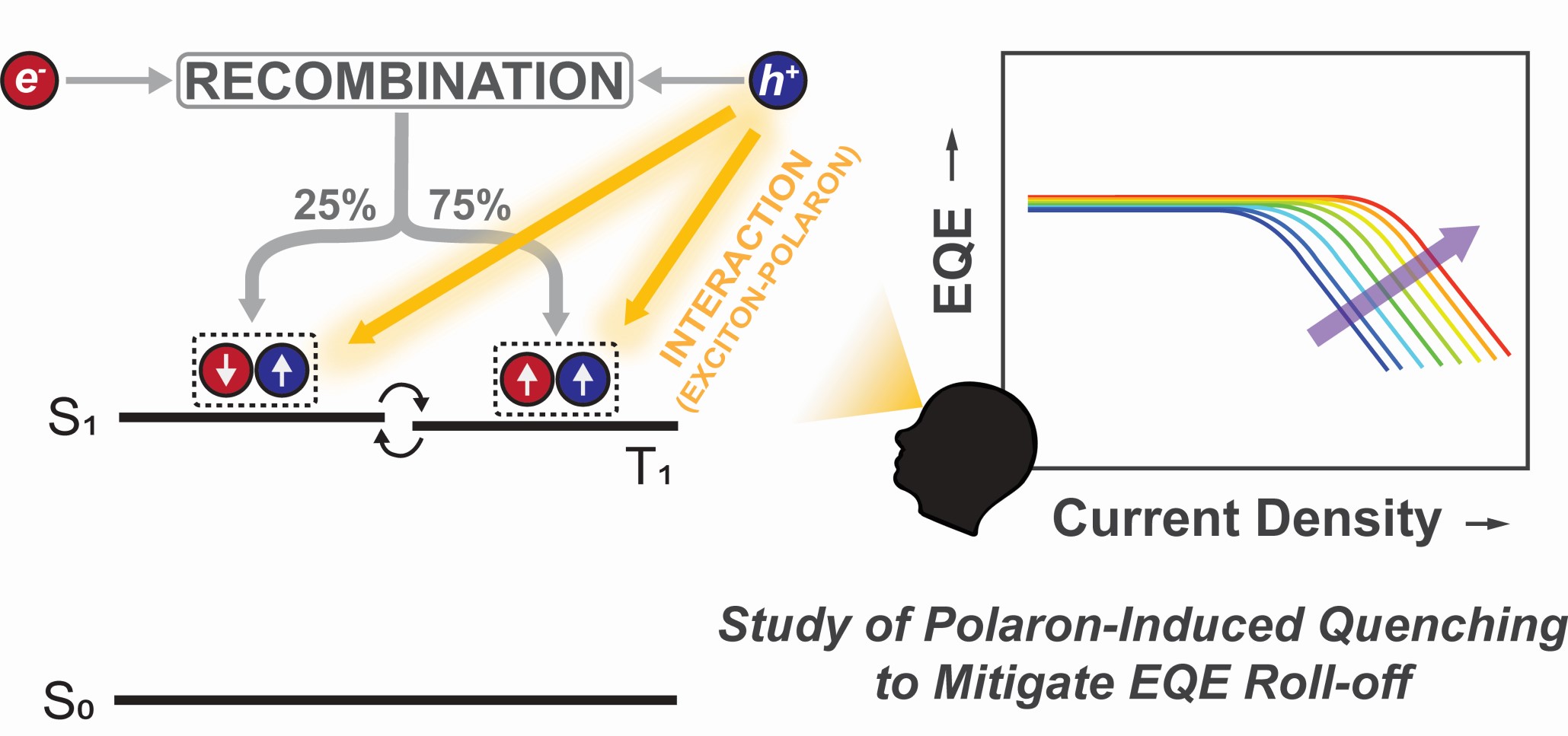

Organic semiconductors have highly tunable electrical and optical properties, which have made them suitable for the fabrication of high-performance organic light-emitting diodes (OLEDs). Lately, the external quantum efficiencies (EQEs) of OLEDs have reached close to 40% and they are being extensively implemented in commercial applications such as display screens in smartphones, tablets, TVs, and panels for general illumination. Despite achieving high EQEs, one of the major challenges for OLEDs is the rapid drop of EQEs at high brightness levels (i.e., more than 1000 cd m−2), commonly referred to as efficiency roll-off. Due to the issue of efficiency roll-off, OLEDs need to be operated under high biases and high current densities to achieve high brightness levels which leads to significant increment in the power consumption and reduction in device operational lifetime.
In recent years, OLEDs with thermally activated delayed fluorescence (TADF) emitters have shown tremendous potential for commercial applications as an alternative to heavy-metal based phosphorescent OLEDs due to their low manufacturing cost. However, EQE roll-off mechanism in TADF OLEDs is poorly known. This is mainly due to the contribution of both the singlet (short-lived) and triplet exciton (long-lived) in the light emission process. From our previous investigation, we found not only exciton-exciton annihilation but also polaron-induced quenching might be contributing to the efficiency roll-off in TADF OLEDs (see also https://doi.org/10.1002/adfm.202000580). In this collaborative work between the University of Queensland (Australia) and Kyushu University (Japan), we report experimental and theoretical analysis on the polaron-induced quenching and electric field-induced exciton dissociation in two well-known TADF molecules, 2,4,5,6-tetra(9H-carbazol-9-yl)isophthalonitrile (4CzIPN) and 3-(9,9-dimethylacridin-10(9H)-yl)-9H-xanthen-9-one (ACRXTN). Our fabricated OLEDs showed excellent device performances under steady-state mode with EQEs close to the theoretical maximum values.
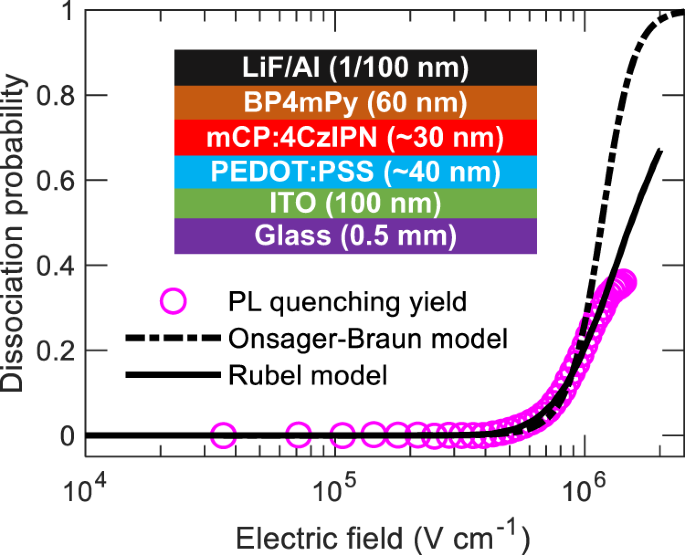
To decipher the role of polarons in EQE roll-off, we modelled a platform to extract singlet-polaron annihilation (SPA) and triplet-polaron annihilation (TPA) rate constants for TADF materials from steady-state photoluminescence (PL) and electroluminescence (EL) measurements. Additionally, the electric field-induced exciton dissociation rate was measured independently. However, it was observed that the impact of field-induced quenching was negligible, for the applied electric field of up to 0.5 MV cm−1 (Figure 1a). To investigate EQE roll-off in TADF OLEDs, we numerically quantified the relative contribution of all the relevant mechanisms for singlet and triplet excited states in TADF. From our results, we can now confirm that the polaron-induced quenching does contribute to the efficiency roll-off in TADF based OLEDs. Furthermore, singlet-triplet annihilation (STA) and charge imbalance were found to be the primary contributors to the efficiency roll-off (Figure 1b). Next, we also disentangled the impact of TPA, SPA, and STA in such a way that it becomes possible to identify the processes that may dominate EQE roll-off, over a range of current density. This can provide vital guidelines for material selection and routes to design OLEDs with reduced efficiency roll-off and device degradation. Finally, we theoretically demonstrated that maximizing the charge recombination rate via enhancing the carrier mobilities, might reduce the impact of polaron-induced quenching and therefore significantly reduce efficiency roll-off (Figure 1c & 1d).
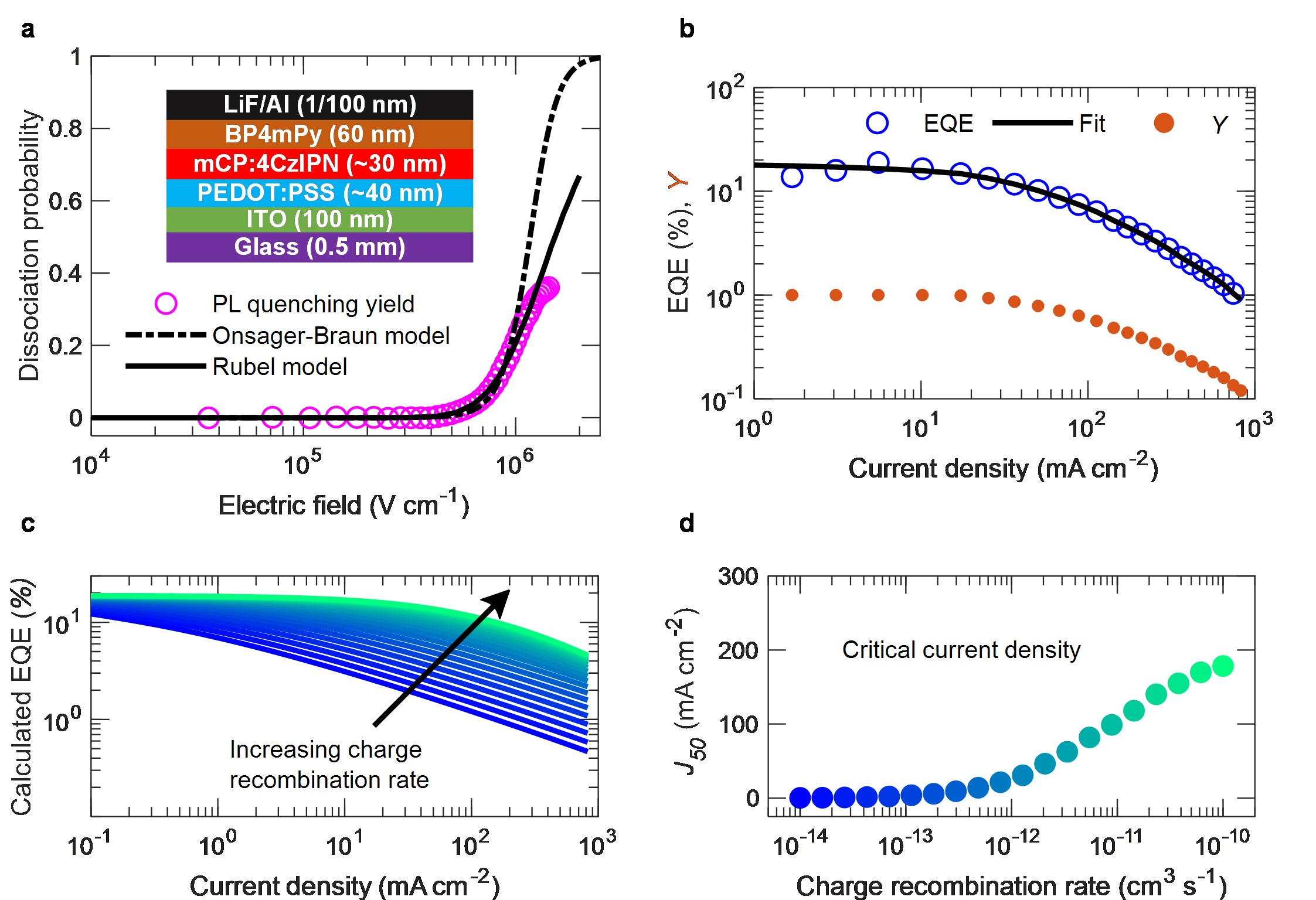
Figure. 1. a Exciton dissociation probability as a function of the applied electric field. Onsager-Braun model and Rubel model were applied to extract exciton binding energy in order to calculate field-induced quenching rate. The inset shows the mCP:4CzIPN OLED device structure. b EQE−current density plot with extracted charge balance factor from the fit c Theoretically calculated EQE with increasing charge recombination rate as a function of current density d Critical current density J50 at which EQE reduces to half of its maximum value as a function of charge recombination rate.
We believe that results obtained from our study can be treated to understand the factors that lead to efficiency roll-off in TADF OLEDs and provide effective strategies to improve OLED efficiencies at high brightness regimes. If you are interested in finding out more about this work, please refer to our paper published in Nature Communications; Probing polaron-induced exciton quenching in TADF based organic light-emitting diodes.

Follow the Topic
-
Nature Communications
An open access, multidisciplinary journal dedicated to publishing high-quality research in all areas of the biological, health, physical, chemical and Earth sciences.

Related Collections
With Collections, you can get published faster and increase your visibility.
Women's Health
Publishing Model: Hybrid
Deadline: Ongoing
Biosensing
Publishing Model: Hybrid
Deadline: Sep 30, 2026




Please sign in or register for FREE
If you are a registered user on Research Communities by Springer Nature, please sign in