Electron beam dosimetry in uniform and spatially varying magnetic fields: implications for MR-guided radiation systems
Published in Cancer
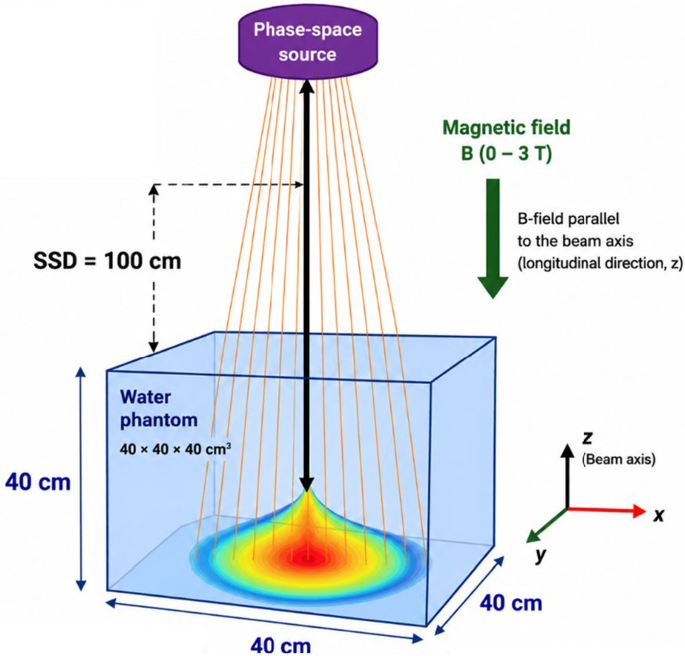

The interaction between therapeutic electron beams and magnetic fields is of growing interest in the context of MR-guided radiotherapy. In this work, Monte Carlo simulations were performed to systematically investigate the dosimetric behavior of clinical electron beams in uniform and spatially varying longitudinal magnetic fields.
Using GATE v9.2, 6 and 12 MeV electron beams were simulated in a water phantom under magnetic field strengths ranging from 0 to 3 T. Both idealized uniform fields and four non-uniform gradient configurations representative of MR-Linac fringe fields were considered, including variations in gradient length and onset position. Field sizes of 3 × 3, 6 × 6, and 15 × 15 cm2 were analyzed. Depth-dose parameters and lateral dose profiles were extracted with statistical uncertainties below 0.5%.
Uniform magnetic fields produced symmetric lateral confinement with limited impact on beam penetration. In contrast, non-uniform fields generated pronounced anisotropic dose distributions, characterized by strong directional focusing, asymmetric penumbra behavior, and energy-dependent proximal shifts of the buildup region. These effects were minimal for small fields but increased markedly with field size and beam energy. Despite substantial lateral perturbations, the therapeutic range remained largely preserved across all configurations. The results demonstrate that spatial magnetic field gradients play a dominant role in shaping electron dose distributions and cannot be approximated by uniform field models, highlighting the need for realistic magnetic field descriptions in future MR-guided electron beam studies.
https://link.springer.com/article/10.1140/epjp/s13360-026-07907-y
https://link.springer.com/article/10.1140%2Fepjp%2Fs13360-026-07907-y?utm_source=email&utm_medium=social&utm_campaign=rh_publication_moment
@SN and #SNAuthor.

Follow the Topic
-
The European Physical Journal Plus
This journal encompasses all aspects of fundamental and applied physics, including energy, environment, cultural heritage, research infrastructures and citizen science, and welcomes in particular interdisciplinary topics.