Engineering Magnetic Exchange Coupling in High-Entropy Spinel Oxides for Enhanced Oxygen Evolution

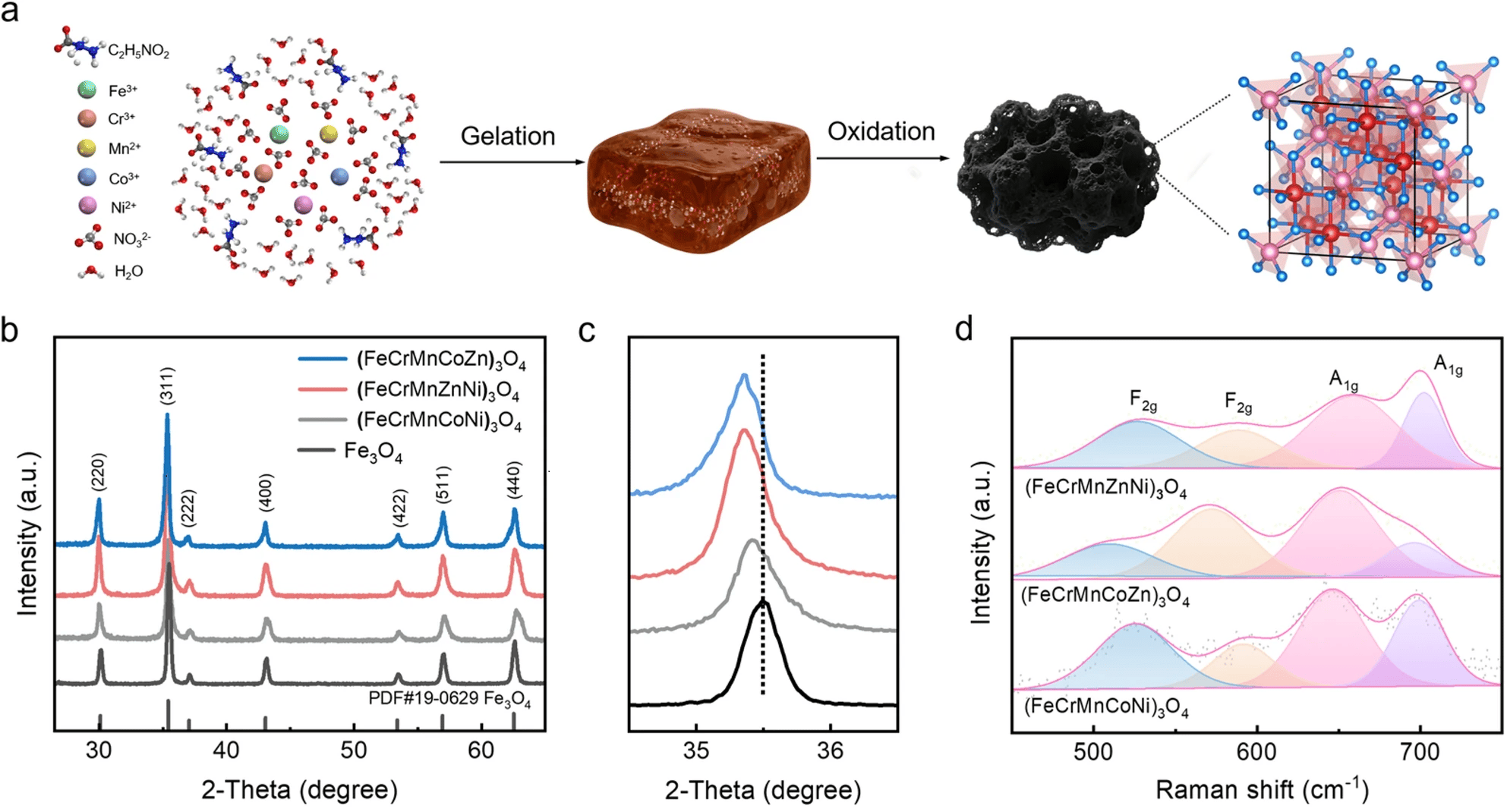
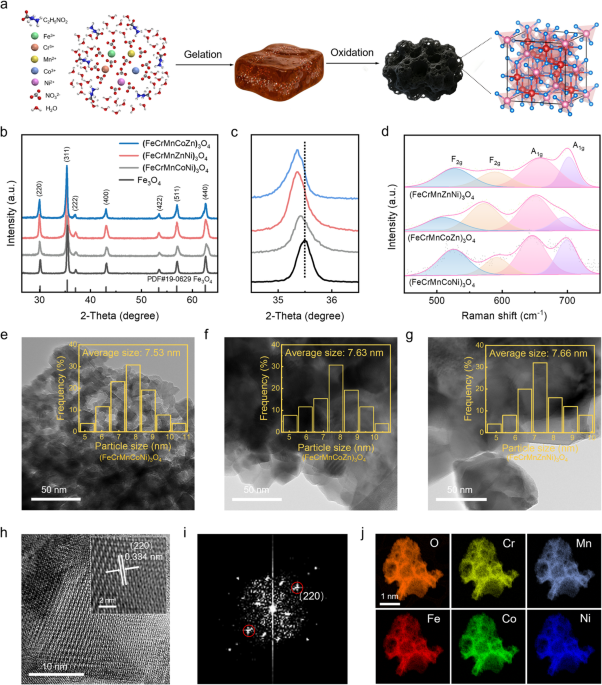

In this study, we investigate how magnetic exchange coupling can be engineered in high-entropy spinel oxides to enhance magnetic-field-assisted oxygen evolution reaction (OER) performance. By tailoring local coordination environments through compositional regulation, we reveal the critical role of magnetic interactions in governing OER activity under external magnetic fields. Combining operando characterization and theoretical calculations, we establish a structure-property relationship that links local coordination evolution, electronic structure modulation, and magnetic exchange interactions to improved electrocatalytic performance.
Key Insights
- High-entropy spinel oxides with compositions (FeCrMnCoNi)₃O₄, (FeCrMnCoZn)₃O₄, and (FeCrMnZnNi)₃O₄ were synthesized to systematically investigate the origin of magnetic-field-enhanced OER activity.
- Zn incorporation effectively regulates the local Co–O coordination environment while preserving the spinel crystal framework, providing a powerful strategy for tuning magnetic exchange interactions.
- (FeCrMnCoZn)₃O₄ exhibits the highest saturation magnetization (11.2 emu g⁻¹) and demonstrates the strongest response to an external magnetic field among the catalysts studied.
- Under a 3000 G magnetic field, (FeCrMnCoZn)₃O₄ achieves the largest decrease in OER overpotential, indicating superior magnetic-field-assisted catalytic enhancement.
- Operando Raman spectroscopy reveals reversible potential-dependent evolution of local metal-oxygen coordination environments during OER while maintaining structural integrity of the spinel lattice.
- The most significant local coordination reconstruction occurs in (FeCrMnCoZn)₃O₄, highlighting its greater structural flexibility under reaction conditions.
- Density functional theory calculations show that Zn-modified Co environments induce pronounced redistribution of Co-centered d-orbital electronic states, strengthening magnetic exchange coupling and facilitating spin-dependent electron transfer.
- The catalytic enhancement observed under magnetic fields arises from the synergistic interplay of local coordination evolution, electronic structure regulation, and magnetic interactions, rather than intrinsic catalytic activity alone.
- The work establishes local coordination engineering as an effective approach for designing magnetic-field-responsive electrocatalysts with improved oxygen evolution performance.
Why This Matters
Magnetic-field-assisted electrocatalysis has emerged as a promising strategy for improving water-splitting efficiency, yet the fundamental mechanisms controlling magnetic enhancement remain poorly understood. This study demonstrates that tailoring local coordination environments in high-entropy oxides can effectively regulate magnetic exchange interactions and catalytic behavior. The findings provide important design principles for developing next-generation magnetic electrocatalysts for renewable hydrogen production and sustainable energy-conversion technologies.
Looking Ahead
Future research opportunities include:
- Expanding magnetic exchange coupling engineering to a broader range of high-entropy oxide systems.
- Developing catalysts with stronger magnetic responsiveness and greater electrocatalytic efficiency.
- Leveraging operando characterization techniques to track local structural evolution under magnetic fields.
- Exploring the interplay between spin polarization and charge-transfer processes during electrocatalytic reactions.
- Integrating computational screening and machine-learning approaches to accelerate the discovery of magnetic-field-responsive catalysts.
- Applying magnetic-field-assisted catalyst design principles to other electrochemical reactions beyond OER.
Authors & Affiliations
Authors
Siqi Xie, Bingshuai Fu, Mengxin Chen, Siteng Wang, Linlin Li, Liyan Zhao, Yuanyuan Zhang, and Ping Xu.
Affiliations
- State Key Laboratory of Space Power-Sources, School of Chemistry and Chemical Engineering, Harbin Institute of Technology, Harbin, China.
- Key Laboratory for Photonic and Electronic Bandgap Materials, Ministry of Education, Harbin Normal University, Harbin, China.
Corresponding Authors
Mengxin Chen
Email: 20250169@hit.edu.cn
Yuanyuan Zhang
Email: zhangyy@hrbnu.edu.cn
Ping Xu
Email: pxu@hit.edu.cn
How to Cite This Article
Xie, S., Fu, B., Chen, M. et al. Enhanced oxygen evolution by magnetic exchange coupling modulation of high‑entropy spinel oxides. Catal 2, 21 (2026). https://doi.org/10.1007/s44422-026-00034-w
Follow the Topic
-
Catal
Catal is an open access journal covering full spectrum of catalysis critical advances. From biocatalysts to heterogeneous catalysts, it integrates fundamental and applied sciences. Catal offers a primary platform for researchers and practitioners in the field.

Related Collections
With Collections, you can get published faster and increase your visibility.
Porous Materials for Sustainable Green Catalysis
The advancement of our collective understanding in the field of porous materials for sustainable green catalysis is crucial as we face urgent environmental challenges and the need for sustainable energy solutions. The integration of porous materials into catalytic processes has opened new avenues for improving efficiency, selectivity and stability while minimizing waste. Significant advances have been made, including the development of zeolites, mesoporous materials, metal-organic frameworks (MOFs) and covalent organic frameworks (COFs), which have demonstrated remarkable catalytic performance in various reactions.
Future research holds immense potential, with speculations ranging from the design of novel porous materials with tailored properties to their application in industrial catalysis, biocatalysis, H2 production and carbon capture technologies. By continuing this research, we can drive progress toward achieving Sustainable Development Goals (SDGs), particularly in clean energy (SDG 7) and climate action (SDG 13), ultimately fostering a sustainable future for our planet.
We invite researchers to contribute to this special Collection by submitting research articles, brief communications, perspectives, reviews, and analyses.
Topics of interest include but are not limited to:
- Synthesis of porous materials
- Catalytic performance evaluation
- Green synthesis methods
- Application in environmental remediation
- CO2 conversion technologies
- Biocatalysis in porous matrices
- Design of multifunctional porous catalysts
- Mechanistic studies of catalysis
Publishing Model: Open Access
Deadline: Dec 31, 2026
National Catalysis Conference 2025
The 22nd National Catalysis Conference, held in December 2025 in Xiamen, China, stands as the largest national academic event in the field of catalysis, bringing together leading scientists from academia and industry to discuss frontier research and emerging technologies across catalytic science.
In collaboration with several internationally recognized researchers from Xiamen University - the main organizer of the conference - Catal will publish a Special Issue featuring selected contributions from the meeting. This joint effort ensures high academic standards and showcases the scientific breadth and excellence presented at the conference.
Potential topics include, but are not limited to:
• Catalytic materials
• Thermocatalysis
• Electrocatalysis
• Biomass and CO₂ conversion
• Industrial catalysis
• Theoretical and computational catalysis
Publishing Model: Open Access
Deadline: Dec 31, 2026