Guppies, pikes and sturgeons: why the fishes we use are rarely ordinary
Published in Ecology & Evolution

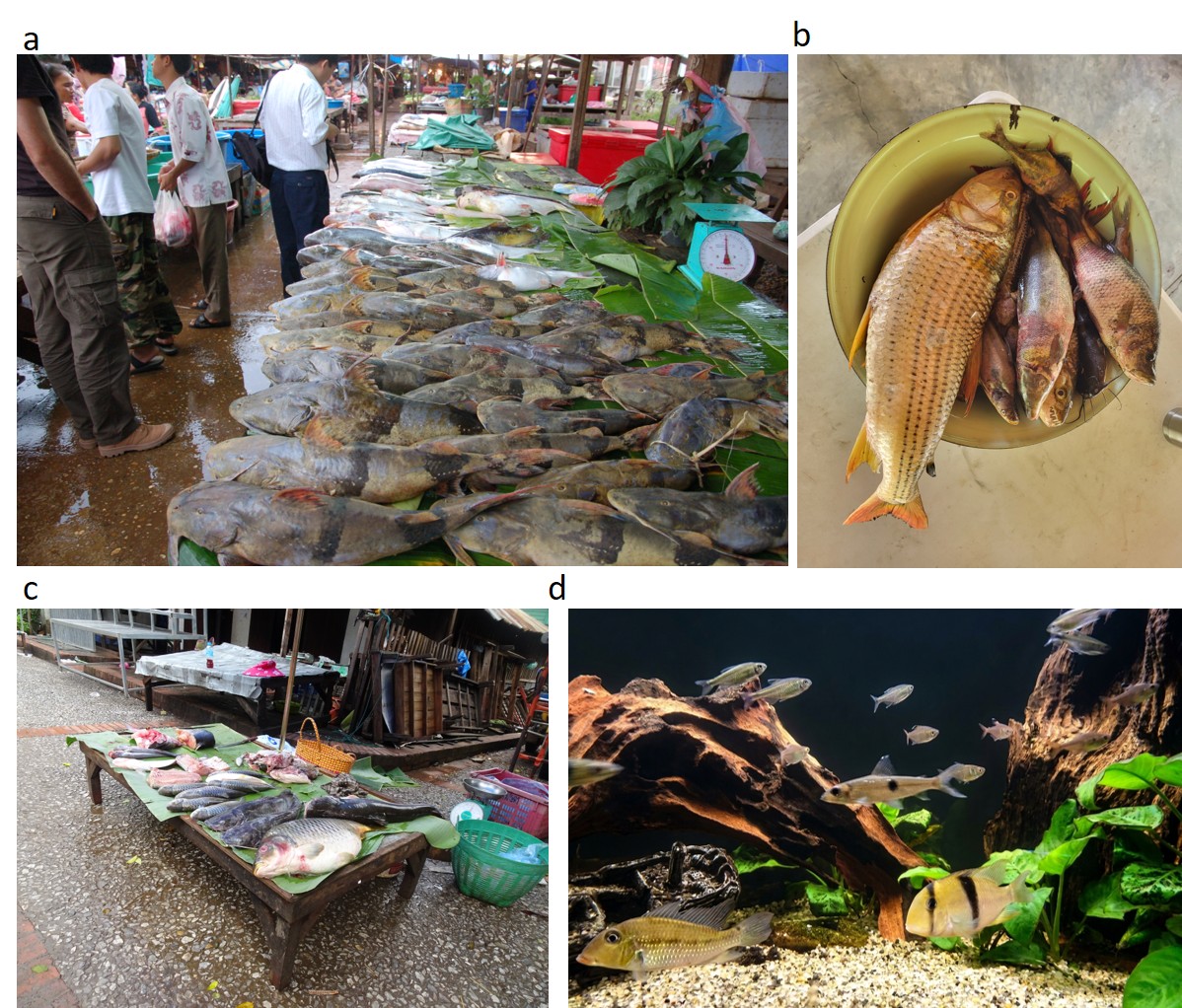

Walk through any fish market in Southeast Asia, the Amazon or West Africa, and you will see an astonishing variety of shapes: flat-headed catfishes, deep-bodied carps, elongated predators. Then walk into an aquarium shop in Europe, and you will see a completely different set of fishes: tiny, colourful, big-eyed. Same freshwater realm, very different selections.Where the question came from
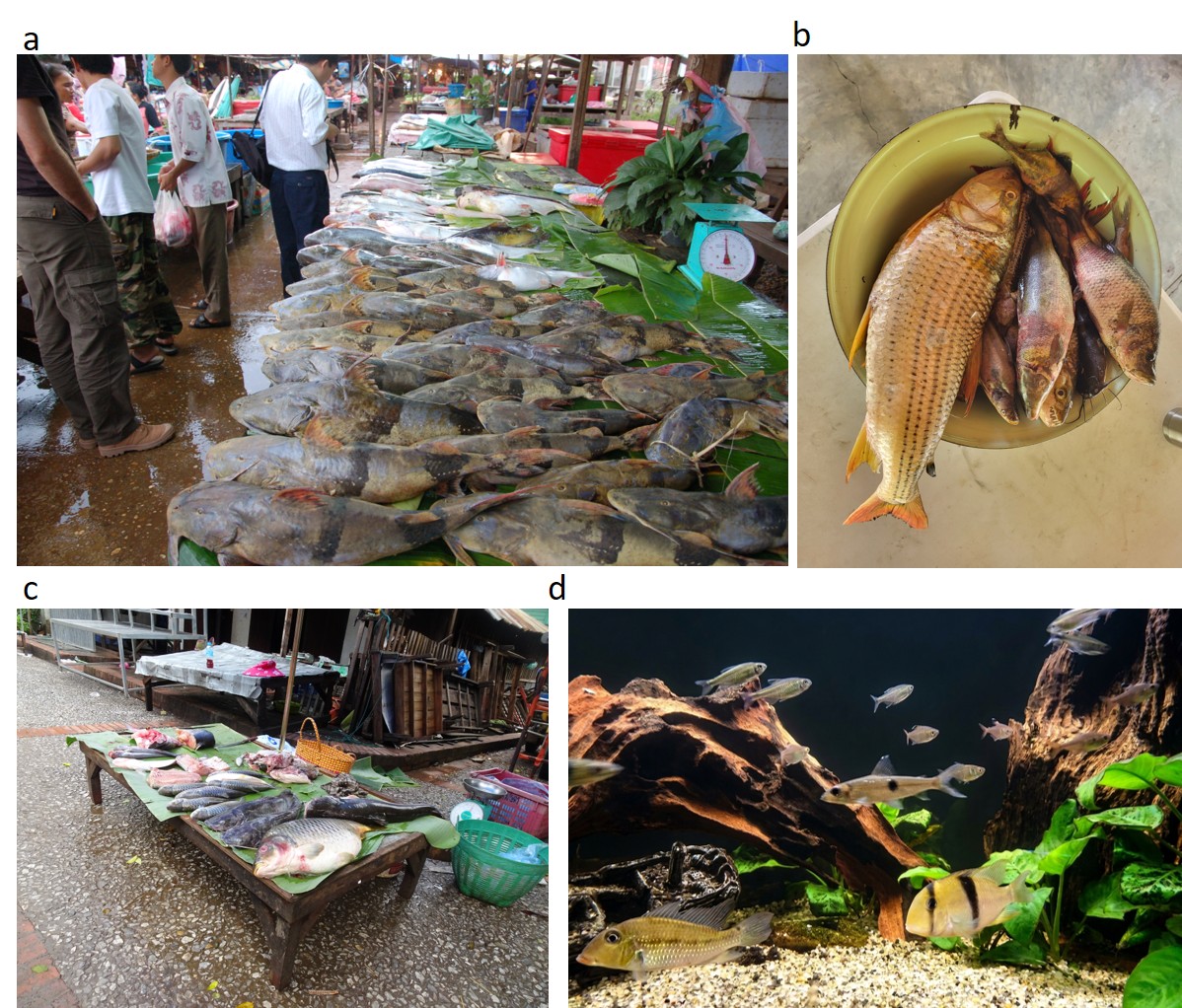
Freshwater fishes are among the most heavily used groups of wild animals. More than 18,000 species have been described, and inland fisheries alone feed more than 150 million people. Aquaculture, recreational angling and the ornamental trade each rely on hundreds of species. Yet, when we started this project, we realised that a simple question had never been asked at the global scale: are the species we use a random sample of freshwater fish diversity, or do they share particular ecological characteristics?
The question matters because conservation and fisheries policies generally assess species through two lenses: how threatened they are, and how much of them is traded. What species actually do in ecosystems is rarely considered. If the fishes we use were functionally ordinary, losing some of them could be partly buffered by similar species. If they were unique, their loss would leave gaps that nothing else could fill.
This question became a central part of Pierre Bouchet's PhD at the Centre de Recherche sur la Biodiversité et l'Environnement (CRBE) in Toulouse, France, which explores the links between vertebrate functional traits, human use and the biodiversity crisis.
Reading ecology from body shape
To answer it, we needed two things at the global scale: a description of what each species looks like, and a record of how humans use it.
For the first, we relied on FISHMORPH, a database our group has built over the years, describing eleven morphological traits for 8,970 freshwater fish species: body size and elongation, mouth size and position, eye size and position, fin shapes and positions. These traits are far from cosmetic. A streamlined body with a narrow caudal fin points to a fast open-water swimmer; a ventral mouth to a bottom feeder; large, dorsally placed eyes to a visual hunter near the surface. Body shape is a window onto how a fish moves, feeds and uses its habitat.
For the second, we extracted human uses from FishBase and grouped them into four categories: fisheries, aquaculture, game fishing and the aquarium trade.
We then built a global morphospace from the eleven traits (four principal axes capturing 74% of trait variation) and asked three questions. Where do used species sit in this space compared with random sets of species? Does the probability of being used depend on a species' morphological distinctiveness? And what would we lose if the threatened species among them went extinct?
The main hurdle was data completeness: about a quarter of raw trait values were missing and had to be imputed. We spent considerable time checking that imputation did not drive the results; species positions in the morphospace shifted by only about 5% of axis range on average. The other challenge was to choose null models that answer the right question, comparing used species to random draws of the same size from the global pool.
Each use has its own fish
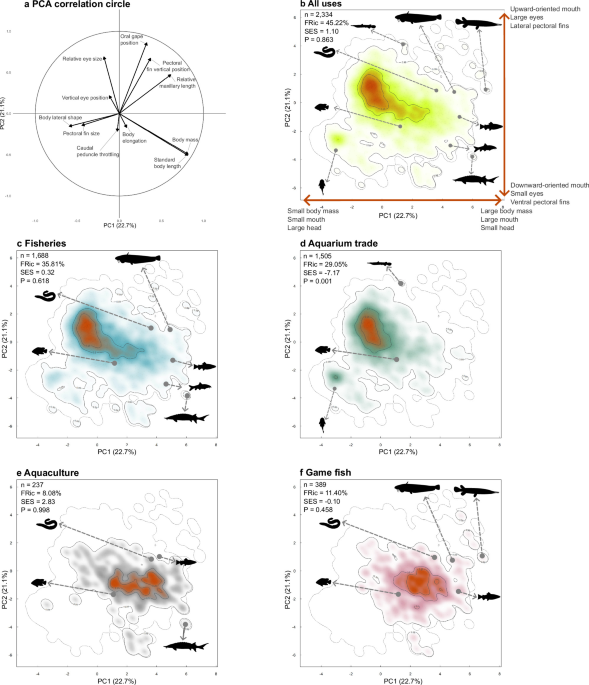
The first result was reassuring in a way: the 2,334 species used by humans (26% of the species studied) span 45% of the global morphospace, no more and no less than an equivalent random set of species. Human use, taken as a whole, draws on a broad range of ecological strategies.
The picture changed when we split uses apart. The aquarium trade (1,505 species) concentrates on small species with large eyes and upturned mouths, the guppy being a textbook example, and shows the strongest morphological clustering of all uses. Aquaculture (237 species) favours large, bottom-dwelling species with downturned mouths, such as some African catfishes. Game fishing (389 species) targets large, wide-mouthed predators like the largemouth bass or the northern pike. Fisheries (1,688 species) cover the broadest spectrum, from the small forage fishes of the African Great Lakes to the largest predators, with a clear shift towards large-bodied species.
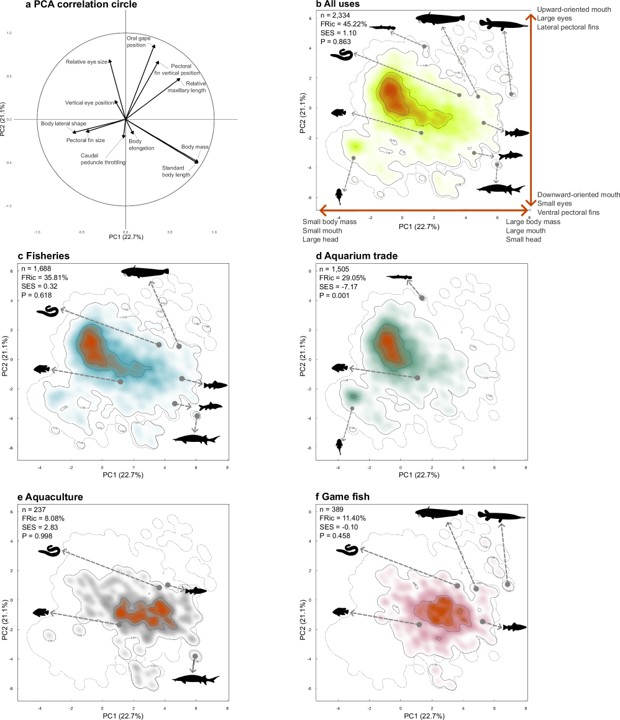
Morphospace of freshwater fish species used by humans.
a Correlation circle depicting the loadings of the traits in the PCA for PC1 and PC2.
b Morphospace of species encompassing all species used by humans.
c–f Morphospaces of species considering each type of usage. Usage is indicated above each panel.
Targeting the unusual
We then modelled the probability that a species is used as a function of its morphological distinctiveness, that is, how far its shape lies from all other species. Aquaculture and game fishing clearly favour distinctive species with rare trait combinations, often large ones. The relationship is much weaker for fisheries and the aquarium trade, whose species pools sit closer to the bulk of the morphospace.
Many of these species are already in trouble. Of the used species, 396 (17%) are threatened or near threatened on the IUCN Red List, and 139 more are Data Deficient.
When we simulated their extinction, from the most to the least threatened, global morphological richness of freshwater fishes dropped by 4.7%, while the decline was only 1.1% when the same number of species was removed at random: about four times more. The losses fell disproportionately on the edges of the morphospace, occupied by species with no close functional equivalent, such as sturgeons or the giant catfishes of Asian rivers.
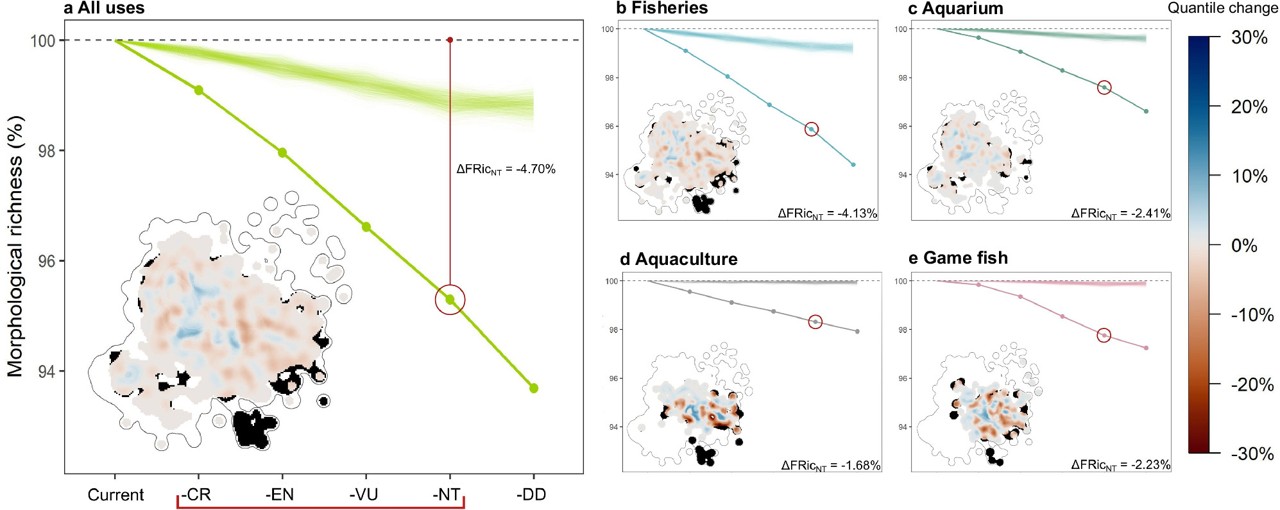
Loss of morphological richness following the potential extinction of threatened freshwater fish species
used by humans.
For a All uses and b–e each human use category (indicated in the panel title),
the percentage of morphological richness loss (ΔFRic) is shown.
Morphological richness loss was assessed following a stepwise removal of species used by humans
and classified as threatened by IUCN.
Use is not only a threat
One point we were keen to stress is that use and conservation are not necessarily opposed. The common carp, threatened in its native range, has become one of the most widespread fishes on Earth thanks to aquaculture. In Brazil, community-based management of the arapaima fishery, a giant of Amazonian floodplains, has led to a 193% increase in its populations while improving local incomes. Well-managed use can be part of the solution, but attention is also required on the invasion potential of non-native species
We also want to be clear about what our study does not show. Body shape is a proxy for ecological role, not a direct measurement of it. FishBase use records are uneven across regions, and many species still lack a Red List assessment. Most importantly, we do not show that use causes the threats these species face: dams, pollution, invasive species and overexploitation act together. What we show is that human use concentrates on species that are both distinctive and vulnerable.
Why it matters
International frameworks such as FAO fisheries assessments and CITES trade regulations evaluate species through their threat status or trade volume. They remain largely blind to what species do in ecosystems. The ecological importance of a threatened species also depend on the presence or not of functionally equivalent species that could insure ecological processes.
Global trait databases now make it possible to identify species that are at once used, threatened and functionally irreplaceable. Integrating this functional dimension into management would mean protecting not only species, but the processes that freshwater ecosystems, and the people who depend on them, rely on.
Looking ahead
This study focused on freshwater fishes, but the same question applies to every group we exploit, from hunted mammals to harvested birds and marine fishes. As trait databases keep growing, we hope this approach will help move conservation from counting species to understanding what we stand to lose when they disappear.
This work was led by Pierre Bouchet as part of his PhD at CRBE (CNRS, Université de Toulouse, IRD, Toulouse INP), together with Sébastien Brosse and Aurèle Toussaint. We thank the reviewers whose comments improved the manuscript.
Read the paper: Human targeting of morphologically unique fishes amplifies the risk of functional erosion, Nature Communications (open access)
Data and code: github.com/pierrolaloune/FishUsage · doi.org/10.5281/zenodo.21873314
Credit photos. S. Brosse
Follow the Topic
-
Nature Communications
An open access, multidisciplinary journal dedicated to publishing high-quality research in all areas of the biological, health, physical, chemical and Earth sciences.
Related Collections
With Collections, you can get published faster and increase your visibility.
Women's Health
Publishing Model: Hybrid
Deadline: Ongoing
Data for AI, AI for Data: cross-disciplinary cleaning, processing and analysis approaches
Publishing Model: Open Access
Deadline: Dec 31, 2026