Faith without action? Bridging the gap between ecological conviction and environmental action
Published in Social Sciences


Our new research, published in Ambio, draws on a nationally weighted Australian survey (n = 1,295) to explore the relationship between Christian faith, environmental responsibility and civic participation. It examines a deceptively simple question: why do sincerely held ecological convictions so often fail to translate into environmental action?
Religious communities have extensive local networks, trusted relationships and shared moral commitments. Yet these assets do not automatically generate collective environmental action. We wanted to look beyond what people believe and examine the social and institutional conditions that might help them participate.
What the survey revealed
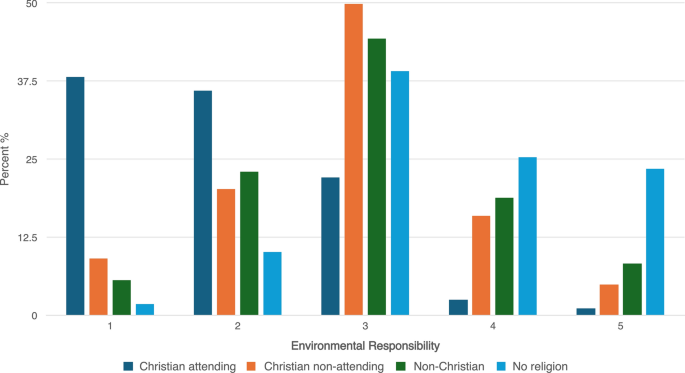
Our analysis draws on the 2025 Australian Community Survey, conducted by NCLS Research in April 2025. The study used an online panel of 1,295 adults, with data weighted by age, gender and education to reflect the Australian adult population. We compared four broad groups: Christians attending religious services at least monthly, other Christians, people affiliated with non-Christian religions and people reporting no religion. We examined everyday environmental practices alongside civic participation, including conservation activities and contact with elected representatives.
The contrast is striking. Nearly three-quarters (74.3%) of regular Christian churchgoers agreed that Christian faith helps people become more environmentally responsible. Yet this conviction was not matched by higher reported levels of environmental action. On everyday practices, Christians generally resembled other Australians; on some civic measures, they were less engaged.
The distinction between individual and collective action is particularly revealing. Across the survey, 84.6% reported at least one practical environmental action, but only 31% reported at least one civic environmental action over the previous five years. Switching off lights or recycling is relatively straightforward to do alone. Conservation activities and public engagement require coordination, confidence and opportunities to participate.
Why the gap persists
We interpret this pattern through three interconnected levels. At the individual level, people may doubt whether their contribution will make a difference, or feel constrained by competing priorities and the perceived risks of public engagement. At the community level, congregations may affirm environmental stewardship without making civic participation a visible or expected part of church life. At the institutional level, practical arrangements and partnerships that would make participation easier may be missing.
A sermon about environmental responsibility, however persuasive, does not necessarily provide a practical opportunity to act. Nor does conviction automatically overcome time pressures or concerns about political division.
Seven practical ways to translate conviction into action
Drawing on these findings and the wider behavioural and sustainability literature, our paper proposes seven congregation-level strategies. They are intended as practical, testable approaches—not interventions whose effectiveness our survey has already demonstrated.
-
Make civic participation a normal part of church life. A short, regular 'civic moment' could invite members to take one concrete action, such as contacting a local representative about a conservation issue, with an accessible template or QR code.
-
Build collective confidence through small groups. Home groups could organise a local landcare activity, community submission or other modest project together. Shared responsibility makes participation less daunting and more sustainable than relying on isolated individuals.
-
Remove practical obstacles. Providing ready-to-use materials, transport to activities or childcare where appropriate can help people act on commitments they already hold. Convenience and practical support matter alongside motivation.
-
Connect action with familiar Christian narratives. Leaders and community members can frame environmental participation through stewardship, care for creation and love of neighbour. Concrete examples make the link between faith and public responsibility easier to recognise.
-
Develop partnerships beyond the congregation. Churches could work with local councils, conservation groups and other community organisations to create recurring opportunities for participation. Such relationships can provide expertise, continuity and shared resources.
-
Make commitments visible and track progress. A congregation might set a modest annual participation goal and report progress through newsletters or a simple display. Public commitments and feedback can help sustain engagement beyond a single event.
-
Encourage leaders to model participation. When church leaders take part in environmental initiatives themselves, and make space for these activities in congregational life, civic participation becomes more familiar and socially supported.
Some strategies are modest and low-cost; others depend on partnerships and practical resources. Their common purpose is to make participation normal, accessible and collectively supported, moving from general approval to concrete opportunities for action.
Beyond changing minds
The findings challenge a common assumption: that stronger ecological convictions naturally lead to greater environmental action. Our research suggests otherwise. Translating belief into meaningful civic participation also depends on how communities organise, model and normalise collective action.
The study has limitations: it relies on self-reported, cross-sectional survey data, and the religious categories are broad. It cannot establish causation or tell us which proposed strategies work best. Testing these approaches in real congregational settings, including across denominations and cultural contexts, is an important next step.
The central message: Faith communities have considerable yet underappreciated and underutilised potential to mobilise collective action for sustainability. Realising this potential requires moving beyond belief towards practical, organised engagement. This is where churches—and potentially other faith communities—could contribute to more participatory and sustainable societies.
What would make environmental civic action more achievable in your community?
Read the open-access article here: https://doi.org/10.1007/s13280-026-02388-w

Johannes M. Luetz is Professor of Sustainability and Religion and Director of Graduate Research and Research Development at Alphacrucis University College, based in Brisbane, Australia.
He is an interdisciplinary social scientist whose work examines ecological and climate adaptation challenges through spiritual, humanitarian, and policy lenses, with a particular focus on worldview-inclusive learning.
Raised across Sierra Leone, Switzerland, Germany, and Australia, he has conducted research at the science–faith, interfaith, and science–policy interfaces.
He is Adjunct Associate Professor at the University of New South Wales and Adjunct Professor at the University of the Sunshine Coast, and serves on the editorial boards of international journals.
Follow the Topic
-
Ambio
This journal publishes research for a global audience on the interrelationships between environment and society with focus on both the natural and the social dimension of sustainability challenges.