When Newborn Jaundice Management Becomes a Test of Health-System Reliability
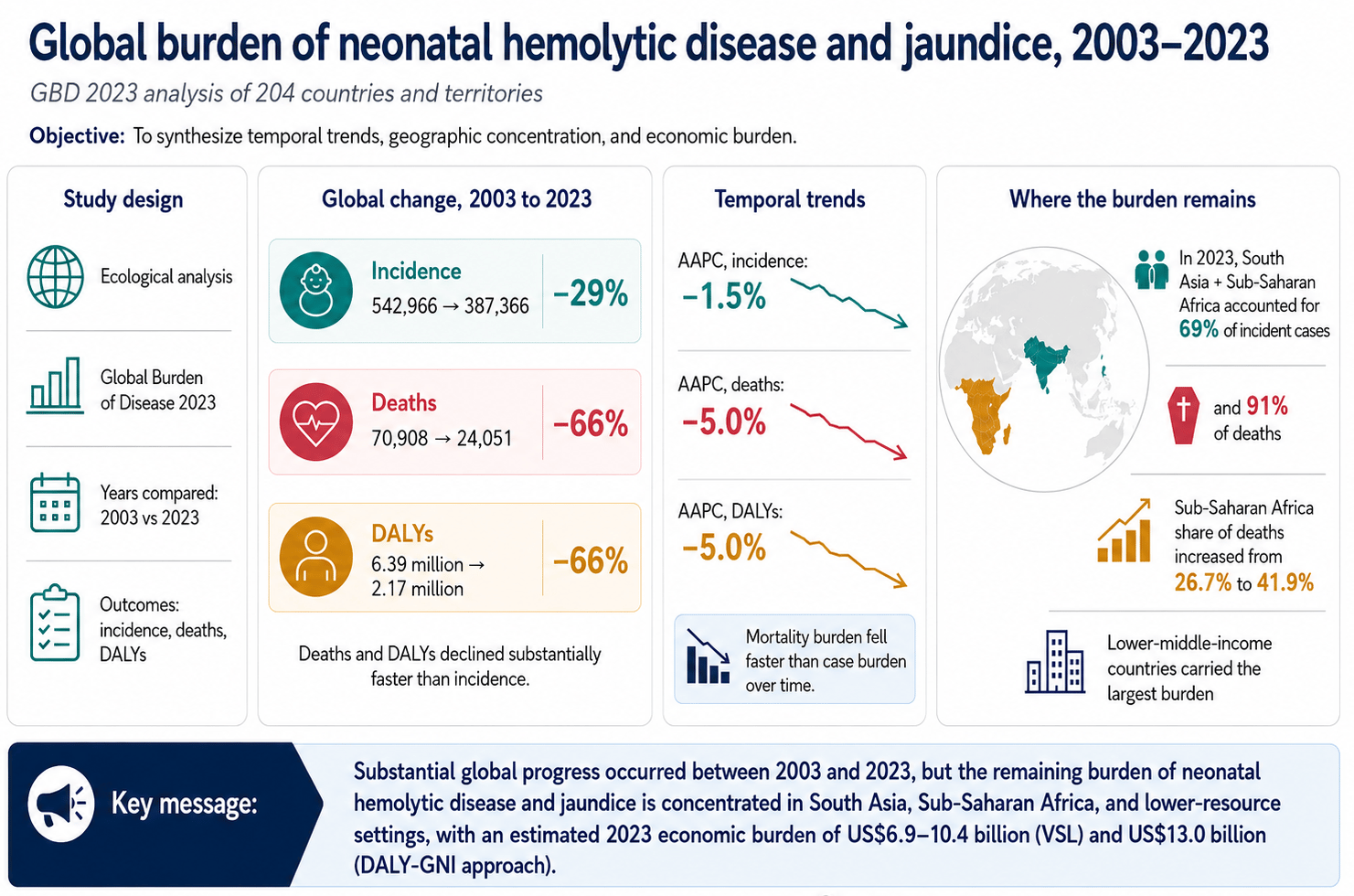

Our study asked a simple but important question: How has the global burden of severe neonatal jaundice changed over the past two decades, and where does the greatest risk remain? We analyzed Global Burden of Disease 2023 estimates for “hemolytic disease of the newborn and other neonatal jaundice” across 204 countries and territories from 2003 through 2023. We examined estimated new cases, deaths, and disability-adjusted life years, or DALYs, which combine years of life lost through early death with years lived with disability. We also assessed trends by World Bank region and income group, explored how incidence and mortality traveled together within different economic settings, and estimated the economic scale of the 2023 burden.
Fortunately, the global picture shows real progress. Estimated incident cases fell and related deaths declined much faster during the study period. The modeled deaths-to-incidence ratio was more than halved. In other words, severe disease still occurs, but an affected newborn was substantially less likely to die in 2023 than two decades earlier.
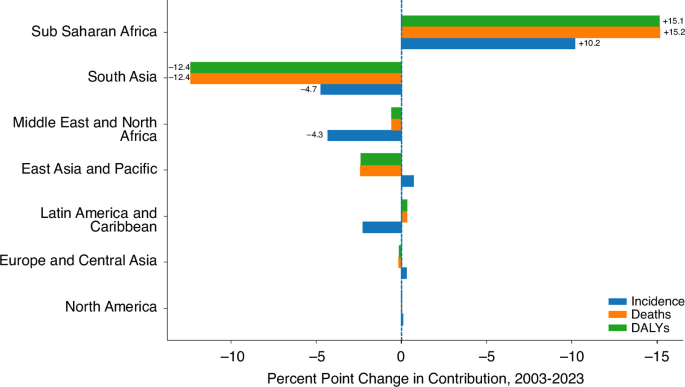
That separation between occurrence and death may reflect better “system buffering”- the ability of health services to recognize danger and prevent progression after jaundice develops. Our ecological study cannot prove that better screening or treatment caused the decline. However, evidence from clinical practice supports this interpretation. A global systematic review (Slusher et al, BMJ Paediatrics Open, 2017) found the highest incidence of severe neonatal jaundice in Africa, followed by Southeast Asia. A nationwide Swedish study (Alken et al, JAMA Network Open, 2019) showed that kernicterus can persist even in a high-resource system and found that most cases involved potentially avoidable failures in screening, diagnosis, treatment, or escalation. Progress was also deeply unequal. In 2023, South Asia and Sub-Saharan Africa accounted for about 90% of estimated deaths. Lower-middle-income countries carried almost two-thirds of deaths and DALYs.
Our exploratory country clusters revealed another important contrast. In low-income settings, higher incidence was strongly associated with higher mortality. In upper-middle-income settings, higher incidence was not accompanied by proportionately higher mortality. This suggests, but does not prove, that stronger detection, treatment, transport, and rescue capacity can loosen the link between illness and death.
The economic consequences were also substantial. These figures do not place a price on a child’s life, nor do they demonstrate the return on investment of a particular intervention. They translate population health loss into policy-relevant terms and remain sensitive to assumptions about income, purchasing power, and the value assigned to risk reduction.
The practical message is hopeful but urgent. Preventing kernicterus does not require one universal strategy. High-incidence, high-mortality settings need both prevention and stronger rescue systems. High-incidence, lower-mortality settings should preserve effective treatment while reducing preventable disease. Everywhere, neonatal jaundice should be treated as a measure of whether maternal services, newborn screening, follow-up, transport, and hospital care function as one dependable system.

Follow the Topic
-
Pediatric Research
Pediatric Research publishes original translational research papers, invited reviews, and commentaries on the etiologies and treatment of diseases of children and disorders of development, extending from basic science to epidemiology and quality improvement.