Escaping the “Interpreter’s Trap”: When Explainable AI Fails to Protect Justice

My debut paper challenges the growing belief that "Explainable AI" (XAI) equates to safety. Driven by concerns over black-box opacity, I investigate whether this technical optimism causes us to overlook fundamental aspects of human responsibility and accountability.
Escaping the “Interpreter’s Trap”: When Explainable AI Fails to Protect Justice
Like

Share this post

Choose a social network to share with, or copy the URL to share elsewhere

This is a representation of how your post may appear on social media. The actual post will vary between social networks

Explore the Research

SpringerLink
SpringerLink SpringerLink

The interpreter’s trap: how explainable AI launders uncertainty into justification—a socio-legal case study of COMPAS risk assessment - AI & SOCIETY

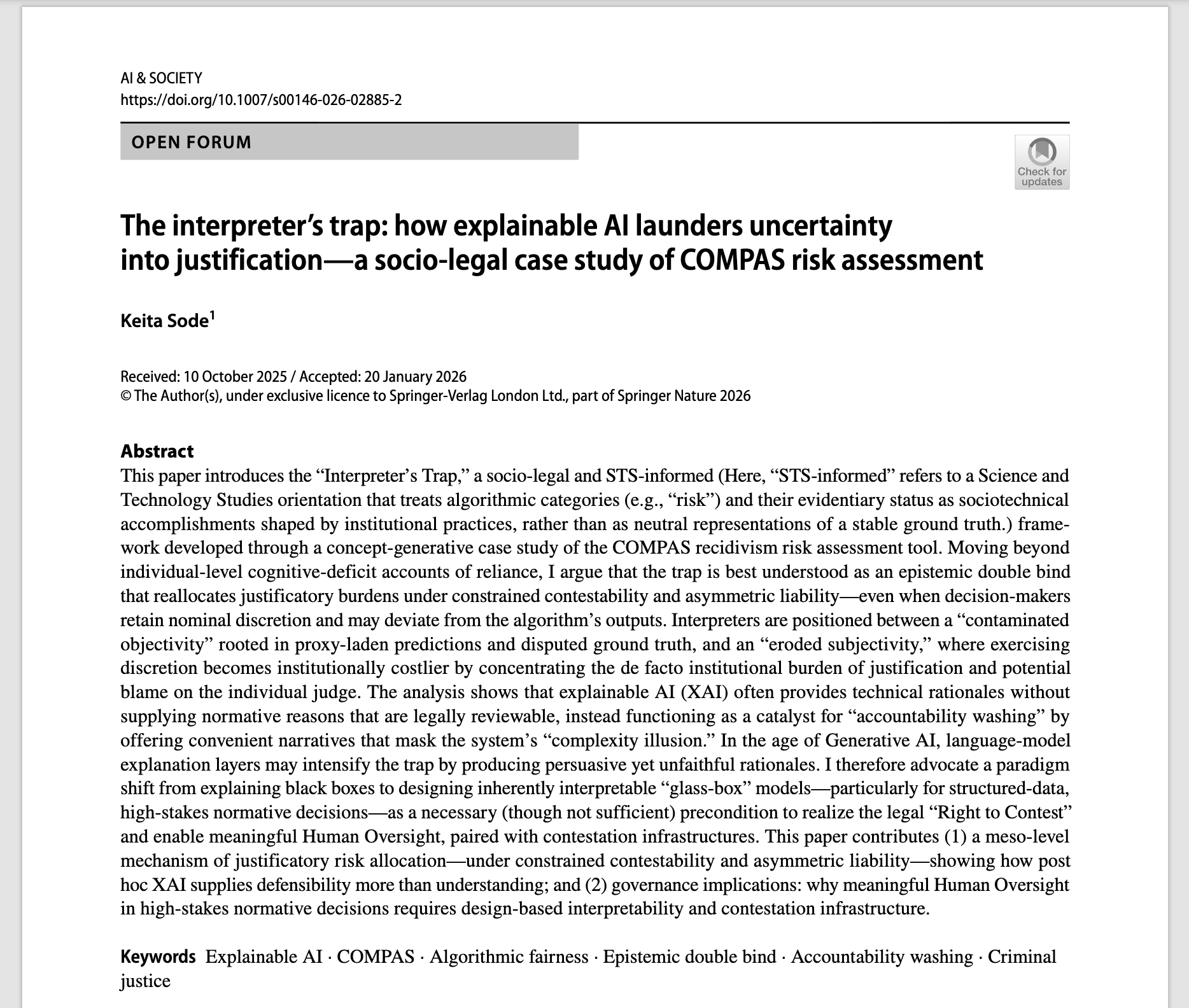
This paper introduces the “Interpreter’s Trap,” a socio-legal and STS-informed (Here, “STS-informed” refers to a Science and Technology Studies orientation that treats algorithmic categories (e.g., “risk”) and their evidentiary status as sociotechnical accomplishments shaped by institutional practices, rather than as neutral representations of a stable ground truth.) framework developed through a concept-generative case study of the COMPAS recidivism risk assessment tool. Moving beyond individual-level cognitive-deficit accounts of reliance, I argue that the trap is best understood as an epistemic double bind that reallocates justificatory burdens under constrained contestability and asymmetric liability—even when decision-makers retain nominal discretion and may deviate from the algorithm’s outputs. Interpreters are positioned between a “contaminated objectivity” rooted in proxy-laden predictions and disputed ground truth, and an “eroded subjectivity,” where exercising discretion becomes institutionally costlier by concentrating the de facto institutional burden of justification and potential blame on the individual judge. The analysis shows that explainable AI (XAI) often provides technical rationales without supplying normative reasons that are legally reviewable, instead functioning as a catalyst for “accountability washing” by offering convenient narratives that mask the system’s “complexity illusion.” In the age of Generative AI, language-model explanation layers may intensify the trap by producing persuasive yet unfaithful rationales. I therefore advocate a paradigm shift from explaining black boxes to designing inherently interpretable “glass-box” models—particularly for structured-data, high-stakes normative decisions—as a necessary (though not sufficient) precondition to realize the legal “Right to Contest” and enable meaningful Human Oversight, paired with contestation infrastructures. This paper contributes (1) a meso-level mechanism of justificatory risk allocation—under constrained contestability and asymmetric liability—showing how post hoc XAI supplies defensibility more than understanding; and (2) governance implications: why meaningful Human Oversight in high-stakes normative decisions requires design-based interpretability and contestation infrastructure.

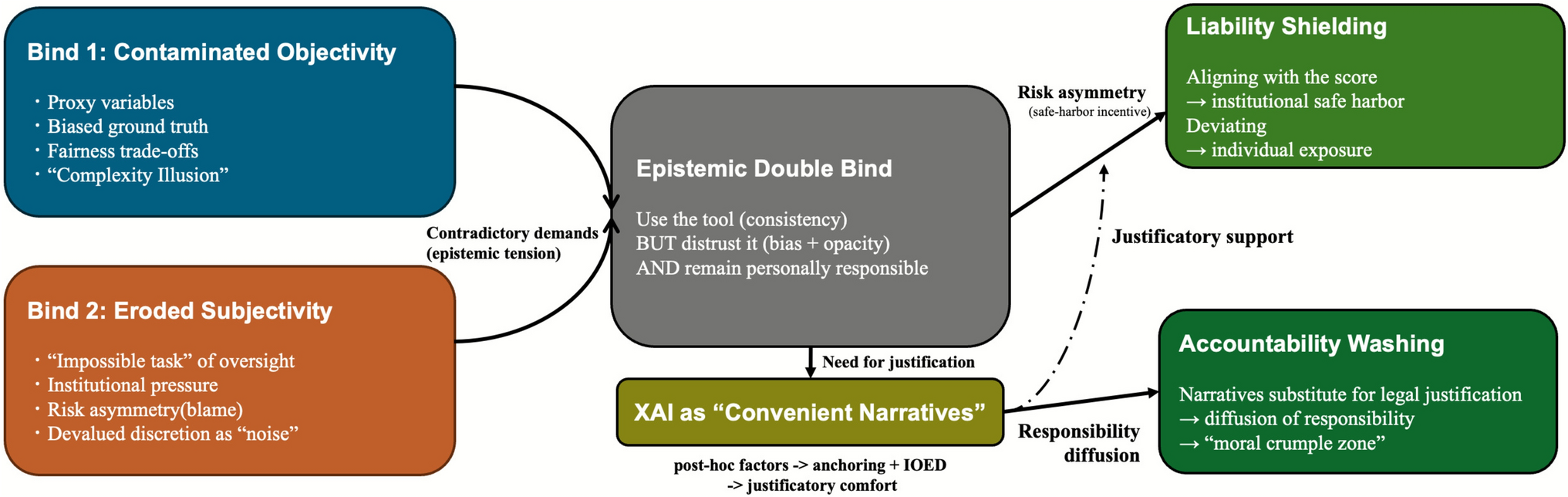
My investigation led me to the concept of "The Interpreter’s Trap." In studying risk assessment tools like COMPAS, I realized that the problem wasn't merely technical opacity, but a structural "institutional double bind." Decision-makers are often caught between "contaminated objectivity"—data carrying hidden historical biases and proxy variables—and "eroded subjectivity," where their own professional discretion is devalued against the machine’s "evidence-based" output.

Crucially, my research suggests that this trap is sustained by a mechanism of "liability shielding." I found that decision-makers face an asymmetry of risk: aligning with a high-risk score creates a safe harbor of "scientific" justification, whereas deviating from the algorithm imposes a heavy personal burden of proof. In this high-stakes environment, post-hoc XAI often fails to empower human oversight. Instead, it creates "convenient narratives"—simplified rationales like "prior arrests"—that anchor the judge’s decision to the algorithm. This effectively converts uncertainty into institutionally defensible justifications, facilitating what I term "accountability washing."

As this was my first peer-reviewed article, the research process itself was a steep learning curve. While the initial drafts were unpolished, rigorous feedback from reviewers helped me refine my critique from simple technological skepticism into a robust socio-legal framework. This process taught me that the "trap" is not just about the algorithm, but about the specific legal and organizational structures that incentivize deference to machines.

Ultimately, I argue that we should aspire to a higher standard of system design. We must pierce the "Complexity Illusion"—the false assumption that opaque, complex models are inherently more accurate. For high-stakes normative decisions, "explaining" a black box is often insufficient. I advocate for a paradigm shift toward inherently interpretable "glass-box" models—systems designed to be transparent from the ground up, where the logic is visible and contestable by default.

However, this is not just a technical challenge—it is a legal and normative one too. Transparency alone is meaningless if the human in the loop cannot act upon it. My paper argues that true "Human Oversight," as envisioned in emerging frameworks like the EU AI Act, requires more than just receiving an explanation; it requires the effective power to disagree. We must couple interpretable models with a robust "Right to Contest," creating a socio-legal infrastructure where algorithmic outputs are treated not as objective verdicts, but as contestable evidence. Without this normative shift, even the most transparent model risks becoming another tool for bureaucratic validation rather than justice.

As an early-career researcher, I hope this paper contributes to the ongoing conversation about how we can build AI systems that support, rather than supplant, human ethical judgment.

Read the full paper: https://rdcu.be/e2MXo

Please sign in or register for FREE

If you are a registered user on Research Communities by Springer Nature, please sign in

Follow the Topic

Artificial Intelligence
Mathematics and Computing > Computer Science > Artificial Intelligence
IT Law, Media Law, Intellectual Property
Humanities and Social Sciences > Law > IT Law, Media Law, Intellectual Property
Computer Ethics
Humanities and Social Sciences > Philosophy > Moral Philosophy and Applied Ethics > Information Ethics > Computer Ethics
Computers and Society
Mathematics and Computing > Computer Science > Computing Milieux > Computers and Society
Philosophy of Artificial Intelligence
Humanities and Social Sciences > Philosophy > Philosophy of Science > Philosophy of Technology > Philosophy of Artificial Intelligence
  • AI & SOCIETY AI & SOCIETY

    This journal focuses on societal issues including the design, use, management, and policy of information, communications and new media technologies, with a particular emphasis on cultural, social, cognitive, economic, ethical, and philosophical implications.

Related Collections

With Collections, you can get published faster and increase your visibility.

AI in Asia: Social and Ethical Concerns

This collection is opened to Asian Social and Ethical concerns related to AI. Asia is a large continent, with highly diverse religious and cultural systems, variations in industrial development, differing approaches to both government and governance, and unique historical and contemporary geopolitical dynamics that deserve to be treated independent of European or North American (or comparatively with African or Latin American) issues. It is also an important question because Asia is the most populated continent.

Existing studies on intercultural ethics of AI (Hongladarom and Bandasak 2024), comparative governance systems (Hine and Floridi 2024; Okuno and Okuno 2025), and postcolonial studies of AI (Ofosu-Asare 2025; Rodríguez 2025; Hassan 2023) highlight the importance of this work and the need for further studies. While comparative approaches are welcome, this topical collection seeks original research that attends specifically to the Asian context, understood both broadly across the region and within specific Asian societies. To this end, we encourage inter-cultural comparison within the Asian continent, with the special issue serving as a meta-comparative collection on Asian AI concerns. We encourage interdisciplinary approaches to studies along three broad branches: 1) philosophical and cultural considerations rooted in Asian perspectives; 2) political and social AI issues unique to specific Asian societies; 3) region-specific, trans-national challenges raised by AI.

Please consult the detailed call for papers at https://link.springer.com/journal/146/updates/27806474before submitting

Publishing Model: Hybrid

Deadline: Feb 28, 2026