Evaluating the pest control efficiency of wheat storage bags and polypropylene liners against Trogoderma granarium and Tribolium castaneum

Stored grain losses are largely due to insect penetration in conventional bags and limitations of hermetic storage systems. This study evaluates polypropylene liners in storage bags to enhance protection against infestation while maintaining effective fumigation.
Like

Share this post

Choose a social network to share with, or copy the URL to share elsewhere

This is a representation of how your post may appear on social media. The actual post will vary between social networks

Explore the Research

Springer International Publishing
Springer International Publishing Springer International Publishing

Evaluating the pest control efficiency of wheat storage bags and polypropylene liners against Trogoderma granarium and Tribolium castaneum - International Journal of Tropical Insect Science

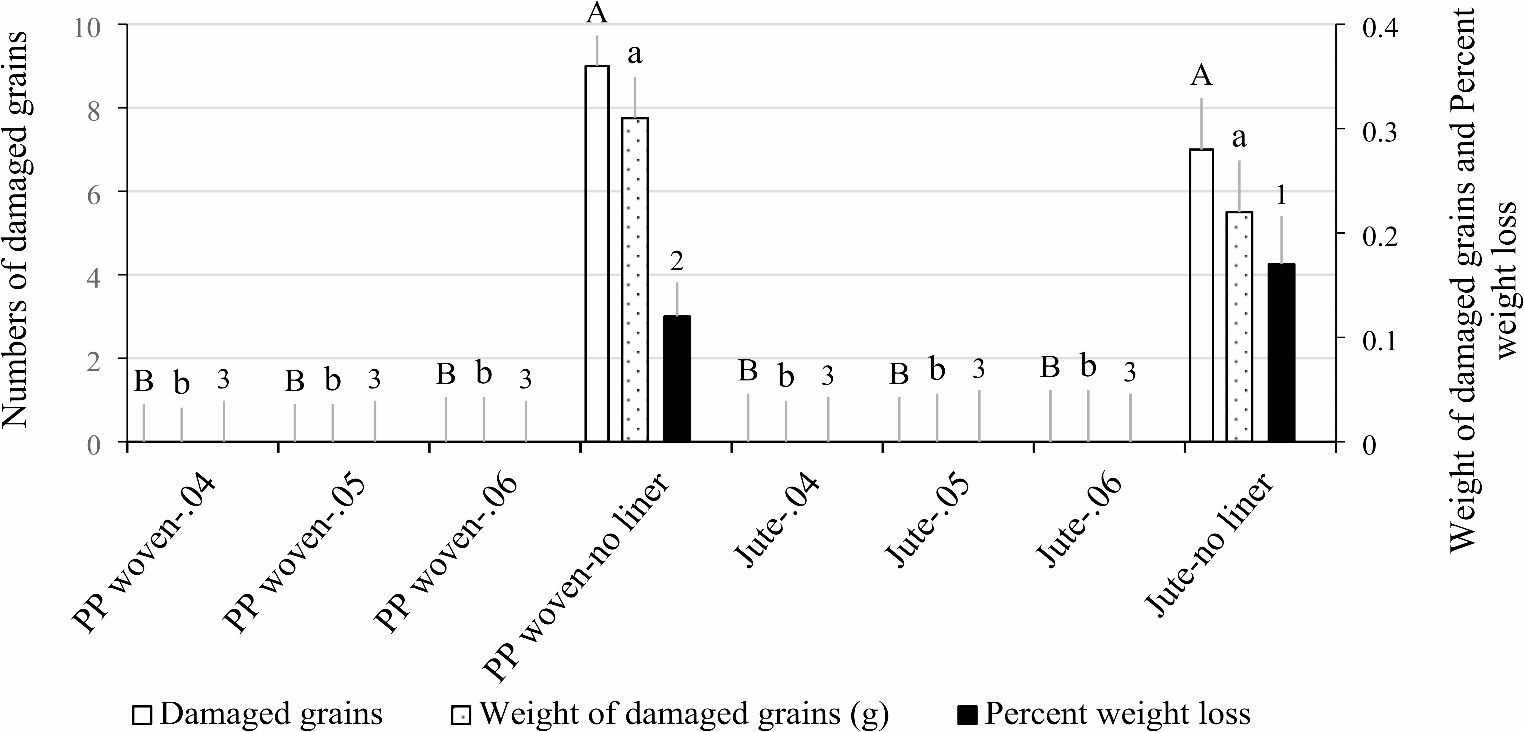
Insects either enter storage bags from outside or are present as resident populations. This study evaluated jute bags (JB) and woven plastic bags (WPB) with polypropylene liners of three thicknesses for resistance to external infestations by Trogoderma granarium (Coleoptera: Dermestidae) and Tribolium castaneum (Coleoptera: Tenebrionidae) and their effect on fumigation-induced mortality of resident populations. Results showed that without liners, T. granarium caused 0.17% weight loss in JB and 0.12% in WPB, while T. castaneum caused 0.12% in JB and 0.05% in WPB. With internal liners, no grain damage occurred (P < 0.05). Fumigation results revealed T. granarium mortality of 90% in JB and 77% in WPB, and T. castaneum mortality of 85% in WPB and 82% in JB (P < 0.05). Liners significantly increased mortality rates: T. granarium (92–90% with liners, 60% without) and T. castaneum (100–99% with liners, 36% without). Bag stacking affected T. granarium mortality (89% in a row, 78% in tight stacking, P < 0.05) but had no significant effect on T. castaneum (P > 0.05). Interaction of bag types and liners showed T. granarium mortality of 100% in JB with liners and significantly lower (61–58%) without liners (P < 0.05). Similarly, T. castaneum mortality was 100–99% with liners but only 41% in WPB and 31% in JB without liners (P < 0.05). The combined effects of liners and row stacking significantly enhanced the mortality of both species, particularly in JB. These findings highlight the critical role of internal liners in minimizing grain losses and increasing fumigation efficacy.

The study results conclude that to safely store valuable grain commodities, the usage of jute and woven plastic bags without internal plastic liners is not recommended. The absence of internal liners in these bags not only allow insects to enter and infest the grains but also insects inside bags escape from bags to cross-infest surrounding bags. Fumigation of both jute and woven plastic bags for the resident insect population can result in control failure due to their very nature of escaping behavior during the fumigation period. Results also showed the importance of bag stacking in wheat warehouses. It showed row stacking of bags which on one hand is recommended for relaxed handling of bag stacks during the storage period but because of vacant spaces between bags stacks fumigant gas freely circulates throughout the interior of the building and can more easily diffuse in bags which can help to kill the relatively resistant insects like T. granarium compared with somewhat susceptible species like T. castaneum because in current results row stacking had significant effect on fumigation induced mortality of T. granarium particularly in combination with woven plastic bags. 

Please sign in or register for FREE

If you are a registered user on Research Communities by Springer Nature, please sign in

Go to the profile of Muhammad Waqar Hassan
about 19 hours ago

This study emphasizes the importance of incorporating internal polypropylene liners into traditional jute and woven bags to improve protection against stored grain pests

Follow the Topic

Entomology
Life Sciences > Biological Sciences > Zoology > Invertebrate Zoology > Entomology
Invasive Species
Life Sciences > Biological Sciences > Ecology > Invasive Species
Food Security
Life Sciences > Biological Sciences > Food Science > Food Security