Forests in transition: climate change is reshaping competition among Europe’s trees
Published in Earth & Environment, Agricultural & Food Science, and Mathematical & Computational Engineering Applications







When assessing the impacts of climate change on forests, attention is often focused on growth reductions, increased mortality, drought stress, fire activity, and insect outbreaks. However, behind these processes lies a more gradual but fundamental mechanism: competition among coexisting tree species.
Forest ecosystems are structured by long-term competitive interactions for essential resources such as light, water, nutrients, and space. Over decades to centuries, these interactions determine which species dominate, how forest communities evolve, and how ecosystem processes are regulated.
A central question, therefore, arises: how does climate change affect the competitive balance among tree species, and what are the consequences for future forest composition?
In a new study published in Communications Earth & Environment, it is demonstrated that climate change is likely to significantly reshape competitive relationships among Europe’s main forest tree species, potentially leading to large-scale reorganization of forest ecosystems across the continent.
Investigating such processes at a continental scale is challenging, as competition operates over long time periods, varies across environmental gradients, and depends on complex interactions among species. Traditional empirical approaches are therefore limited in their ability to capture these dynamics across large spatial extents.
To overcome these limitations, a large harmonized dataset of forest simulations was used, comprising more than 135 million simulation-years from 17 process-based forest models covering over 13,000 locations across Europe. These simulations encode decades of ecological understanding regarding tree growth, competition, and responses to environmental variability under local conditions.
A deep learning model was trained on millions of simulated forest state transitions, enabling the inference of how forest systems evolve over time under different climatic conditions. This artificial intelligence-based meta-modelling approach allows the upscaling of locally calibrated ecological processes to the continental level, providing a consistent framework to analyze changes in species competitiveness under future climate scenarios.
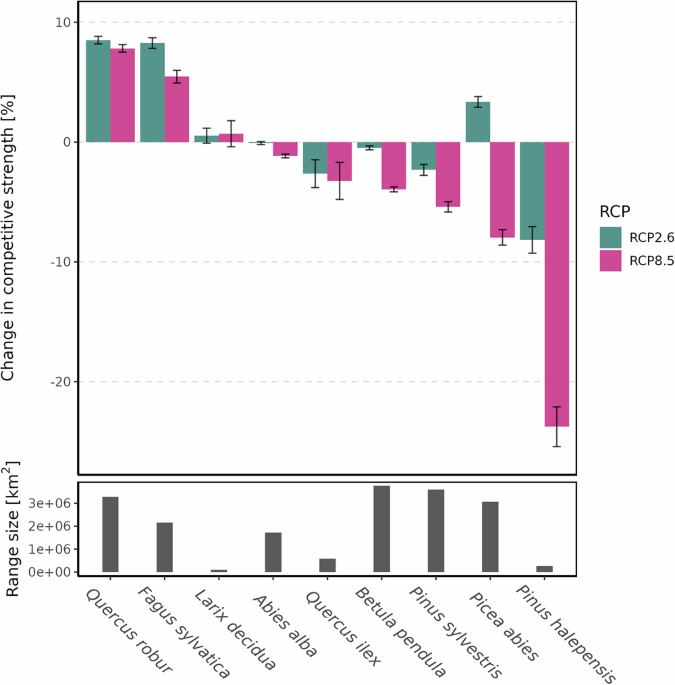
The results reveal a coherent pattern across species and regions. Under climate change, evergreen conifers generally exhibit declining competitive strength, while several deciduous broad-leaved species tend to maintain or increase their relative competitiveness. Species currently dominant in European forestry, including Norway spruce, silver fir, and Scots pine, show pronounced reductions in competitive strength, particularly in warmer and drier parts of their distribution ranges. In contrast, species such as European beech and pedunculate oak show greater resilience and, in many cases, increasing competitiveness.
A particularly consistent signal is observed at the warm edges of species distributions, where trees already operate close to their physiological limits. In these regions, additional climatic stress appears to substantially alter long-standing competitive relationships among species.
Changes in competitive strength at the species level have important implications for forest ecosystems as a whole. When competitive hierarchies shift, forest composition may also change, leading to potential transitions in dominant species across large areas.
Model projections suggest that under severe climate change scenarios, up to 25% of European forests, approximately 96 million hectares, may experience a shift in dominant tree species by the end of the century. These changes are particularly concentrated in ecological transition zones, including mountain systems such as the Alps, southern Scandinavia, and parts of the Mediterranean Basin, where species with different climatic affinities currently coexist.
These findings have significant implications for forest ecosystems and their management. Coniferous species currently dominate more than half of Europe’s forest area and are central to timber production, carbon sequestration, and a wide range of ecosystem services. A decline in their competitive strength may therefore influence both ecosystem functioning and the provision of services at large spatial scales.
At the same time, the results suggest that changes in competitive strength may serve as an early indicator of future ecosystem reorganization, preceding more visible signals such as widespread mortality or forest dieback. Subtle shifts in growth dynamics, canopy structure, and species interactions may already reflect longer-term transitions in forest composition.
From a methodological perspective, the study highlights the potential of artificial intelligence to integrate large ensembles of ecological models and translate local-scale process understanding into continental-scale projections. Rather than replacing process-based models, this approach provides a framework for synthesizing their collective information content and exploring emergent patterns across scales.
In a context of rapid climate change, understanding future forest dynamics requires not only assessing species persistence, but also quantifying how competitive interactions will determine which species are likely to dominate future European forests.

Alessio Collalti has a Master Science Degree in Natural Sciences and a Ph.D. in Forest Ecology. His background concerns Forest Ecology, Carbon and Nitrogen Cycle, Forest and Vegetation Modelling, particularly with regard to vegetation numerical modelling and response under natural and anthropogenic stress, including climate change impacts and forest management scenarios. He is the Forest Modelling Lab. head (https://www.forest-modelling-lab.com/) and a senior researcher at CNR.
Follow the Topic
-
Communications Earth & Environment
An open access journal from Nature Portfolio that publishes high-quality research, reviews and commentary in the Earth, environmental and planetary sciences.

Related Collections
With Collections, you can get published faster and increase your visibility.
Remote sensing and forests
Publishing Model: Hybrid
Deadline: Jul 31, 2026
Sustainable agricultural practices
Publishing Model: Open Access
Deadline: Jul 24, 2026

Please sign in or register for FREE
If you are a registered user on Research Communities by Springer Nature, please sign in