From Emission Hotspots to Net‑Zero Pathways: Satellite‑Based Assessment of Air Pollution Across the Canadian Prairies (Alberta, Saskatchewan, and Manitoba)
Published in Earth & Environment, Sustainability, and Computational Sciences
🌎 Can satellite observations support the journey toward net-zero emissions?
Air pollution remains one of the most significant environmental and public health challenges worldwide. Understanding where pollution is concentrated, how it changes over time, and which sectors contribute most is essential for designing effective climate and environmental policies.
The Canadian Prairie provinces– Alberta, Saskatchewan, and Manitoba – represent one of North America's most important agricultural and energy-producing regions. Rapid economic development, extensive transportation networks, agriculture, and industrial activities create unique environmental challenges that require large-scale monitoring beyond conventional ground stations.
🛰️ Monitoring air pollution from space
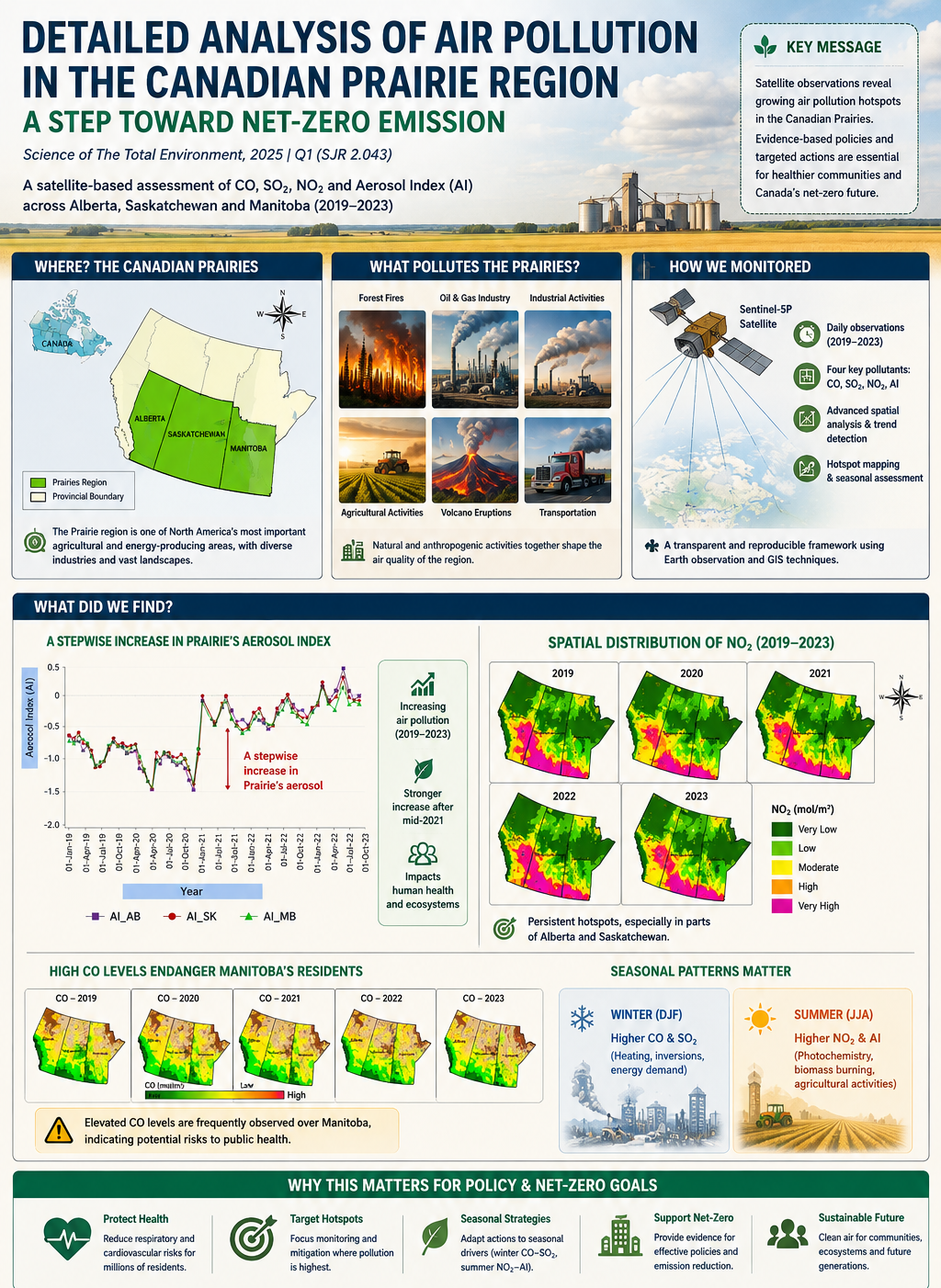
In our recent study published in Science of the Total Environment, we developed a satellite‑based framework to investigate long‑term air‑pollution patterns across the Canadian Prairies.
Using Earth observation data from Sentinel‑5P and spatial analysis, we examined five key pollutants: carbon monoxide (CO), nitrogen dioxide (NO₂), sulfur dioxide (SO₂), formaldehyde (HCHO), and the aerosol index (AI).
Using Earth observation data together with spatial analysis, we examined how air pollution varies across the region, identified pollution hotspots, evaluated temporal trends, and discussed how these findings can support Canada's transition toward net-zero emissions.
Rather than focusing on a single pollution source, the study provides a regional perspective that supports environmental monitoring and strategic policy development.
📊 What did we discover?
Several important findings emerged.
• Distinct spatial differences exist across Prairie provinces – Alberta shows the highest levels for most pollutants due to industrial activities; Manitoba has elevated CO concentrations driven by meteorological conditions; Saskatchewan exhibits summer peaks for NO₂ and aerosols linked to agricultural activities.
• Satellite observations revealed persistent pollution hotspots that deserve continued environmental monitoring.
• The study demonstrates how Earth observation technologies can complement conventional monitoring networks by providing consistent regional coverage.
• The findings also highlight opportunities for targeted emission-reduction strategies that support Canada's long-term climate commitments.
Importantly, satellite observations characterize atmospheric pollution patterns rather than directly measuring individual emission sources. Therefore, identified hotspots should be interpreted as priority areas for further investigation and policy attention.
🌱 Why does this matter?
Achieving net-zero emissions requires reliable information.
Large-scale satellite observations enable governments and researchers to monitor environmental conditions consistently across vast geographic regions, helping prioritize mitigation efforts where they are most needed.
Such information can support:
• Air-quality monitoring
• Climate mitigation strategies
• Net-zero planning
• Environmental reporting
• Sustainable regional development
• Evidence-based policy making
🌍 Beyond the Canadian Prairies
Although this study focuses on Western Canada, the analytical framework is transferable.
The same satellite-based methodology can be adapted to other countries seeking cost-effective approaches for regional air-quality assessment, environmental monitoring, and climate-policy evaluation.
As satellite technologies continue to advance, integrating Earth observation with spatial analytics will become increasingly important for supporting sustainable environmental governance worldwide.
🎯 Supporting the Sustainable Development Goals
This research contributes directly to several United Nations Sustainable Development Goals, particularly:
• SDG 3 – Good Health and Well-being
• SDG 11 – Sustainable Cities and Communities
• SDG 13 – Climate Action
By providing a scalable approach for monitoring regional air pollution, the study demonstrates how satellite observations can support healthier communities and evidence-based climate action.
💬 Looking ahead
How can satellite observations better support environmental decision-making and accelerate progress toward net-zero emissions?
I welcome discussions and collaborations with researchers, policymakers, and practitioners working in remote sensing, air quality, climate change, sustainability, geospatial science, and environmental monitoring.
Link of the paper: https://www.sciencedirect.com/science/article/abs/pii/S0048969725001263

Head of Public Transportation, Tehran Municipality District 22 | Transportation Planning Specialist | 15+ years municipal experience | Sustainability & Climate Researcher: sustainable cities, GIS/Remote Sensing, air quality, methane monitoring & net-zero transition | ✍️ 9 research publications (incl. 5 Q1/Q2), 43 citations & 11 journal reviews | 🖨️ Recent research: Australia methane, Tehran spatial equity & Canada air pollution | 🤝 Collaborations with a Top 2% global scientist and an Australian Principal Scientist | 🎯 Translating research into climate policy & sustainable mobility.
Follow the Topic
What are SDG Topics?
An introduction to Sustainable Development Goals (SDGs) Topics and their role in highlighting sustainable development research.
Continue reading announcement