From hyperbolic in-plane anisotropy to an optical chirality: towards an ultrathin handedness preserved circular polarizers with twisted vdW MoOCl₂
Published in Materials






In recent years, van der Waals (vdW) crystals have evolved from scientific curiosities into a versatile platform for exploring novel quantum phases and unconventional nanophotonic phenomena. Their layered nature allows stacking, twisting and interfacing with a remarkable atomic precision, enabling previously inaccessible nanoscale electronic, optoelectronic and photonic functionalities. Among the most intriguing features of certain low-symmetry vdW crystals is their pronounced in-plane anisotropy across the crystallographic directions, where light experiences dramatically different dielectric responses.
But what happens when an extreme in-plane anisotropy is turned into an optical functionality?
If the goal is to control the circular polarization of light, a strong in-plane optical contrast becomes essential. Twisted vdW bilayers are already known to generate optical chirality through geometric stacking, breaking mirror symmetry, and, hence, producing a circular dichroism (CD). However, the strength of this effect is often limited by the intrinsic dielectric contrasts of the individual layers. To significantly enhance the twist-induced optical chirality, one should first identify crystals with exceptionally large anisotropy in real and imaginary parts of dielectric permittivity tensor components. This search naturally led us to the novel vdW family of transition-metal oxyhalides (MOX2, where M is a transition metal and X is a halogen atom). Notably, their crystal structures consist of strongly bonded metal–oxygen chains interconnected by halogen atoms, producing unusually strong optical contrast within the plane. In certain metallic members of the vdW family, one in-plane permittivity component remains negative while the orthogonal component acquires a positive real part in the optical spectral region giving rise to hyperbolic iso-frequency contours.
In this context, vdW MoOCl2 has recently attracted much attention as a novel platform supporting Vis- to-NIR hyperbolic plasmon polaritons, enabling subwavelength confinement and strongly directional propagation1-3. This hyperbolicity signals an exceptionally strong optical contrast between the in-plane crystallographic axes. Here, we display that such extreme anisotropy can be converted into a functional chiral optical response. By twisting two ultrathin layers of vdW MoOCl2, we realize handedness preserved circular polarizer exhibiting a CD about 43% in Vis-to-NIR spectral region — a remarkably strong response for a natural layered material system only a hundred nanometers in total thickness.
Mapping the optical DNA of vdW MoOCl2
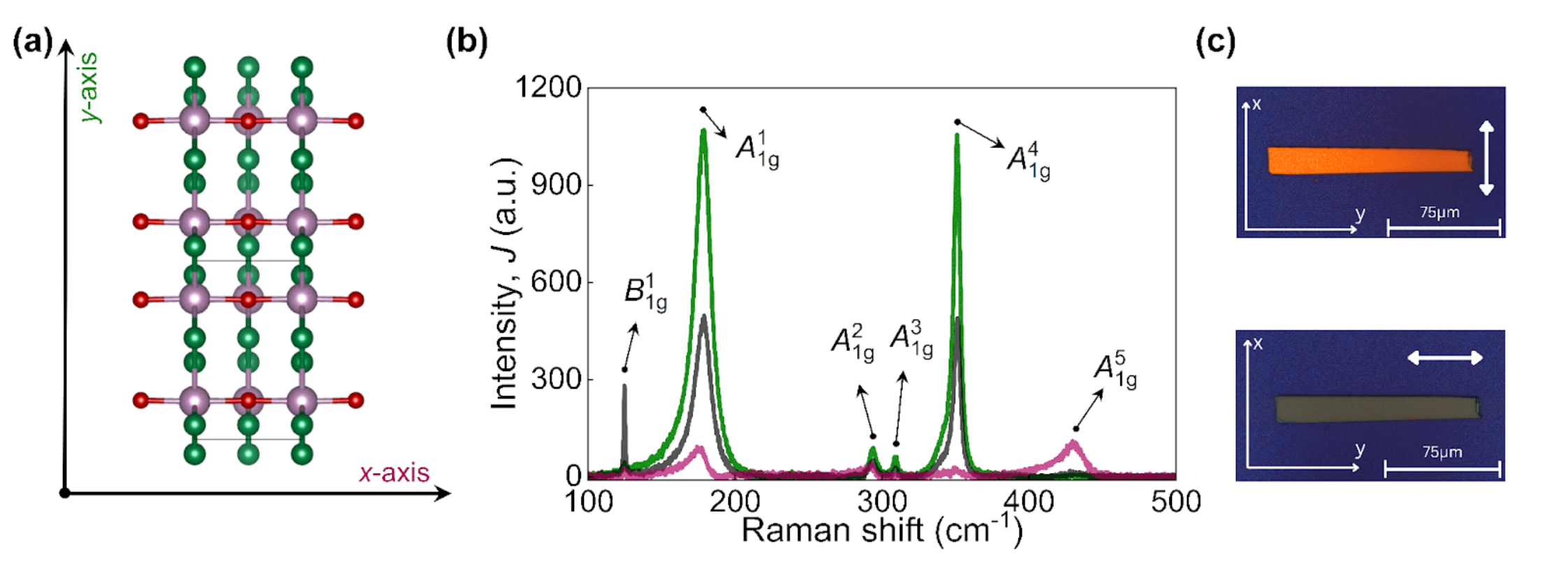
We launched our studies with the angle-resolved polarization Raman spectroscopy of vdW MoOCl2 to establish a reliable crystallographic reference frame (see Fig. 1a). The polarization-dependent Raman spectra recorded at selected in-plane polarization configurations (Fig. 1b) reveal pronounced intensity variations of the vibrational modes. The strong polarization dependence across all observed modes further confirms the pronounced anisotropy at the lattice level. Rather than using Raman as a vibrational fingerprint, we employed it to establish a symmetry-based orientation framework essential for the subsequent optical design.
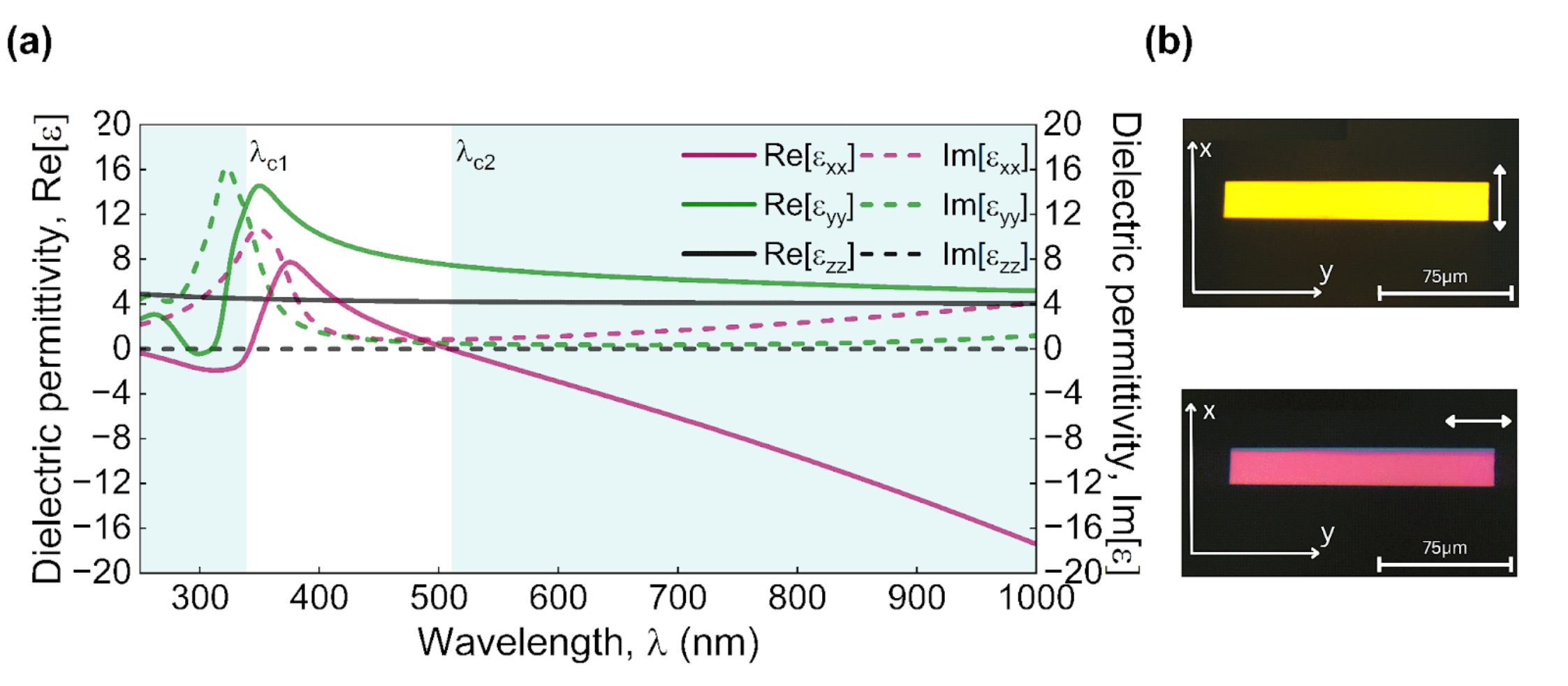
With the crystallographic axes established, the next step was to determine how the light interacts with the crystal along each in-plane direction. For this purpose, we employed imaging spectroscopic micro- ellipsometry, which directly probes the changes in the polarization state of the light reflected from the sample. The extracted dielectric permittivity tensor components (see Fig. 2a) reveal an exceptionally strong in-plane contrast at Vis-to-NIR spectral region. This remarkably large dielectric contrast provides precisely the condition required to enhance polarization-dependent phase retardation and CD in twisted multilayers. Besides, we further identify another hyperbolicity window of vdW MoOCl2 emerging in the UV spectral region, which unlike the latter arises from strong interband transitions (see the first shaded area in Fig. 2a).
From in-plane anisotropy to an optical chirality: towards handedness preserved circular polarizers
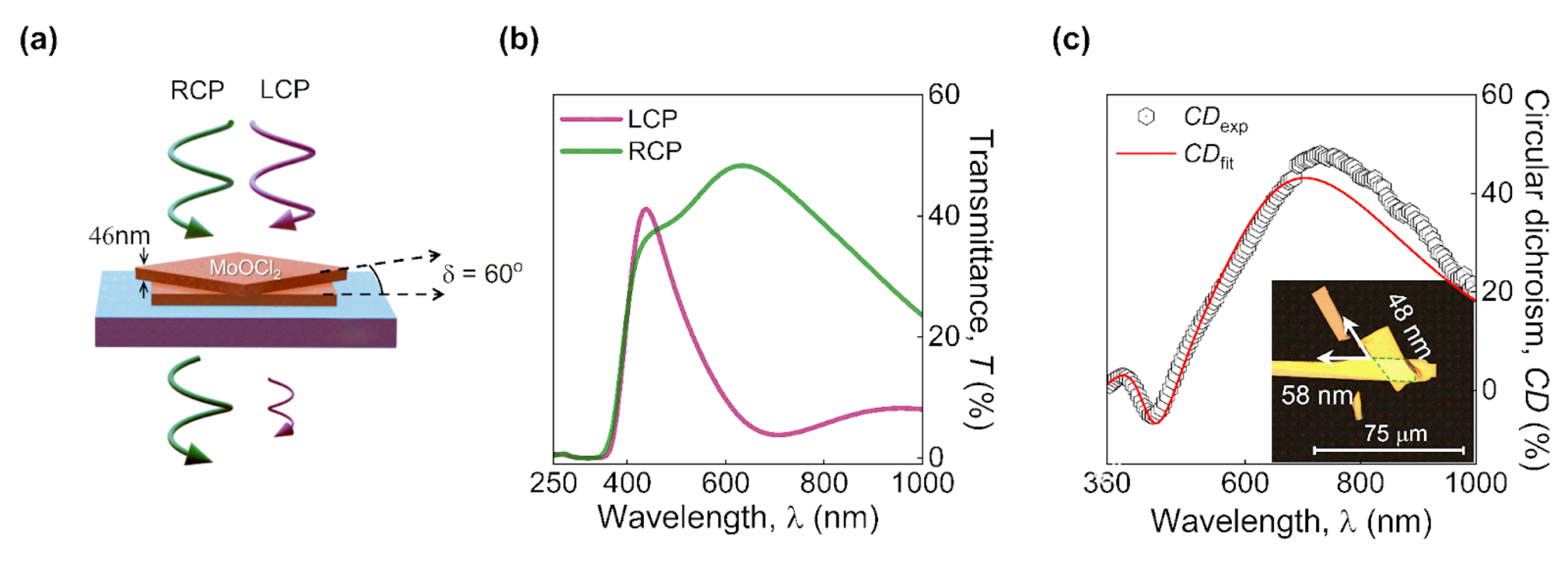
Extreme anisotropy alone is not generating an optical chirality as a singular anisotropic vdW layer usually preserves mirror symmetry within the plane. To produce a CD, that symmetry must be broken — and the twisting provides it exactly. When two anisotropic vdW MoOCl2 layers are rotated relative to each other, their crystallographic axes are no longer aligned, hence, such a bilayer loses the mirror symmetry (and not only) and acquires handedness depending on the helicity of the twist purely through the geometric stacking. In the case of a such bilayer stack, right-circularly and left-circularly polarized lights (RCP/LCP) experience dissimilar transmittance, reflectance and absorption (and interconnected effects), leading to a CD. Using the strong optical contrast of the extracted real and imaginary dielectric permittivity tensor components, we then modelled twisted bilayers and optimized both layer thicknesses and the twist angle between them for a strong CD in transmittance: 46 nm ultrathin layers with twist angle of 60° (see Fig. 3a, b). Our twisted vdW MoOCl2 stack consists of two ultrathin samples (48 nm and 58 nm thick) rotated and crystallographically aligned to 62° (see the inset in Fig. 3c) was prepared guided by these calculations. Here, the RCP and LCP transmittance signal difference reveals pure (not including substrate induced asymmetries) CD about 43% in Vis-to-NIR spectral region (see Fig. 3c). This is a remarkably strong response for a natural layered nanoscale system that went through no lithographic patterning.
Check our manuscript at https://doi.org/10.1038/s41699-026-00681-6.
References
- Venturi, G., et al. Visible-frequency hyperbolic plasmon polaritons in a natural van der Waals crystal. Nat. Comm. 15, 9727 (2024).
- Ruta, F. L. et al. Good plasmons in a bad metal. Science 387, 6735 (2025).
- Li, Y. et al. Broadband near-infrared hyperbolic polaritons in MoOCl2. Nat. Comm. 16, 6172 (2025).
Follow the Topic
-
npj 2D Materials and Applications
This journal publishes papers on the fundamental behavior, synthesis, properties and applications of existing and emerging 2D materials.

Related Collections
With Collections, you can get published faster and increase your visibility.
2D Materials for Integrated Electronics
Publishing Model: Open Access
Deadline: Oct 18, 2026
Functionalization and Reactivity of 2D Materials
Publishing Model: Open Access
Deadline: Oct 06, 2026