From Selfies to Futures: How Social Media Can Shape Career Paths Through AI
Published in Behavioural Sciences & Psychology and Mathematical & Computational Engineering Applications





Rethinking Career Guidance in the Digital Age
Career decision-making is a complex and often uncertain process, particularly for high school students. Traditional career guidance systems rely heavily on self-reported questionnaires, academic performance, and explicit preferences. While these methods provide value, they are inherently limited. Adolescents may lack the self-awareness needed to accurately assess their strengths and interests, and responses are often influenced by bias or social desirability.
At the same time, social media platforms—especially Instagram—have become integral to how young people express themselves. Through images, interactions, and engagement patterns, users continuously reveal aspects of their personality and behavior in a natural and unstructured way.
This contrast motivated our work. Instead of asking students to describe themselves, we explored whether it is possible to infer personality traits directly from their digital behavior and use these insights to support career guidance.
From Personality to Profession: The Core Idea
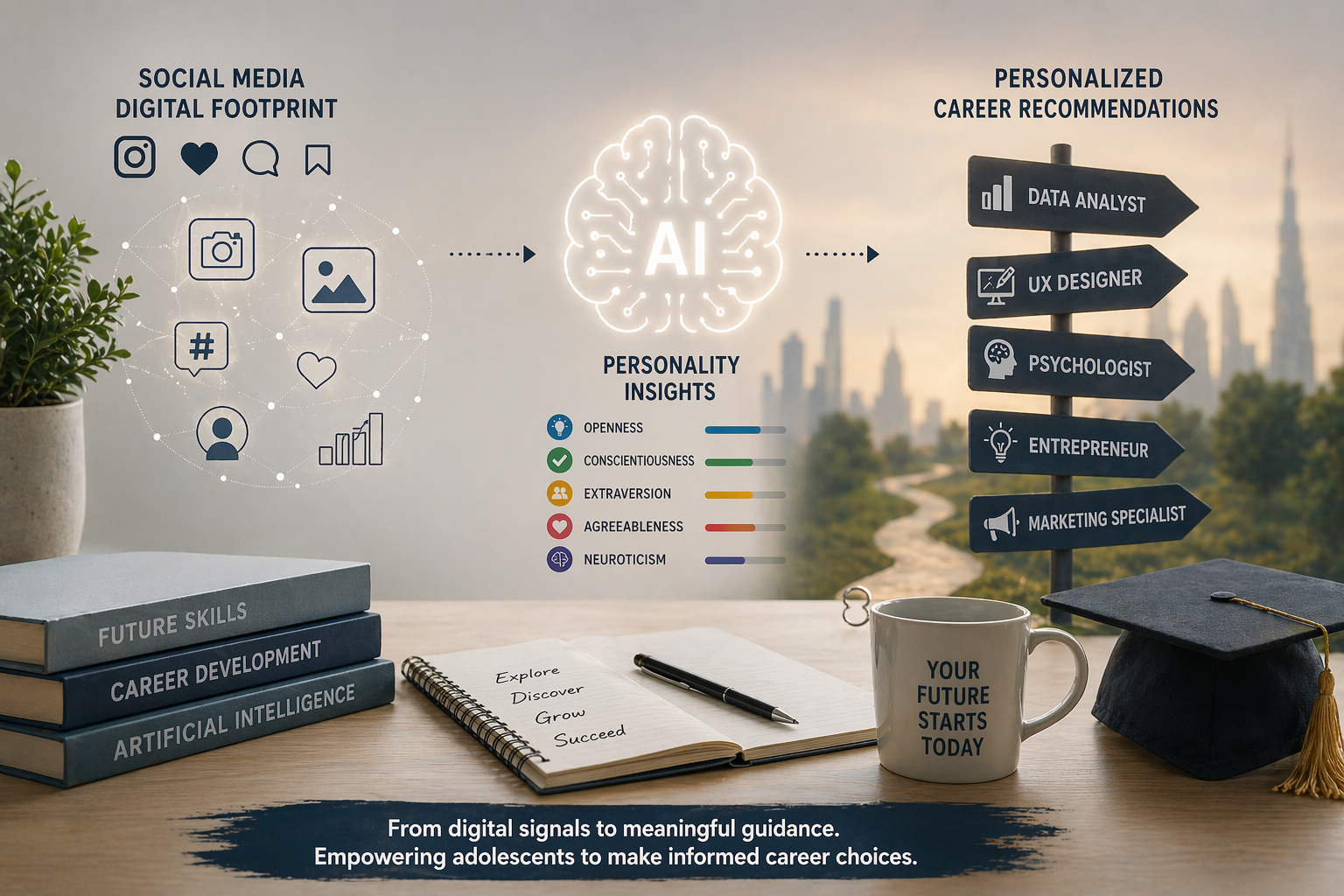
Our research introduces an AI-driven framework that connects three key components:
- Social media data (images and metadata)
- Personality inference using the Big Five model
- Personalized career recommendations
The Big Five personality model—comprising extraversion, agreeableness, conscientiousness, neuroticism, and openness—is widely recognized for its robustness and applicability in educational and career contexts. By linking these traits to career preferences, we can provide recommendations that are more aligned with individual characteristics.
Rather than relying on explicit input, our approach leverages implicit signals, including:
- Profile activity (followers, posts, likes, comments)
- Visual characteristics of images (color composition, semantic content, textures)
- Behavioral patterns reflected in user engagement
Designing the Framework
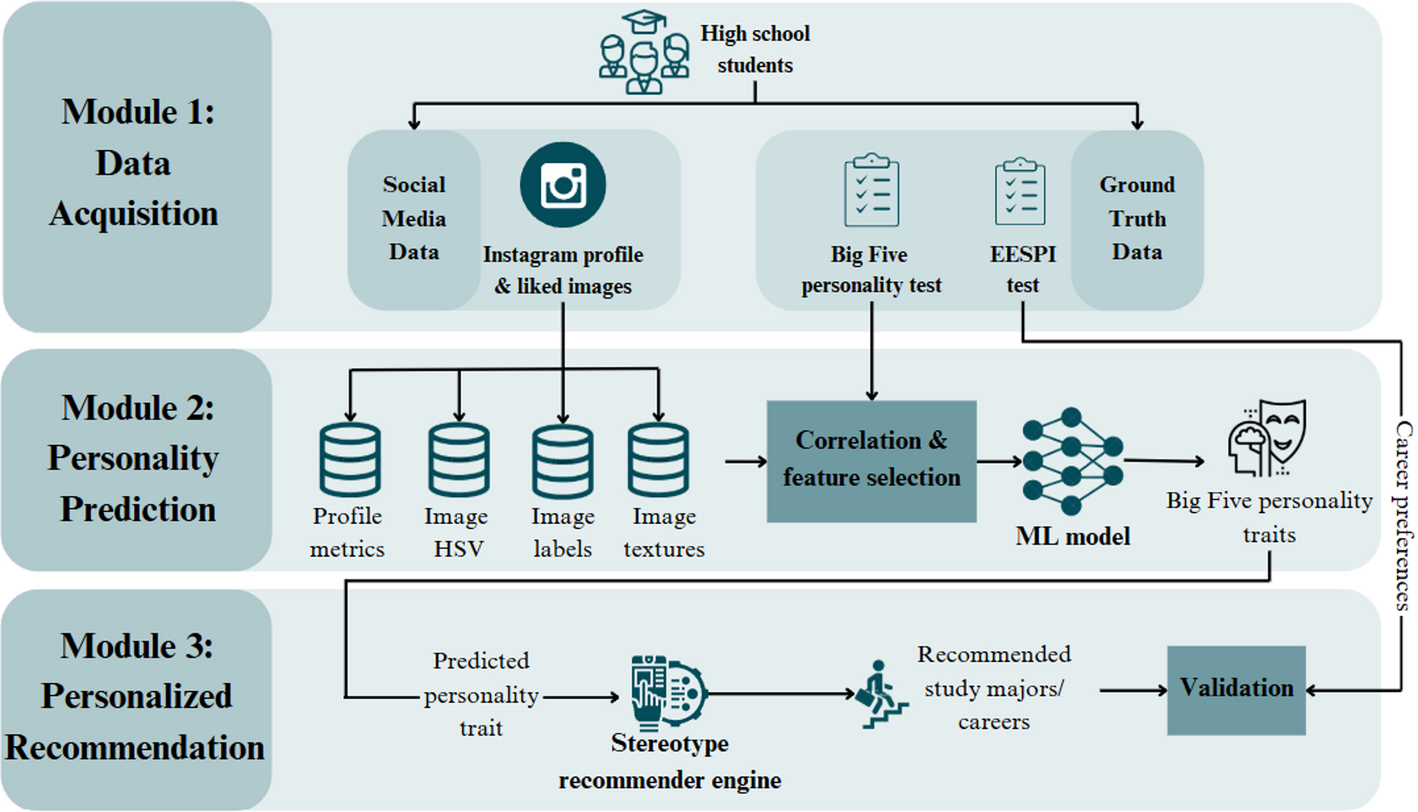
The proposed system consists of three main modules:
Data Acquisition and Feature Engineering
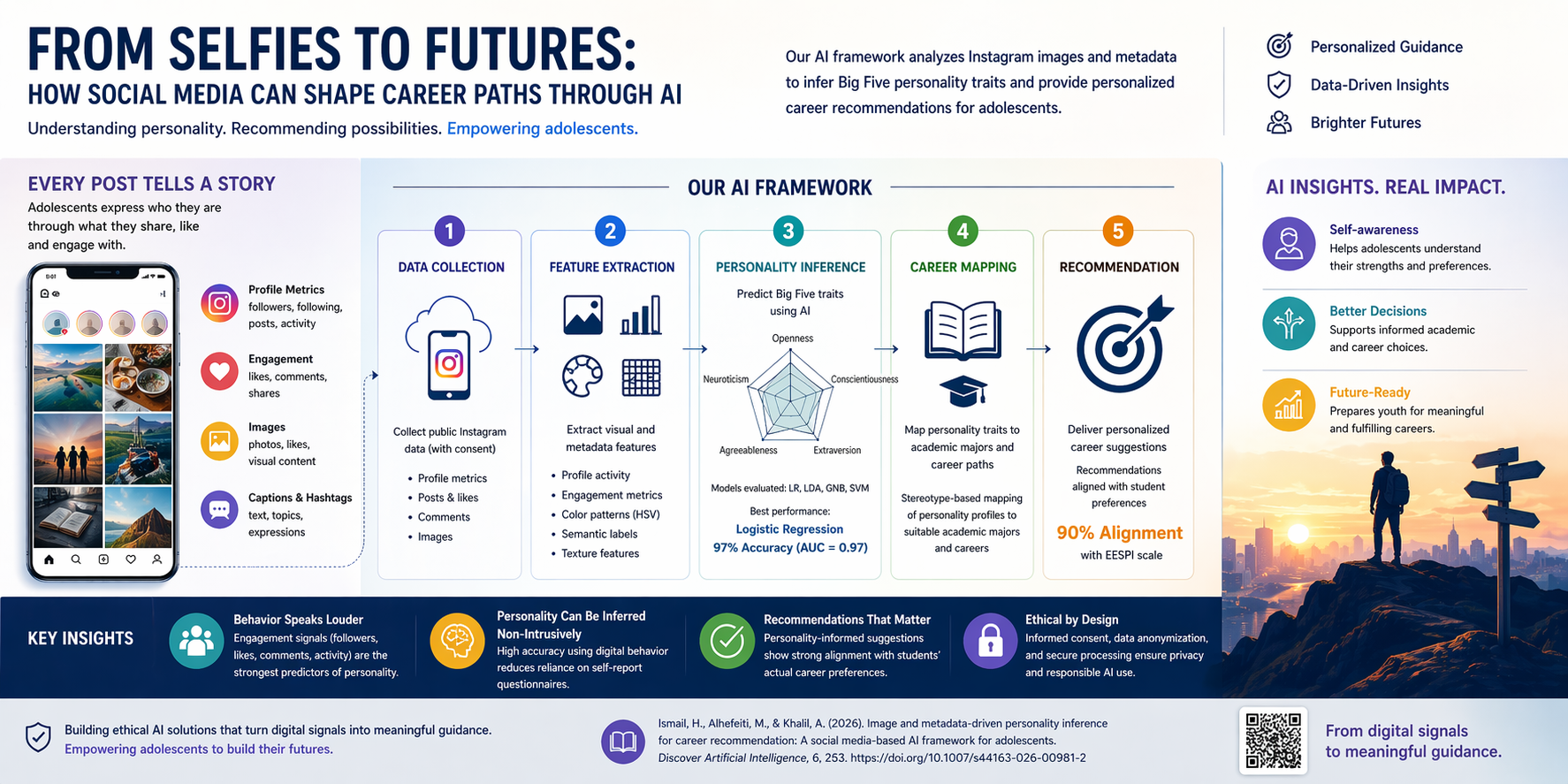
We collected Instagram data from a group of high school students in the UAE, alongside validated ground truth measures including the Big Five personality test and the Electronic Emirati Scale for Professional Inclinations (EESPI). The dataset included profile metrics, image features (HSV color representation), semantic labels, and texture descriptors.
Personality Prediction
We evaluated multiple machine learning models, including Logistic Regression, Linear Discriminant Analysis, Gaussian Naïve Bayes, and Support Vector Machines.
A key finding emerged from this stage:
Logistic Regression achieved the highest performance, with 97% accuracy and a mean AUC of 0.97.
This result highlights the strong predictive power of behavioral metadata and demonstrates that interpretable models can perform exceptionally well, particularly in small-scale educational settings.
Career Recommendation
The predicted personality traits were then mapped to career paths using a stereotype-based recommender system. The system’s recommendations were validated against students’ actual preferences using the EESPI framework.
The outcome was highly promising:
The system achieved a 90% alignment with students’ stated career preferences.
Key Insights
Several important insights emerged from this work.
First, behavioral signals outperform visual features. While image characteristics such as color and content contribute to personality inference, profile-level engagement metrics—such as follower count and interaction frequency—were significantly more predictive.
Second, personality can be inferred with high reliability from non-intrusive data sources. This suggests that implicit modeling can complement or, in some cases, reduce reliance on traditional questionnaires.
Third, personality-informed recommendations are both meaningful and practical. The high alignment with validated career preferences demonstrates that inferred traits can serve as effective proxies for explicit inputs in career guidance systems.
Ethical Considerations
Working with social media data introduces critical ethical responsibilities. In this study, all data collection was conducted with informed consent, and strict measures were taken to ensure privacy and confidentiality. Only anonymized and derived features were used, and no private or restricted content was accessed.
Beyond technical safeguards, this research raises broader questions about the role of AI in decision-making. Career guidance is a deeply personal process, and automated systems must be designed to support—not replace—human judgment. Ensuring fairness, transparency, and user autonomy remains essential.
Implications and Future Directions
This work contributes to a growing body of research on personality-aware recommender systems and highlights the potential of integrating AI into educational guidance.
In contexts such as the UAE, where young populations are navigating rapidly evolving career landscapes, there is a need for scalable and adaptive guidance solutions. By leveraging data that students already generate, this approach offers a pathway toward more personalized and accessible career support.
Future research will focus on:
- Expanding the dataset to improve generalizability
- Incorporating temporal behavioral patterns
- Exploring multimodal deep learning approaches
- Enhancing fairness and interpretability in recommendations
Conclusion
This study demonstrates that social media data can serve as a powerful resource for understanding personality and supporting career decision-making. By combining behavioral analytics with machine learning, we move toward a new paradigm of non-intrusive, data-driven personalization.
Ultimately, the goal is not simply to predict who individuals are, but to help them better understand themselves—and make more informed choices about their future.

Follow the Topic
-
Discover Artificial Intelligence
This is a transdisciplinary, international journal that publishes papers on all aspects of the theory, the methodology and the applications of artificial intelligence (AI).

Related Collections
With Collections, you can get published faster and increase your visibility.
Transforming Education through Artificial Intelligence: Opportunities, Challenges, and Future Directions
Artificial Intelligence (AI) is rapidly changing the educational field by enabling personalized learning, intelligent tutoring systems, automated assessments, learning analytics, and administrative automation.
This collection invites original research, systematic reviews, and visionary perspectives on the transformative impact of AI in education. It aims to explore how AI technologies can enhance equity, inclusion, and efficiency in educational settings across different contexts, including higher education, K-12, vocational training, and lifelong learning. This collection will address technical, pedagogical, ethical, and policy aspects, fostering interdisciplinary perspectives and evidence-based insights.
This Collection supports and amplifies research related to SDG 4 and SDG 9.
Keywords: Artificial Intelligence, AI in Education, Educational Technology, Data Analytics, AI Ethics
Publishing Model: Open Access
Deadline: Nov 30, 2026
Advanced AI Methods for Personalized Healthcare
The advancement of Artificial Intelligence (AI) technologies, especially Reinforcement Learning (RL) and Deep Learning (DL), is transforming healthcare, enabling innovative solutions for patient monitoring, diagnostics, and personalized treatment. These technologies facilitate the effective use of healthcare data and intelligent analytics, enhancing clinical decision-making and improving patient outcomes. AI is revolutionizing how healthcare is delivered, making it more proactive, efficient, and accessible. This Collection explores new methods and applications of AI for healthcare such as personalized healthcare. Contributions in this Collection showcase novel frameworks, case studies, and interdisciplinary approaches that drive the future of personalized healthcare, fostering innovations that bridge technology and patient care.
In this context, we are inviting original research articles, reviews, and perspective papers addressing (but not limited to) the following themes:
- Personalized medicine
- IRL for dynamic treatment regimes
- Wireless sensor networks for patient monitoring
- Identification and prevention of critical condition
- Monitoring systems within the medical devices contest
- Methodologies and tools for the rapid integration of WSNs, IoT and AI in health monitoring
- Behavior analysis of patients
- Personalized health-promoting interventions
- Ambient assisted living and active assisted living
- AI security and privacy models for healthcare applications
- AI methods for rehabilitation
Publishing Model: Open Access
Deadline: Feb 27, 2027