The Parasite’s Dilemma: to multiply, or to transmit, that is the question.
Published in Cell & Molecular Biology, Genetics & Genomics, and Biomedical Research



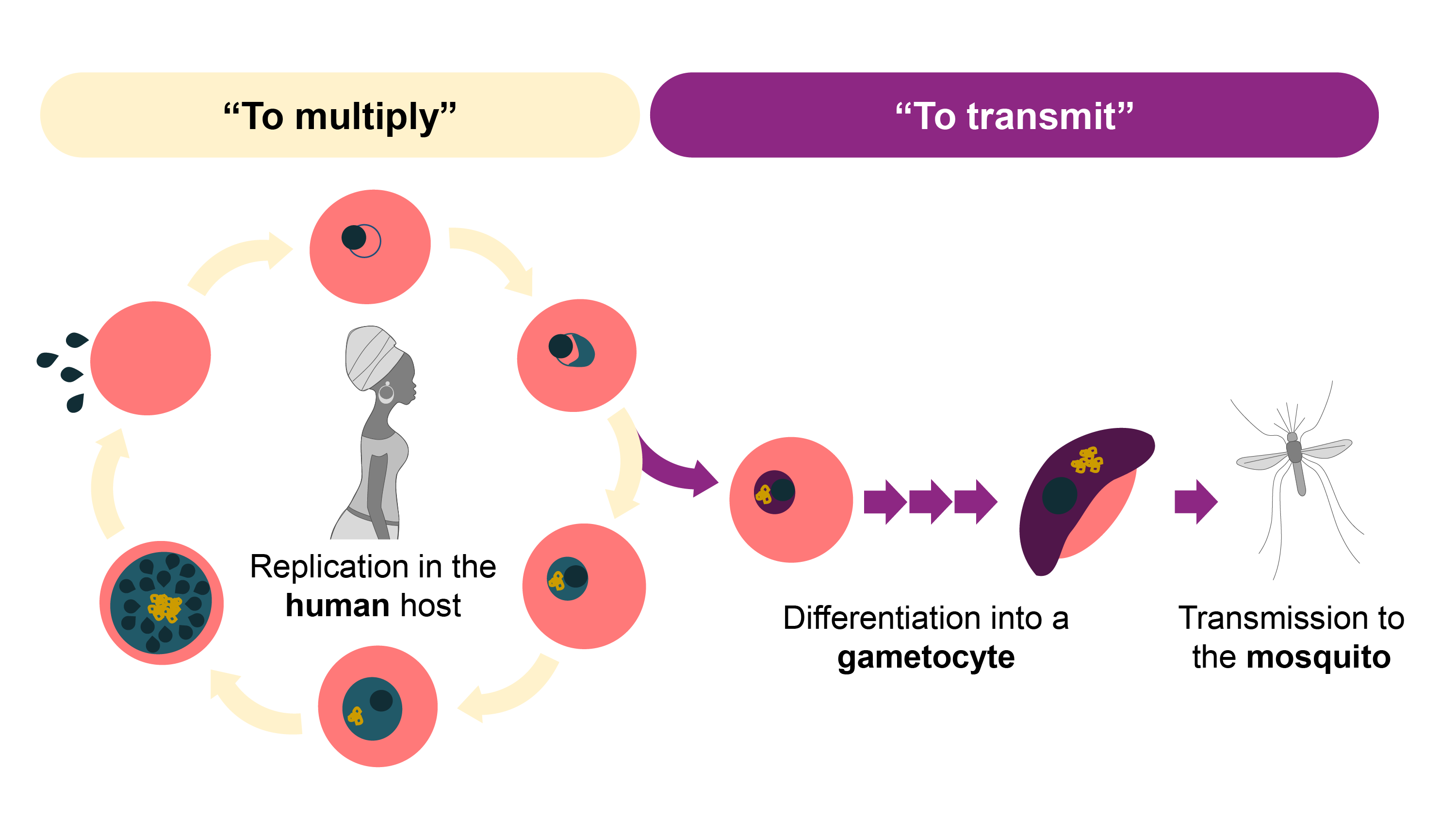
“To multiply, or to transmit, that is the question”. Every 48 hours inside a human host, Plasmodium falciparum parasites face this existential choice.
To survive in the human bloodstream, the parasite invades red blood cells, multiplies, bursts out, and repeats this 48-hour cycle, a relentless expansion that drives the fever and clinical symptoms of malaria. However, these asexual parasites cannot infect a mosquito. To jump from one host to another, the parasite must make a critical developmental decision: a small fraction of the population must stop replicating, exit the endless cycle of disease, and commit to becoming transmissible gametocytes. It is the ultimate biological gamble. Commit too few parasites to sexual development, and transmission fails; commit too many, and the population risks being outcompeted by other parasite strains or cleared by the host’s immune system before a mosquito ever bites.
For years, a central question in malaria research has been: how does a parasite operate this critical decision-making switchboard? In our recent paper in Nature Microbiology, we provide key new insight into the molecular mechanism governing this decision.
A Tale of Two Overlapping Transcripts
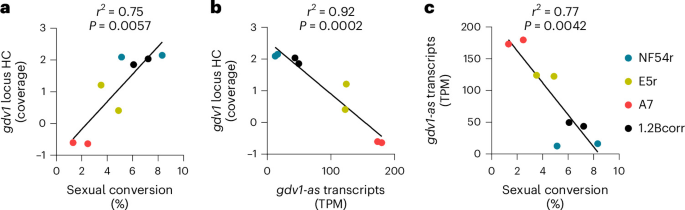
Our journey began with gdv1, a known upstream regulator of sexual conversion, and its antisense counterpart, the long non-coding RNA gdv1-as. These two transcripts overlap on opposite strands of the parasite genome and are expressed simultaneously.
To disentangle their relationship, we used different parasite strains and generated several specific transgenic parasite lines: a gdv1 knockout, a gdv1-as knockout, and a gdv1-as overexpression line. Designing these genetic editions was particularly tricky because the two transcripts overlap on opposite strands. Editing gdv1 without perturbing gdv1-as (and vice versa) required us to think very carefully about the editing strategy.
To make matters worse, the gdv1 locus proved stubbornly resistant to precise editing: the parasite responded to targeted modifications by deleting massive chunks of the surrounding chromosome. In fact, we did not realize that our transgenic lines carried these extensive chromosomal deletions until after we had already collected and analyzed almost all the data. This turned out to be a genetic engineering nightmare.
Discovering this forced us to start over: we had to repeat the transfections from scratch and screen countless parasite clones. In total, we generated and analyzed more than 20 different parasite strains across the study to rigorously dissect every single node of this pathway.
The Feedback Loop
Once we had the transgenic lines, interpreting the data presented another hurdle. Because gdv1 and gdv1-as constantly regulate one another, any perturbation in either transcript had an impact across the entire gdv1/gdv1-as locus.
Finally, we uncovered a finely tuned, self-limiting loop: GDV1 displaces repressive heterochromatin from its own locus, and this local chromatin opening boosts expression of gdv1-as, which in turn acts as a molecular brake to repress gdv1. Simultaneously, GDV1 displaces heterochromatin from the locus of the master regulator ap2-g, unleashing the downstream cascade of early gametocyte genes.
Capturing this rapid, multi-step mechanism required tightly synchronized parasite cultures and sample collection at very specific developmental time points. Since parasites have a rigid 48-hour developmental clock and have no concept of “human” schedules, spending late nights and weekends in the laboratory became part of our routine.
The Unexpected Role of AP2-HS
Crucially, we show that various environmental stressor —such as host fever, antimalarial drug pressure, or nutrient depletion— can all signal to the parasite that its immediate survival is threatened, triggering an increase in sexual conversion. But how are these disparate stress signals integrated into a single cellular decision?
After carefully considering which factors might regulate this system, we narrowed our search down to two candidates, based on their known roles and properties: AP2-G4 and AP2-HS. We soon realized AP2-G4 wasn't the piece we were missing, as knocking it out left sexual conversion completely unchanged. But when we started studying AP2-HS, everything shifted.
Years ago, our lab identified AP2-HS as the transcription factor driving the parasite’s heat-shock response. We already had an ap2-hs knockout line sitting in our freezer, and we decided to test its sexual conversion phenotype. What we could never have imagined back then was that these ap2-hs knockout parasites would be unable to increase sexual conversion rates in response to any type of stress, while exhibiting alterations in both gdv1 and gdv1-as expression.
It turned out that our two main research passions —AP2-HS and gametocyte biology— were destined to cross paths! We could hardly believe it at first, but after generating the same knockout in some additional parasite strains, we confirmed that AP2-HS was truly involved in this mechanism.
Furthermore, we also found that under baseline (non-stress) conditions, AP2-HS acts as a repressor, keeping gdv1 silenced and preventing unnecessary sexual conversion. However, under stress conditions, AP2-HS releases this inhibition, consequently inducing sexual conversion and enabling the parasite to escape a hostile host environment by transmitting to a mosquito vector.
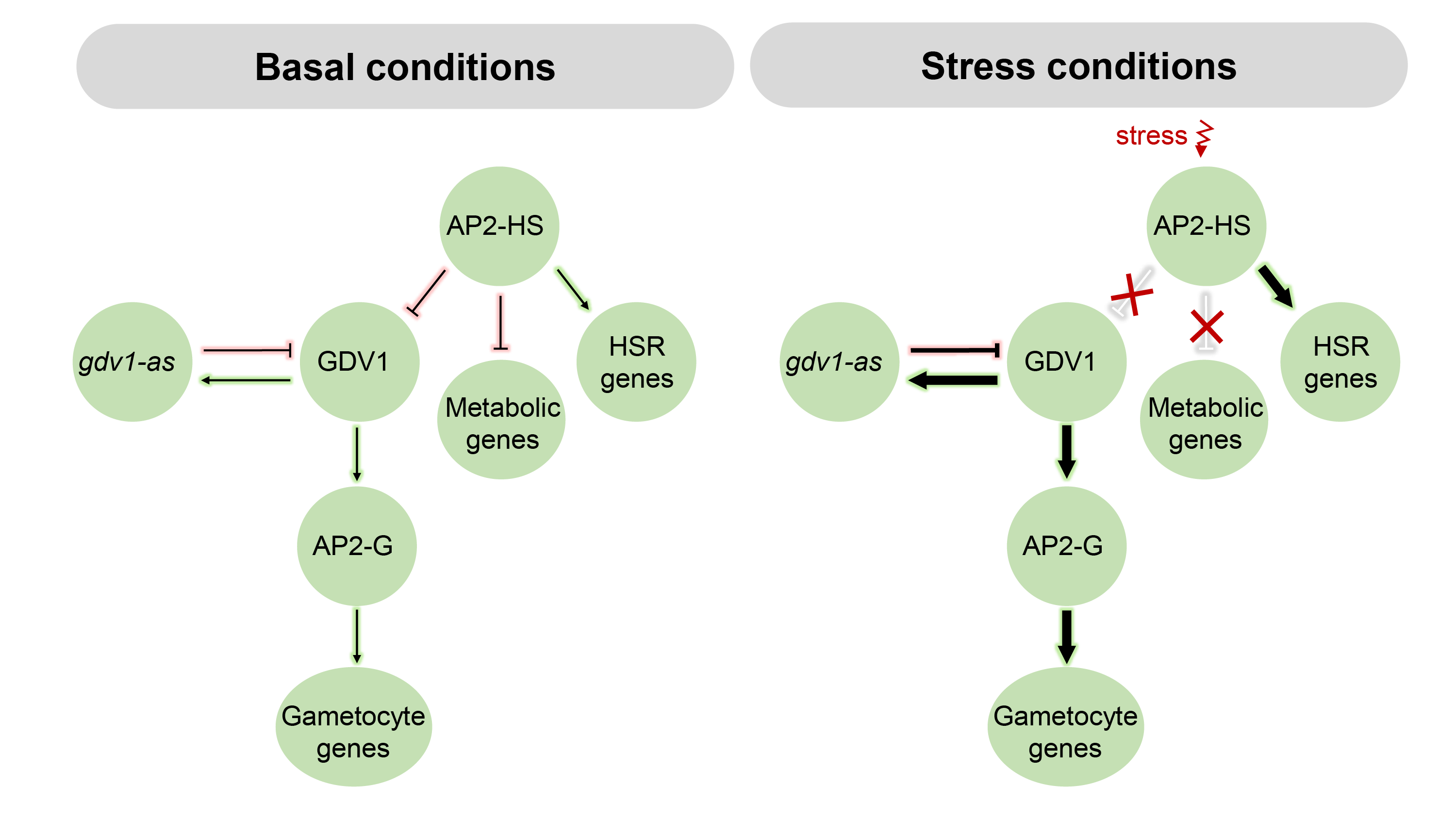
In short, AP2-HS serves as the central hub integrating these distinct environmental warning signals. Intriguingly, we also found that AP2-HS represses a subset of metabolic enzymes, relieving this repression when nutrients become scarce.
Breaking the Transmission Chain
Standard antimalarials are effective at clearing asexual parasites to cure illness, but transmissible gametocytes often survive, allowing transmission to persist. By showing how ap2-hs, gdv1, and gdv1-as form a unified stress-sensing circuit, our study reveals a new molecular target: AP2-HS. If we could target this AP2-HS hub, we could eventually blind the parasite’s stress radar, trapping the parasite in its asexual stage and stopping transmission.
Of course, translating these basic biological insights into real-world interventions is a long-term goal, and whether AP2-HS will prove to be a suitable target remains to be seen. For now, we have plenty of work ahead to fully decode this intricate mechanism and understand every detail of how the parasite decides its fate.
Check out the full manuscript:
If you don’t have access, you can read the full paper here.
Follow the Topic
-
Nature Microbiology
An online-only monthly journal interested in all aspects of microorganisms, be it their evolution, physiology and cell biology; their interactions with each other, with a host or with an environment; or their societal significance.