Global disparities and structural imbalances in AI integration for urban climate resilience research
Published in Earth & Environment and Sustainability

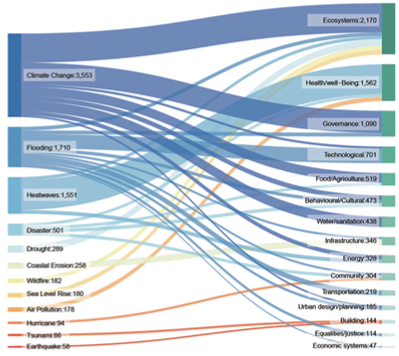


Our research team has found that Artificial intelligence (AI) nowadays holds transformative potential to decode urban climate resilience (UCR) complexities, yet its unguided expansion risks amplifying systemic biases.
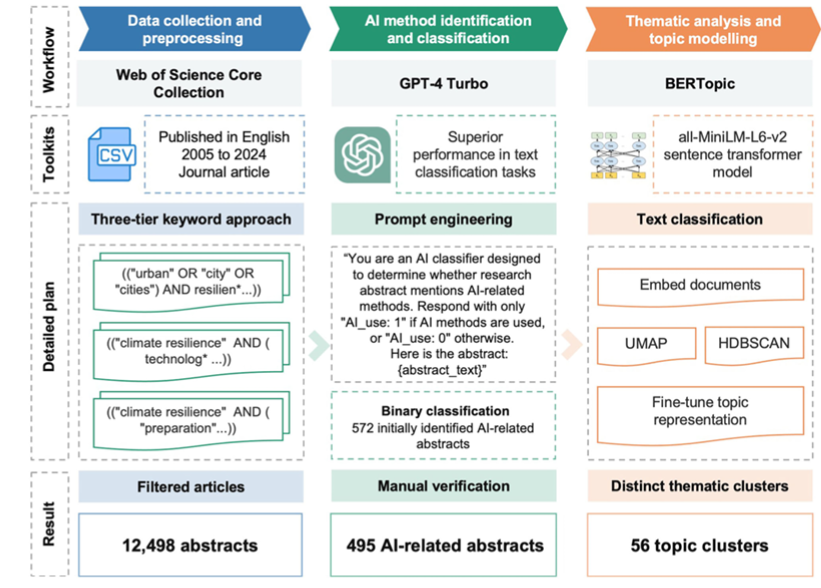
Here, we leverage large language models to conduct a systematic analysis of around 12,500 UCR publications from 2005 to 2024 by using BERTopic mixed with the GPT-4 Turbo plus using the WoS Core platforms (see Figure 1 below).
Our findings in this study reveal a fifteenfold increase in AI-related publications since 2018, yet this growth remains geographically concentrated: the United States, China, and the United Kingdom account for ~40% of AI-integrated studies, featuring a deepening digital divide in both research capacity and geographic focus, which could limit the transferability of AI models to low-income regions.
Crucially, we identify a statistically significant structural imbalance and we explore that - AI is heavily deployed for physical hazard prediction (40%), it remains underrepresented in governance resilience domains (<4%) (See Figure 2 below).
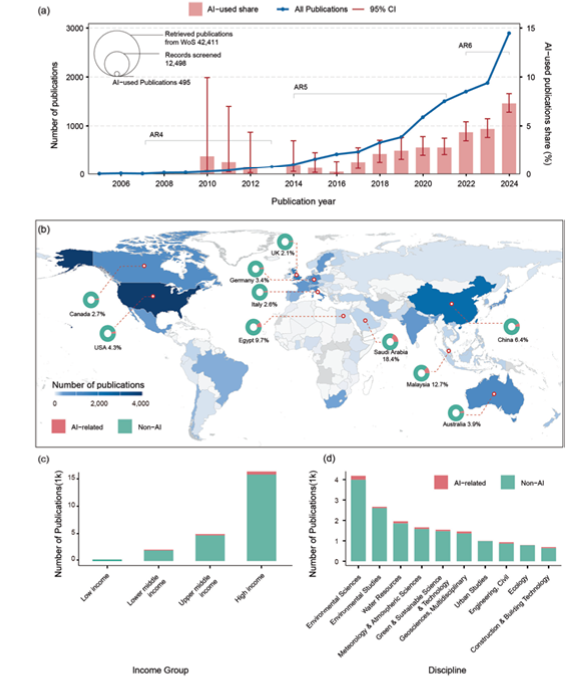
This asymmetry suggests a greater emphasis on quantifiable, engineering-oriented problems than on social-institutional adaptation needs relevant to vulnerable populations.
We argue that bridging this gap requires a pivot from purely data-driven optimisation of physical systems toward human-centricAI paradigms that integrate unstructured socio-economic knowledge.
We would like to ensure that technologies address the holistic needs of complex urban environments.
For details of the paper from us - Mei, Nick, Emlyn, Jianghao and Faith we recommend that you read our full paper here:
Meng, M., Hamm, N.A.S., Yang, L.E. et al. Global disparities and structural imbalances in AI integration for urban climate resilience research. npj Clim. Action (2026). https://doi.org/10.1038/s44168-026-00431-w
or simply use the sharable link provided by the Springer Nature Sharedit system here:
Follow the Topic
-
npj Climate Action
This journal considers research that explores all aspects of mitigating the hazardous effects of global climate change.

What are SDG Topics?
An introduction to Sustainable Development Goals (SDGs) Topics and their role in highlighting sustainable development research.
Continue reading announcementRelated Collections
With Collections, you can get published faster and increase your visibility.
From Minds to Society: Linking Individual, Social, and Political Dynamics for Collective Climate Action
Publishing Model: Open Access
Deadline: Feb 15, 2027
Carbon Dioxide Removal
Publishing Model: Hybrid
Deadline: Jan 16, 2027