Going down the salamander hole: uncovering the world’s oldest salamandrids
Published in Ecology & Evolution



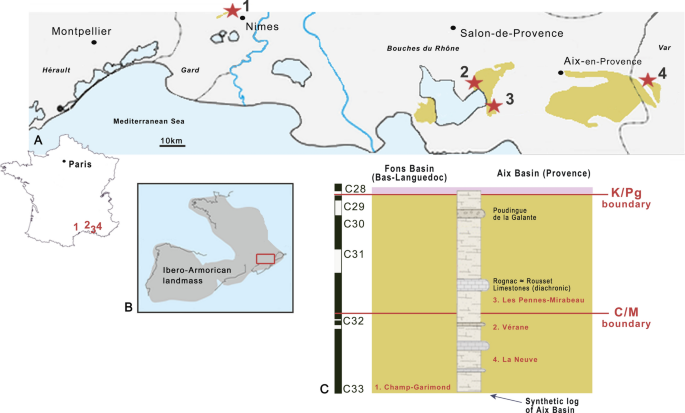

When most people think of the Late Cretaceous, dinosaurs immediately come to mind. For us, however, the story began with much smaller vertebrates: salamanders. Over several years, the team from the PALEVOPRIM laboratory (Poitiers, France) collected material from four Late Cretaceous freshwater localities in southern France: Champ-Garimond, La Neuve, Véranes, and Les Pennes-Mirabeau. These sites, dated between ~78 and 67 million years ago, required extensive fieldwork, sediment processing and careful sorting of thousands of small vertebrate remains. Without the sustained effort of the field teams, these tiny fossils would likely never have been recovered.
This study is therefore a clear example of how palaeontology depends on close collaboration between field collectors and specialists. The fossils must first be found and prepared, often through years of meticulous work, before they can be properly identified and placed in an evolutionary context.
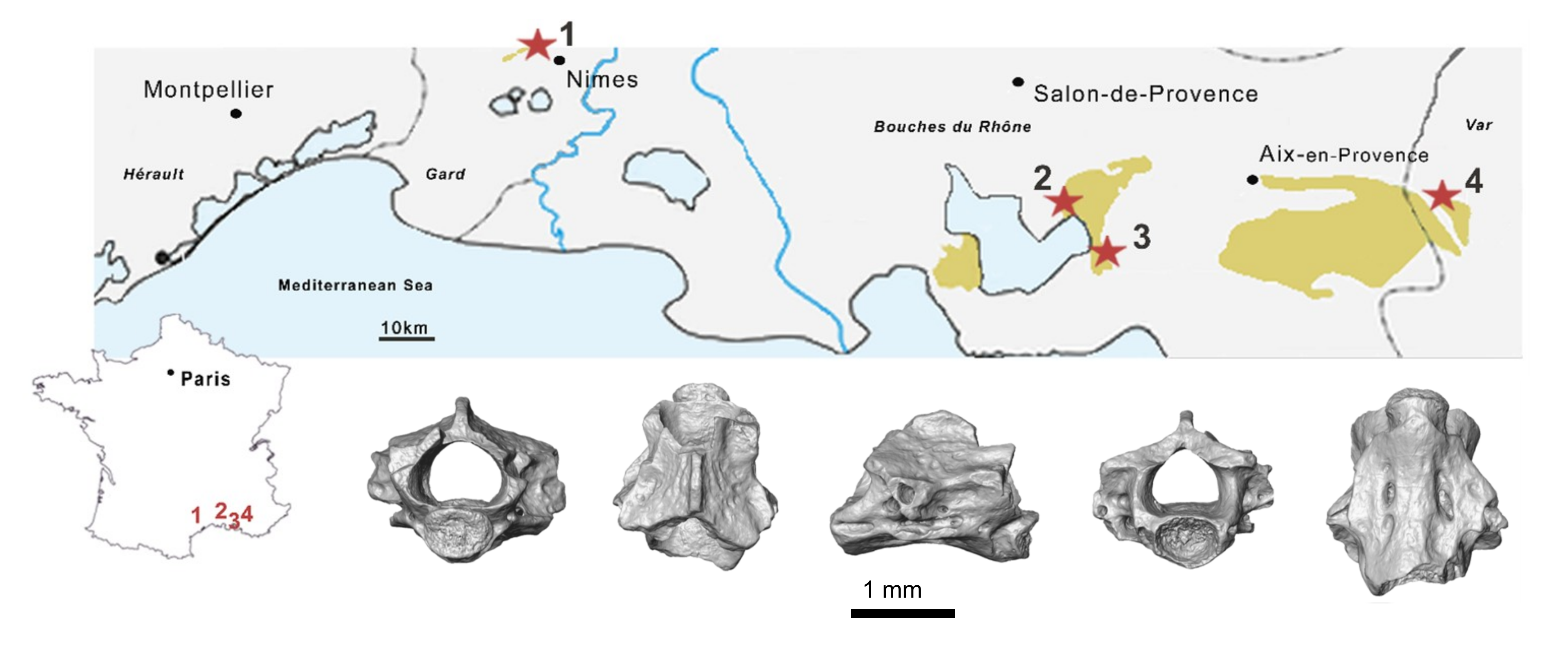
Geographical locations of the four French sites that have yielded Upper Cretaceous salamandrid fossils. 1) Champ-Garimond, 2) La Neuve, 3) Véranes, 4) Les Pennes-Mirabeau. A particularly well-preserved vertebra from the Les Pennes-Mirabeau site was X-ray scanned and is shown at the bottom of the image in anterior, dorsal, lateral, posterior and ventral views.
I came to visit the paleontological collection to see whether there were any interesting remains to study. As is often the case in European collections, isolated salamander fossils are frequently overlooked because of their small size and the difficulty of identifying them taxonomically. Olivier (i.e. Jansen, co-first author of the paper) was working on these Late Cretaceous localities for his PhD at the PALEVOPRIM laboratory, and we quickly understood we formed a great team while working for endless hours at the microscope, between deep taxonomic discussions and great laughs, while examining the material he had previously sorted.
I was immediately struck when I first looked at the vertebrae. I recognised right away the diagnostic characters I had been studying throughout my PhD, focused on identifying fragmentary salamander remains. Years of comparative work suddenly came together: what initially appeared to be unremarkable isolated bones turned out to belong to Salamandridae, including the oldest known representatives of the family, dating back more than 75 million years.
Among the material, the identification of Koalliella was particularly striking. This genus was previously known only from Palaeocene deposits, post-dating the extinction of the dinosaurs. Its occurrence in the Late Cretaceous of France extends its record by about 10 million years. Even more intriguing is its close relationship to Salamandrina, the spectacled salamander, today the only vertebrate genus endemic to Italy. This link provides a rare and direct connection between the deep evolutionary history of salamanders and present-day European biodiversity.


Palaeoartistic reconstruction of Koalliella, an extinct salamandrid from the Late Cretaceous of France, in a puddle of water formed in a dinosaur footprint. Reconstruction by Olivier Jansen, co-lead author of the study (Credit: O. Jansen 2026).
By integrating these fossils into a broader phylogenetic framework, we were able to refine the evolutionary history of Salamandridae. Our results suggest that the family originated in the early Late Cretaceous, at least 83 million years ago, most likely in Western Europe. From there, salamandrids dispersed multiple times, with one lineage reaching North America via northern land connections and others spreading into Asia, likely facilitated by climatic cooling and changing sea levels during the Late Eocene and Oligocene.
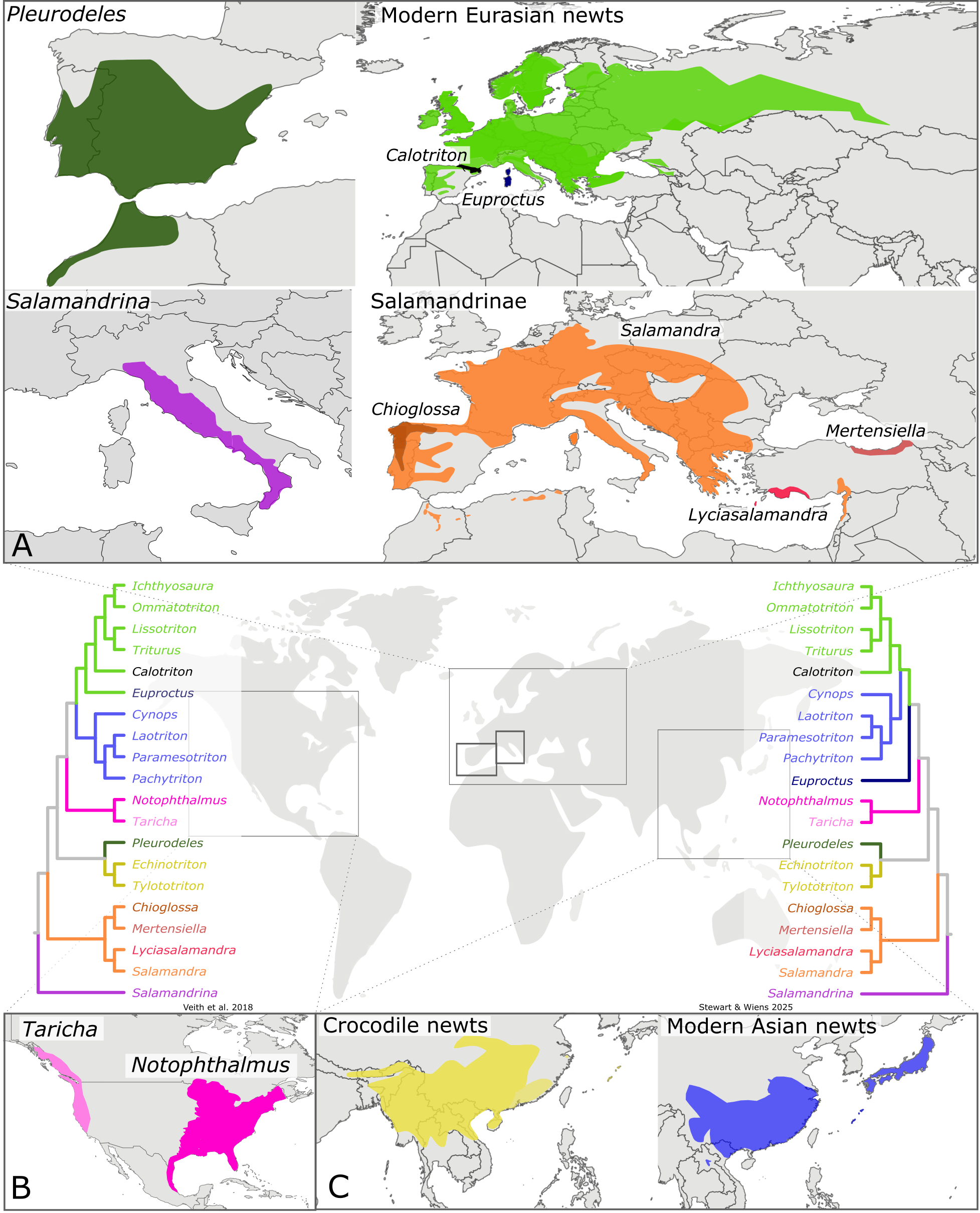
phylogenetic clusters; (B) North America, two genera forming a single phylogenetic cluster; (C)
Southeastern Asia, six genera forming two phylogenetic clusters.
Beyond refining dates and biogeography, this study highlights how fragmentary fossils can still transform our understanding of evolution. Small vertebrae from ancient freshwater environments can carry disproportionate scientific significance when placed in the right analytical framework.
In many ways, this work also reinforces the importance of collaboration across disciplines and institutions. From field excavation to taxonomic expertise and phylogenetic analysis, each step was essential in reconstructing this part of salamandrid history.
Ultimately, this study shows how much remains hidden in the fossil record. Sometimes, all it takes is a handful of vertebrae to take you down a very rewarding salamander hole.
I mainly work on taxonomy, phylogeny and biogeography of fossil salamanders from the Cenozoic. I also worked on the ecological and climatic characterisation of extant and extinct reptiles and amphibians, as well as Paleobotany, Paleobiology and Evolutionary Biology, focusing on macroevolutionary trends.
Follow the Topic
-
Scientific Reports
An open access journal publishing original research from across all areas of the natural sciences, psychology, medicine and engineering.

Related Collections
With Collections, you can get published faster and increase your visibility.
Cancer Prevention and Control
Publishing Model: Hybrid
Deadline: Feb 19, 2027
Healthy Aging
Publishing Model: Open Access
Deadline: Dec 31, 2026