Greener and safer—but who gets to stay?
Published in Earth & Environment and Sustainability




As cities invest in greener neighborhoods, restored wetlands, and safer river corridors, climate adaptation is often framed as an unambiguous public good. In many African cities, where flooding, heat, and environmental stress are intensifying alongside rapid urban growth, that instinct is easy to understand. Yet as we worked on this study, we kept returning to a more difficult question: when urban environments improve, who is actually able to stay—and benefit?
Much of the research on adaptation focuses on physical outcomes—less flood exposure, lower heat, better ecosystem services. These are essential goals. But cities are not only environmental systems. They are also shaped by land markets, housing institutions, tenure arrangements, and unequal access to space. When a neighborhood becomes greener, cooler, or safer, it may also become more desirable. Housing prices can rise. Investment can follow. The social composition of the area can change.
This possibility has long been recognized in urban studies. There is already important work on green gentrification and climate gentrification, much of it based on individual case studies and much of it from the Global North. Our question was whether comparable patterns could be detected at a much larger scale across African cities. At the same time, we wanted to be careful not to impose a concept uncritically. African cities are shaped by hybrid governance, widespread informal tenure, uneven regulatory capacity, and colonial land legacies that still matter today. For that reason, we use the term gentrification dynamics in the paper. It allows us to describe socioeconomic upgrading and possible displacement pressure without assuming that every city follows the same trajectory.
The first challenge was measurement. Administrative records on adaptation are fragmented and often incomplete. A greener satellite image may reflect rainfall rather than a new park. More visible water may reflect seasonal variation rather than a deliberate restoration effort. We therefore used time-series satellite data and focused on sustained structural increases in vegetation and water-related urban features relative to an early baseline. The aim was to capture lasting expansion of green-blue infrastructure, not temporary fluctuation. That may sound like a technical distinction, but it proved central to the credibility of the analysis.
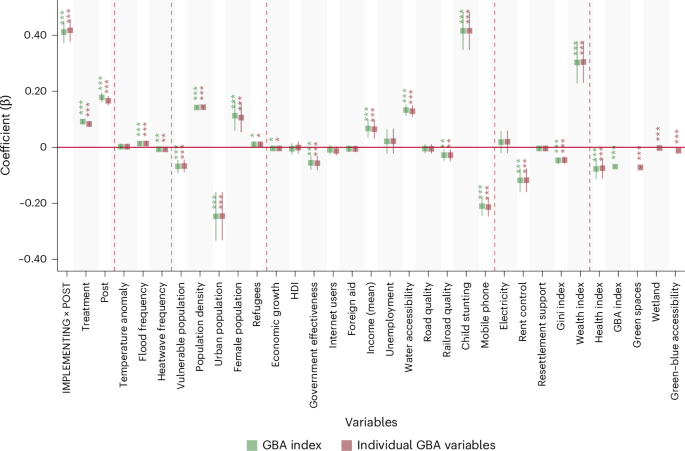
This approach allowed us to study 5,503 municipal administrative areas within 221 urban agglomerations across 32 African countries between 2005 and 2024. We then used a difference-in-differences design—comparing places before and after change over time with places that did not experience the same sustained expansion—to examine how green-blue adaptation was linked to socioeconomic change. Because comparable data on formal evictions or relocations do not exist at this scale, we did not claim to observe displacement directly. Instead, we focused on measurable indicators often associated with early-stage gentrification dynamics, including housing prices, homeownership, income, consumption, population change, and shifts in age structure.
The results show a consistent pattern. Areas exposed to green-blue adaptation saw increases in housing prices, income, household consumption, and homeownership, along with faster population growth and demographic change. Taken together, these findings suggest that climate adaptation is doing more than improving environmental conditions. It is also reshaping urban space in socioeconomic terms.
Some of the most revealing findings emerged when we looked at context. The pressures were stronger in dense urban cores than in lower-density peripheral areas. Policy context also mattered, but not always in the way one might expect. Rent control on its own did not appear to moderate these pressures in any straightforward way. By contrast, municipalities with resettlement support showed smaller increases in gentrification-related indicators. That contrast suggests that the social effects of adaptation are shaped as much by housing and land institutions as by the interventions themselves.
This points to a difficult paradox. The very interventions designed to reduce climate vulnerability and improve urban livability can also generate new forms of socioeconomic pressure if their distributional consequences are ignored. That is not an argument against adaptation. Cities need safer river corridors, restored wetlands, and more vegetation. But adaptation is not socially neutral. Its success cannot be judged only by cooler temperatures, lower flood risk, or ecological gains. It also has to be judged by whether existing residents can remain in place and share in the benefits.
That point feels especially urgent in many African cities, where the residents most exposed to flooding, heat, and environmental degradation often also have the least secure tenure and the weakest protection from rising land values. When resilience investments increase local desirability without stronger safeguards—such as tenure security, housing protection, or other anti-displacement measures—the result can be an uncomfortable pattern: improved environments alongside greater pressure on vulnerable residents.
The broader lesson from this work is simple. Climate adaptation is never only environmental policy. It is also housing policy, land policy, and social policy. If governments, planners, and funders want adaptation to be both effective and equitable, those dimensions need to be built into planning from the beginning rather than added later as an afterthought.
As investment in adaptation accelerates, the question is no longer only whether cities will become greener and safer, but how these changes will reshape urban life. Our findings suggest that these tensions are already visible at scale. The challenge now is to ensure that climate resilience does not come at the cost of deeper urban inequality. When cities become greener and safer, who gets to stay?
Further details are available in our paper published in Nature Cities:
https://www.nature.com/articles/s44284-026-00432-0

Seung Kyum Kim is a Professor at KAIST specializing in urban resilience, climate change adaptation, and environmental justice. He examines how climate risks and adaptation strategies reshape urban systems, with particular attention to inequality, vulnerability, and long-term sustainability. He holds master’s and doctoral degrees from Harvard University and has previously worked at the University of Hong Kong, Harvard University, and in the public sector. His work integrates spatial analytics, remote sensing, and advanced AI and data-driven modeling to address complex urban and environmental challenges. His research explores the unintended social consequences of climate adaptation, including the relationship between green–blue infrastructure and urban gentrification. He has published extensively in leading journals, including Nature Cities and Nature Climate Change, and has led numerous international research projects.
Follow the Topic
-
Nature Cities
This journal aims to deepen and integrate basic and applied understanding of the character and dynamics of cities, including their roles, impacts and influences — past, present and future.

What are SDG Topics?
An introduction to Sustainable Development Goals (SDGs) Topics and their role in highlighting sustainable development research.
Continue reading announcement