Heteroaggregation Governs Nanoplastic Transport Beyond Colloidal Stability
Published in Chemistry, Earth & Environment, and Ecology & Evolution
The DLVO Delusion in Ecotoxicology
If you review the current literature on the environmental transport of micro- and nanoplastics (MNPs), you will find a heavy reliance on classical colloidal physics—specifically, Derjaguin-Landau-Verwey-Overbeek (DLVO) theory. Researchers routinely measure the zeta potential and hydrodynamic diameter of nanoplastics in ultrapure water or simple electrolyte solutions. If the particles exhibit a highly negative surface charge (e.g., < -30 mV), they are declared "colloidally stable." The assumption follows that these plastics will remain suspended indefinitely, traveling vast distances across oceans and river networks.
This is a fundamental thermodynamic and statistical delusion.
The assumption of colloidal stability relies entirely on the premise of homoaggregation—the likelihood of a nanoplastic particle colliding with and adhering to another nanoplastic particle. But natural aquatic systems are not sterile laboratory beakers filled with pristine polymer spheres. They are chaotic, turbid environments packed with Suspended Particulate Matter.
In a real river or estuary, the concentration of natural colloids (clays, silica, iron oxyhydroxides, and natural organic matter) is orders of magnitude higher than the concentration of nanoplastics. Statistically, a nanoplastic particle is millions of times more likely to collide with a natural mineral than with another plastic particle.
Homoaggregation is a laboratory artifact. Heteroaggregation is the inescapable environmental law.
Rewriting the Buoyancy Equation
Understanding heteroaggregation completely resolves one of the greatest mysteries in modern environmental science: the "Missing Plastic Paradox."
Oceanographic surveys routinely report that the amount of plastic floating on the ocean surface is only a tiny fraction (often estimated at <1%) of the total plastic waste known to have entered the marine environment. Where is the remaining 99%?
For years, models failed to account for it because they relied on the intrinsic density of the bulk polymers. Polyethylene and polypropylene have densities lower than seawater (approx. 0.92 g/cm³ vs. 1.02 g/cm³). According to basic physics, they should float forever.
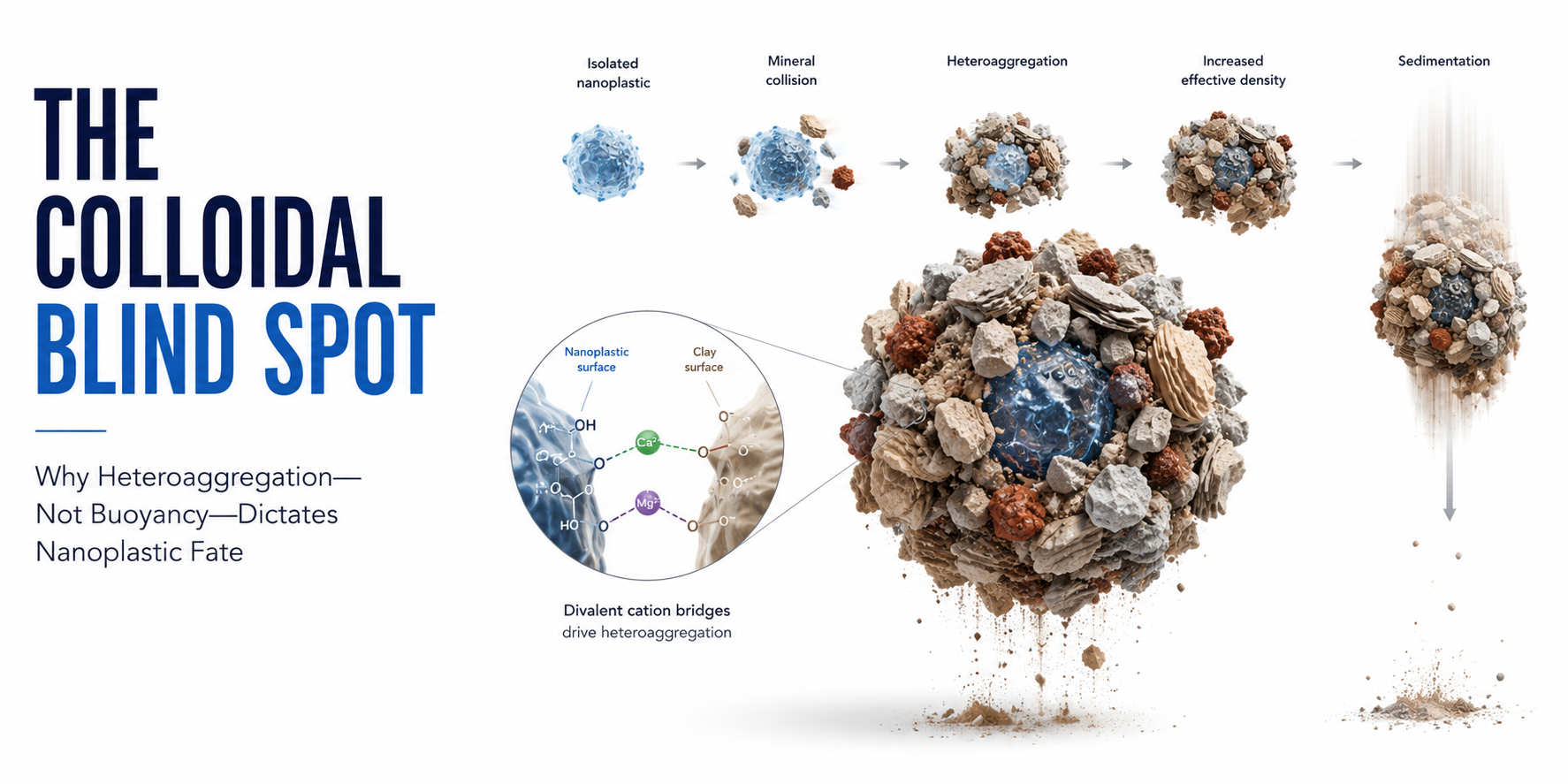
However, when a 100-nanometer polyethylene particle undergoes heteroaggregation with a massive montmorillonite clay particle or a dense silica fragment (density approx. 2.65 g/cm³), the physical identity of the plastic is entirely overridden. The resulting hetero-agglomerate possesses a drastically higher composite density. The buoyancy of the core polymer becomes irrelevant.
The heavy, mineral-plastic agglomerate undergoes rapid sedimentation, raining down through the water column. The "missing" plastic isn't missing at all; it has been dragged down by heteroaggregation into the benthic zone, accumulating in deep-sea sediments and suffocating benthic ecosystems. The ocean surface is merely a transit zone; the true sink is the sediment.
The Divalent Cation Bridge
Heteroaggregation is not a passive process; it is aggressively catalyzed by the natural water matrix.
Many nanoplastics (especially weathered ones with oxygenated functional groups) and natural clay particles both carry net negative surface charges. According to classical DLVO theory, they should repel each other. Yet, they rapidly agglomerate in estuarine and marine environments.
The catalyst is the presence of background divalent cations, specifically calcium (Ca2+) and magnesium (Mg2+). These ions act as molecular anchors. Through a mechanism known as cation bridging, the positively charged divalent ions neutralize the electrostatic repulsion between the negatively charged plastic and the negatively charged clay, physically linking them together. As rivers flow into the highly saline environment of an estuary, this bridging effect is exponentially amplified, triggering massive, rapid heteroaggregation and sedimentation right at the coastal boundary.
Groundwater and Porous Media: The Clogging Effect
The dominance of heteroaggregation is equally critical for hydrogeologists modeling the leaching of nanoplastics into groundwater aquifers.
When nanoplastics infiltrate soil profiles, their mobility is dictated entirely by their interactions with the soil matrix. If nanoplastics bind to mobile natural organic matter (NOM) or mobile humic colloids, they experience "facilitated transport," moving rapidly deep into groundwater reserves and threatening drinking water supplies.
Conversely, if they heteroaggregate with immobile soil grains or larger mineral complexes, they become trapped. This leads to severe pore-clogging within the soil matrix, altering the local hydraulic conductivity and disrupting the natural flow of water and nutrients to plant root systems. Once again, measuring the bare size and zeta potential of the plastic provides virtually no predictive power regarding its subterranean mobility.
The Analytical Shift: Stop Testing in Ultrapure Water
To build predictive models that actually reflect reality, the environmental chemistry community must fundamentally update its analytical protocols.
Publishing the colloidal stability of a new nanoplastic in standard Milli-Q water is no longer sufficient. If we want to understand environmental fate, we must perform heteroaggregation assays using complex, synthetic or natural water matrices containing standard ratios of illite (nonswelling 2:1 clay mineral), montmorillonite, and background electrolytes. We must utilize time-resolved dynamic light scattering to measure the specific attachment efficiency between the plastic and the natural minerals, not just the plastic with itself.
Conclusion
The physical chemistry of the environment is ruthless and highly competitive. In the vast thermodynamic arena of natural waters, nanoplastics are quickly stripped of their idealized, pristine properties. They do not travel as isolated, buoyant spheres; they travel as heavy, complex, mineral-bound agglomerates.
If our global transport models, risk assessments, and environmental policies do not explicitly incorporate the mechanics of heteroaggregation, we will continue to look for nanoscale pollution in all the wrong places. The true fate of nanoplastics is not dictated by the polymer itself, but by the minerals it meets along the way.
#Nanoplastics #Heteroaggregation #EnvironmentalChemistry #ColloidalScience #WaterPollution #Hydrogeology #Oceanography #AdvancedMaterials #Sedimentation #SpringerNature

Dr. Akeem Adeyemi Oladipo is a globally recognized Research Professor of Materials and Environmental Chemistry at Eastern Mediterranean University. Ranked among the world's Top 2% Scientists, his expertise bridges nanotechnology, renewable energy, and electro-analytical chemistry. He specializes in advanced materials synthesis for wastewater treatment, highly sensitive electrochemical biosensors, and solar energy conversion. By integrating machine learning and artificial neural networks, his research drives scalable deep-tech innovations in environmental sustainability and energy storage.