High Polarity Doping of CoFe Layered Hydroxides: Bifunctional and Corrosion‑Resistant Anion Exchange Membrane Seawater Electrolyzers
Published in Chemistry, Materials, and Mechanical Engineering
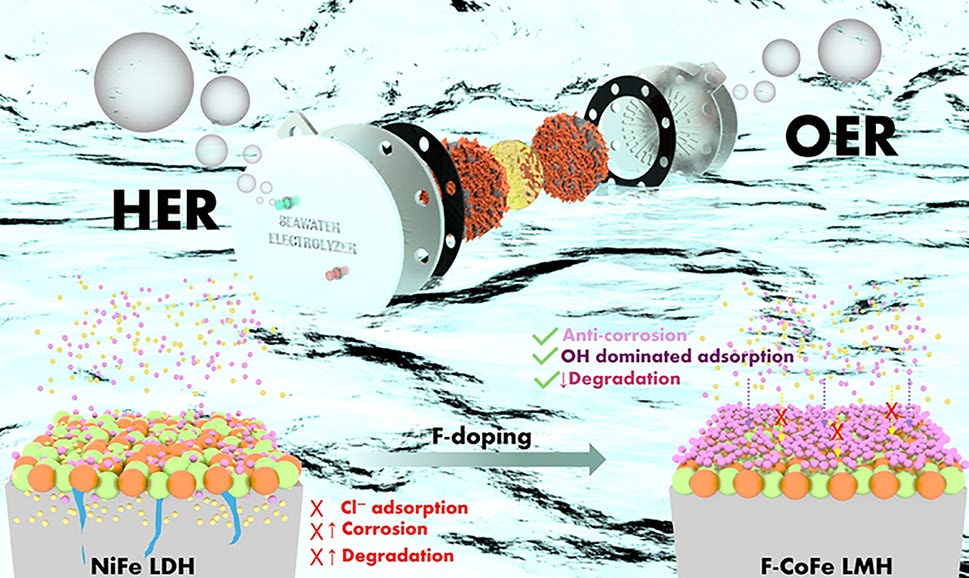

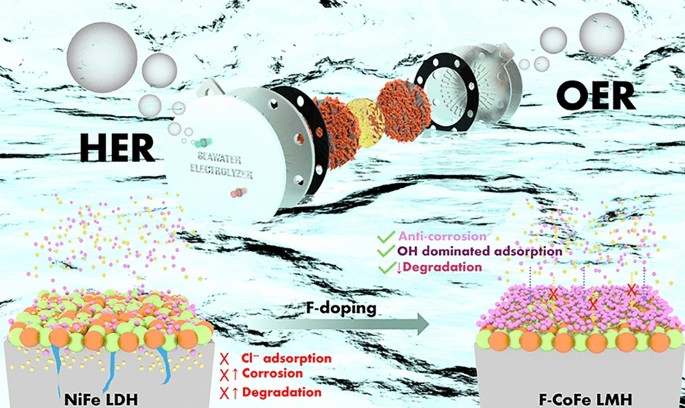

As the global push for green hydrogen accelerates, direct seawater electrolysis stands out as an ideal solution—eliminating freshwater dependency and unlocking a virtually unlimited feedstock. Yet, conventional catalysts face a brutal dual challenge: sluggish oxygen evolution reaction (OER) kinetics and aggressive chloride (Cl⁻) corrosion that rapidly degrades anodes. Now, researchers led by Professor Sang Jae Kim (Jeju National University), Professor Do Hwan Kim (Jeonbuk National University), and their collaborators have unveiled a breakthrough bifunctional catalyst that redefines durability and activity for seawater splitting.
Why This Catalyst Matters
Traditional transition metal hydroxide catalysts suffer from chloride-induced corrosion and surface reconstruction during seawater electrolysis, often limiting operational lifespan to mere hundreds of hours. The novel fluorine-doped cobalt-iron layered metal hydroxide (F-CoFe LMH-8) overcomes these limitations by introducing a "chlorophobic" barrier—actively repelling corrosive Cl⁻ ions while simultaneously accelerating both hydrogen evolution reaction (HER) and OER kinetics in a single material.
Innovative Design and Mechanism
The material is synthesized via a scalable, cost-effective MgO nanoparticle-assisted ion-exchange method, where fluorine acts as a weak-field ligand that selectively occupies Fe-centered coordination sites while preserving Co-based active centers intact. Advanced spectroscopies (XANES, EXAFS, EPR, WT-EXAFS) combined with spin-polarized DFT calculations reveal that F-doping stabilizes high-spin Fe–O configurations, expands the lattice framework (d-spacing increased from 8.10 Å to 8.45 Å), and strengthens metal 3d–oxygen 2p hybridization. Critically, fluorine withdraws electron density from Fe and Co, polarizing the metal–oxygen network and weakening Cl⁻ adsorption energy from −4.092 eV to −2.354 eV—creating a robust chlorophobic shield within the electrochemical double layer that suppresses corrosion while sustaining OH⁻ accessibility.
Outstanding Performance
F-CoFe LMH-8 delivers exceptional bifunctional activity with low overpotentials of merely 81.23 mV for HER and 265.5 mV for OER at 10 mA cm-2, far surpassing undoped counterparts and benchmarking against the best non-precious metal catalysts. The material exhibits dramatically accelerated charge-transfer kinetics (charge-transfer resistance drops from 11.07 Ω to 6.77 Ω for HER and from 11.74 Ω to 3.0 Ω for OER) and a significantly enhanced electrochemically active surface area (204.25 cm2 vs. 134.25 cm2). Notably, it maintains stable performance across 24-hour chronopotentiometry tests at 50–400 mA cm-2 with negligible degradation in both simulated and real seawater.
Applications and Future Outlook
When integrated into an anion exchange membrane water electrolyzer (AEMWE), the F-CoFe LMH-8 device achieves industrial-grade metrics: 1 A cm-2 at merely 2.3 V in real seawater, with an ultralow degradation rate of 0.15 μV h-1 over 500 hours of continuous operation—far surpassing the U.S. DOE technical target of 1 μV h-1. A machine learning-based LSTM model further validates long-term stability forecasting. Gram-scale synthesis confirms the protocol is readily upscalable without performance loss, and the team has already demonstrated solar-PV integration for practical green hydrogen generation.
This work establishes a new paradigm for scalable, corrosion-resistant bifunctional catalysts, opening promising avenues for gigawatt-scale green hydrogen production directly from the ocean.
Stay tuned for more groundbreaking research from this collaborative team at Jeju National University, Jeonbuk National University, and partner institutions across Korea and India!

Editor of Nano-Micro Letters, which is an Open-Access, peer-reviewed journal reported papers that have at least one dimension ranging from a few sub-nanometers to a few hundreds of micrometers. The journal is published by Springer Nature and indexed by SCI, EI, SCOPUS, Pubmed, etc. The 2025 JCR Impact Factor is 38.5. The 2025 CiteScore is 58.9.
Follow the Topic
-
Nano-Micro Letters
Nano-Micro Letters is a peer-reviewed, international, interdisciplinary and open-access journal that focus on science, experiments, engineering, technologies and applications of nano- or microscale structure and system in physics, chemistry, biology, material science, and pharmacy.