How climate change and deforestation interact in the transformation of the Amazon rainforest
Published in Earth & Environment



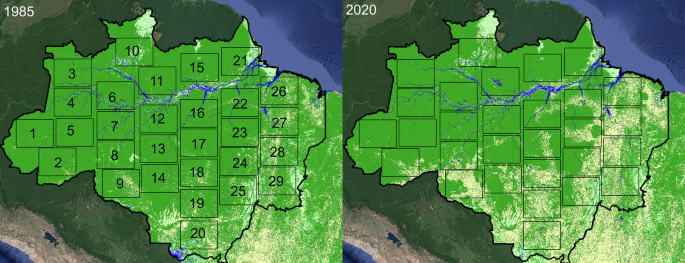

Using 35 years of satellite and atmospheric data, researchers analyzed 29 regions across the Brazilian Amazon. By combining a statistical approach with function parametrization, they successfully separated the impacts of deforestation from those of global climate change.
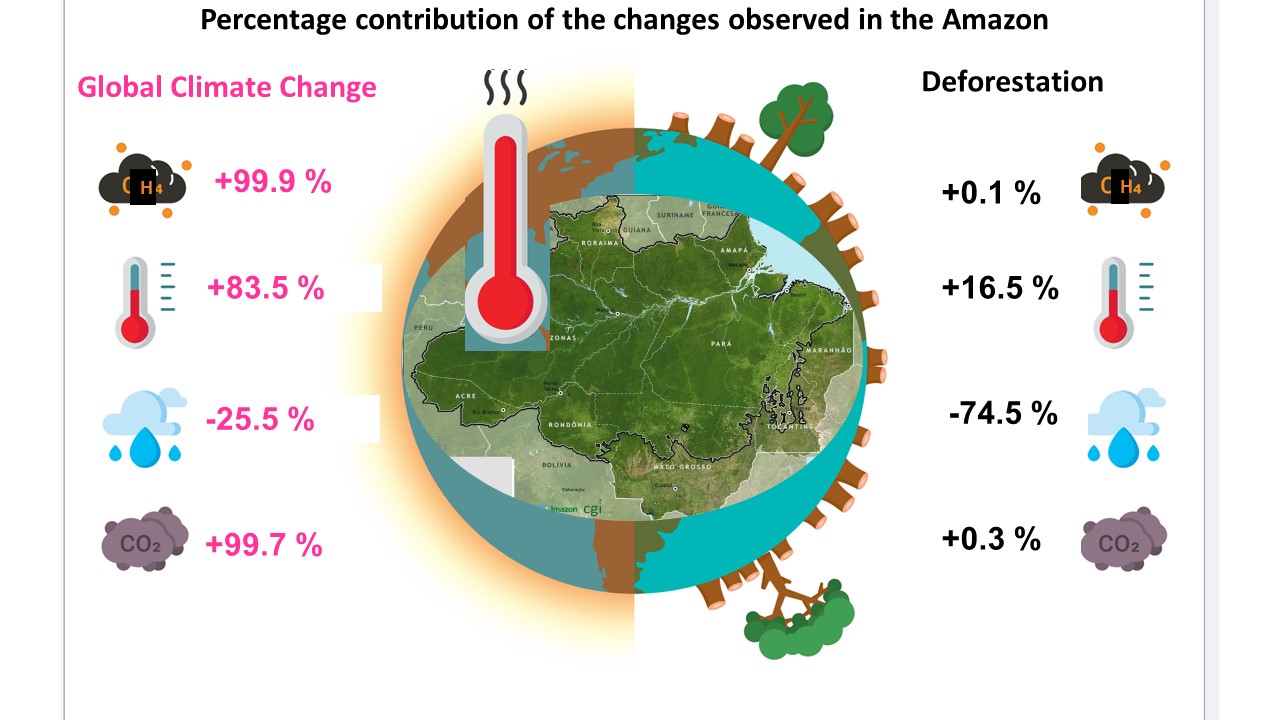
Their findings indicate that while global emissions overwhelmingly drive the increase in greenhouse gases like CO₂ and CH₄ and temperature, deforestation is the dominant factor altering precipitation. Between 1985 and 2020, the Amazon’s dry season became warmer and drier, and deforestation accounted for 74% of the rainfall reduction and 16.5% of the temperature rise.
The results show that the most severe climatic disruptions occur at the beginning of the deforestation process. Losing between 10% and 40% of forest cover can lead to a significant decrease in rainfall and a sharp temperature rise. This means that preventing even minor additional deforestation is crucial to maintaining the stability of the Amazon.
Without action, deforestation will continue unabated. Projections suggest that the region could face an additional 0.6°C of warming and a further decrease of 7 mm in rainfall per dry season by 2035, which would push the Amazon ecosystem towards increasingly unstable states.
These findings underscore the importance of maintaining and restoring forest cover in the Amazon as a crucial strategy for mitigating climate change and ensuring the stability of ecosystems..
Percentage share of global climate change and deforestation in driving changes in greenhouse gases (methane and carbon dioxide), maximum surface air temperature, and precipitation across the Amazon during the dry season.

Luiz Machado has experience in meteorology and expertise in Amazonas and field campaigns. He has worked mainly in the following areas: remote sensing, convection, climatology, convective systems, nowcasting, and atmospheric chemistry. B.Sc. in Meteorology (1981) and Master in Meteorology at the University of São Paulo (1984), Diplôme d'études Approfondies Oceanologie Meteorologie - (1989) and PhD in Meteorology and Oceanography (1992) at the University of Paris VI at Pierre et Marie Curie. Visiting researcher at NASA/GISS and LMD/France. Visiting scientist at the Max Planck Institute for Chemistry and the Instituto de Física da Universidade de São Paulo. Luiz Machado has been Head of the Satellite Department and Coordinator of the CPTEC of the National Institute of Space Research, Chairman of the Expert Team on Satellite Applications of the WMO, member of the GEWEX Radiation Panel and the International Commission on Clouds and Precipitation, Rapporteur of the WMO Space Programme in RA III. He was the coordinator of the CHUVA project and co-PI of GoAmazon, ACRIDICON, and CAFE-Brazil.
Follow the Topic
-
Nature Communications
An open access, multidisciplinary journal dedicated to publishing high-quality research in all areas of the biological, health, physical, chemical and Earth sciences.

Related Collections
With Collections, you can get published faster and increase your visibility.
Women's Health
Publishing Model: Hybrid
Deadline: Ongoing
Tumor Microenvironment Crosstalk and Therapeutic Implications
Publishing Model: Hybrid
Deadline: Nov 02, 2026