How do structural change patterns differ across countries? Evidence from long‑term systemic dynamics
Published in Social Sciences, Sustainability, and Mathematics







This article hypothesizes that the structural change (SC) tendency may manifest across different economies, regardless of their respective levels of development, in a manner analogous to the stagnation and reversal trends. To address this issue, the study examines SC patterns in 147 economies from 2000 to 2021 using unsupervised machine learning techniques (MLTs), grounded in the system approach to SC.
This study integrates a system approach to structural change, taking the structural tendencies as the core analytical unit. This approach extends beyond the traditional analysis of factor movements between sectors; instead, it suggests that the SC process emerges from the interaction of system components, undergoing qualitative and quantitative alterations manifested in a subjacent tendency toward an SC or its constraint.
How are structural change patterns unveiled?
This article infers SC patterns associated with countries' proneness to structural transformation, as well as their stagnation and reversal.
In this context, the application of unsupervised MLTs facilitates the uncovering of fundamental properties in the data and captures multidimensional latent dynamics. On the one hand, principal component analysis (PCA) provides a novel factor approach, in which the latent dimensions capture the maximum variance of key variables and reflect countries' structural tendencies.
This article frames these latent dimensions within the system approach to structural change (Salinas, 2025; Salinas & Zhang, 2025, 2026), including the multilateral contributions regarding human development, productive capacities, competitive industrial performance, the Sustainable Development Goals (SDGs), and other policy-oriented theoretical perspectives.
On the other hand, cluster analysis (CLA) identifies similarities among countries based on their alignment with SC patterns, their progress in reducing gender inequality, and their trends in planetary pressures.
What is the relevance of this study for the fields of structural change and development economics?
The relevance for the fields of SC and development economics lies in the estimation of two key dimensions that enable inference about countries' structural tendencies, thereby facilitating the identification of four distinct SC patterns. Moreover, these latent dimensions are used to perform a CLA that contrasts countries' trajectories in reducing gender inequalities and planetary pressures. CLA identifies three clusters, each providing factual evidence, structural challenges, and development guidelines for different groups of countries.
Latent dimensions:
The application of PCA identified two latent dimensions that encapsulated the structural tendencies underlying countries' systemic evolution. The first latent dimension corresponds to human development, synergic complementarities, complexity, and diversification progress (HDSCD). This dimension encompasses the dynamics of social, productive, and synergistic factors that shape developmental trajectories. The variables composing it tend to decelerate as countries reach high levels. Similarly, the HDSCD captures the systemic slowdown processes in developing economies (Salinas, 2025; Salinas & Zhang, 2025).
Instead, the structural change and institutional enhancement dimension (SCI) reflects countries' advancements in manufacturing, including both domestic production and international trade. It additionally reflects the progress of manufacturing activities in terms of their sophistication, productivity, and international competitiveness, as well as shifts in institutional governance (Salinas, 2025; Salinas & Zhang, 2025).
Both dimensions are expressed as normalized. Positive values indicate systemic evolution in the corresponding latent dimension (either HDSCD or SCI) over the period analyzed, whereas negative values indicate systemic downgrade, stagnation, or slowdown.
Structural change patterns:
Based on the interaction between the two latent dimensions, four structural change patterns are identified:
Pattern 1 includes countries experiencing systemic evolution in both dimensions (HDSCD>0 and SCI>0).
Pattern 2 comprises countries undergoing systemic decline or stagnation in SCI and deceleration in HDSCD (HDSCD<0 and SCI<0).
Pattern 3 characterizes countries exhibiting advancement in SCI and deceleration in HDSCD (HDSCD<0 and SCI>0).
Pattern 4 includes countries displaying a decline in SCI but systemic evolution in HDSCD (HDSCD>0 and SCI<0).
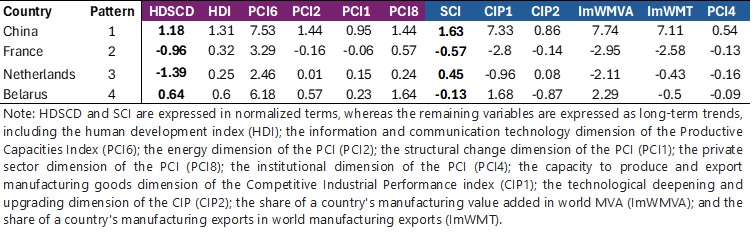
To illustrate, China belongs to Pattern 1, as both latent dimensions demonstrate strong dynamism (HDSCD = 1.18; SCI = 1.63); France falls into Pattern 2, with both latent dimensions exhibiting decline, stagnation or deceleration (HDSCD = -0.96; SCI = -0.57); Netherlands represents Pattern 3, showing significant progress in SCI alongside deceleration in HDSCD (HDSCD = -1.39; SCI = 0.45). Finally, Belarus exemplifies Pattern 4 with systemic evolution in HDSCD and declines in SCI (HDSCD = 0.64; SCI = -0.13).
As illustrated in the table below, the latent dimensions capture the aggregate dynamics of their underlying variables, expressed as long‑term growth rates for the period 2000–2021. Positive values indicate outstanding dynamism relative to the sample examined, whereas negative values in HDSCD indicate below-average slowdowns, and negative values in SCI capture stagnation and decline.
It is worth noting that in advanced economies, HDSCD tends to decelerate (yielding negative values) as its underlying variables reach mature levels, whereas in developing economies, negative values reflect systemic stagnation or downgrade.
Clusters:
The CLA revealed three clusters according to SC patterns, gender, and environmental results.
Cluster 1: Comprises countries that have demonstrated exemplary performance in HDSCD and SCI while exhibiting a moderate rate of reduction in gender inequality and experiencing the highest growth in planetary pressures. This cluster comprises 58 countries.
Cluster 2: Countries exhibit moderate SCI dynamism and the slowest HDSCD growth. However, they demonstrate exemplary performance in reducing gender inequalities and are effective in mitigating planetary pressures. The number of countries in this cluster is 52.
Cluster 3: Comprises countries with exemplary dynamics in the HDSCD but that suffer a setback in the SCI. These countries have also demonstrated the lowest performance in reducing gender inequality yet are prone to reducing planetary pressures. This cluster includes 37 countries.
CLA delineates developmental challenges and guidelines for the SC patterns and clusters to which each country belongs.
Highlights:
In sum, this article identifies SC patterns that delineate policymaking challenges to promote systemic transformation or reverse its decline. These findings provide empirical insights into development trajectories across a representative sample of countries.
The incorporation of gender and sustainability into the structural change discussion enriches development strategies aimed at achieving the SDGs.
The dynamic and long‑term perspective offers novel insights by identifying reliable benchmarks derived from the empirical experiences of countries facing similar structural conditions.
References:
Salinas, J. (2025). Unveiling structural change patterns: An unsupervised machine learning approach to long-term dynamics. Humanities and Social Sciences Communications, 12(1). https://doi.org/10.1057/s41599-025-05128-9
Salinas, J., & Zhang, J. (2025). Unveiling Structural Change Determinants: A Machine Learning Approach to Long-Term Dynamics. Socio-Economic Planning Sciences, 101, 102290. https://doi.org/10.1016/j.seps.2025.102290
Salinas, J., & Zhang, J. (2026). Unveiling the Determinants of Competitive Industrial Performance Index (CIP) Evolution: A Machine Learning Approach to Midterm Dynamics. Computational Economics. https://doi.org/10.1007/s10614-025-11246-y

I hold a Ph.D. in Economics from Huazhong University of Science and Technology and a Magister Scientiae in Economic Policy from the International Center of Economic Policy (National University, Costa Rica). Additionally, I earned a Bachelor of Science in Economics from the University of El Salvador.
My research interests focus on applied economics, including development economics, structural change, international economics, economic policy, and machine learning, with articles published in high‑impact journals (SSCI-Q1/Q2). Currently, I serve as Head of the Doctoral Program in Economic Sciences at the University of El Salvador, where I have also taught a range of undergraduate and graduate courses in economics, economic policy, and international trade.
My career in El Salvador has included senior government positions such as Deputy Minister of Economy for Foreign Trade, economic advisor to the Salvadoran Parliament, and specialist in economic policy areas, including drug price regulation, fiscal policy, and social policy.
Follow the Topic
-
Humanities and Social Sciences Communications
A fully open-access, online journal publishing peer-reviewed research from across—and between—all areas of the humanities, behavioral and social sciences.

What are SDG Topics?
An introduction to Sustainable Development Goals (SDGs) Topics and their role in highlighting sustainable development research.
Continue reading announcementRelated Collections
With Collections, you can get published faster and increase your visibility.
Environmental advocacy: psychological and behavioural dynamics
Publishing Model: Open Access
Deadline: Nov 25, 2026
Tourists, go home? Sustainable tourism in popular destinations
Publishing Model: Open Access
Deadline: Dec 18, 2026