How Integrated Nutrient Management Improves Dahlia Growth, Flower Quality, and Soil Health
Published in Sustainability and Agricultural & Food Science
Explore the Research

Integrated nutrient management’s impact on Dahlia cultivation (Dahlia variabilis L.) cv. Zail Singh :: BioResources
Dahlia (Dahlia variabilis L.) is one of the most popular ornamental flowering plants worldwide, valued for its diverse flower forms, vibrant colours, and extensive use in landscaping, cut flower production, and loose flower markets. Originating from Mexico and belonging to the family Asteraceae, dahlias have gained significant commercial importance, particularly in countries such as the Netherlands, which exports millions of tubers annually. With the growing demand for high-quality ornamental flowers, there is an increasing need to adopt cultivation practices that enhance flower quality while maintaining long-term soil health.
Nutrient management plays a crucial role in achieving these objectives. Conventional reliance on chemical fertilizers often results in rapid nutrient availability but may negatively impact soil structure, microbial activity, and environmental quality over time. In contrast, Integrated Nutrient Management (INM)—the combined use of inorganic fertilizers, organic manures, and bio-fertilizers—offers a sustainable approach by supplying nutrients efficiently while improving soil fertility and biological activity. Despite its proven benefits in several floricultural crops, limited research has focused on INM practices in dahlia, particularly under subtropical conditions.
This blog summarizes findings from a systematic field experiment conducted to evaluate how INM influences vegetative growth, flowering behaviour, and soil health in Dahlia variabilis L. cv. Zail Singh.
What Was Done: Overview of the Study
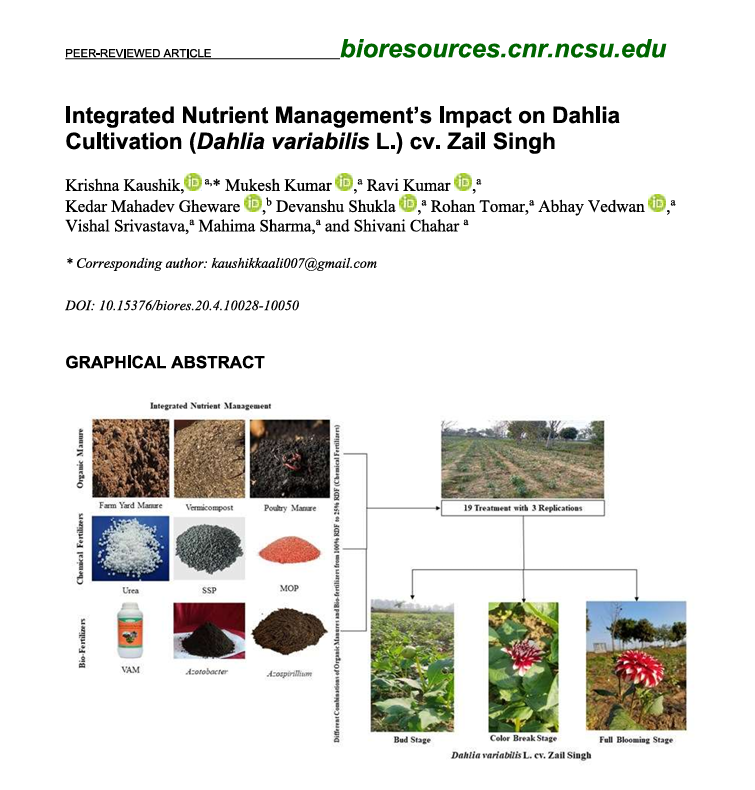
The experiment was carried out during the winter season of 2022–2023 at the Horticultural Research Centre, Sardar Vallabhbhai Patel University of Agriculture and Technology (SVPUA&T), Meerut, India. The study followed a Randomized Complete Block Design (RCBD) comprising 19 nutrient treatments with three replications.
Different combinations of:
-
Chemical fertilizers (recommended dose of fertilizers, RDF),
-
Organic manures such as farmyard manure, poultry manure, and vermicompost, and
-
Bio-fertilizers including Azotobacter, Azospirillum, and vesicular arbuscular mycorrhizae (VAM)
were evaluated to determine their effects on plant growth, flowering traits, and soil properties.
The primary objective was to assess whether reducing chemical fertilizer inputs and integrating them with organic and biological sources could enhance dahlia performance in a sustainable manner.
Key Findings: How INM Influenced Dahlia Performance
Improved Vegetative Growth
The results clearly showed that INM treatments significantly enhanced vegetative growth compared to sole application of chemical fertilizers. Among all treatments, 50% RDF + poultry manure + Azotobacter + VAM performed best for several growth parameters. Plants under this treatment recorded the highest number of primary branches, larger leaf area, improved leaf area index, and higher chlorophyll and nitrogen indices. These improvements indicate better nutrient uptake and enhanced photosynthetic efficiency.
Such responses can be attributed to the synergistic effect of organic manures, which improve soil structure and microbial activity, along with bio-fertilizers that enhance nutrient availability and root development.
Enhanced Flower Quality and Yield Attributes
Flowering behaviour was also markedly influenced by integrated nutrient application. While 50% RDF + 0.82 ton/ha PM + 4 Kg/ha Azotobacter + 4.50 L/ha VAM excelled in overall plant vigour and flowering attributes, 25% RDF + vermicompost + Azospirillum + VAM recorded the largest stem diameter, stalk diameter, and flower size. This suggests that even with a substantial reduction in chemical fertilizers, superior flower quality can be achieved through appropriate organic-biological combinations.
Certain treatments were associated with specific advantages:
-
Early colour break was observed under 75% RDF + 0.83 ton/ha VC + 2 Kg/ha Azospirillium + 4.50 L/ha VAM,
-
Extended vase life was achieved under 50% RDF + 1.6 ton/ha VC + 4 Kg/ha Azotobacter + 4.50 L/ha VAM,
-
Improved flower size and structural strength were noted under reduced RDF combined with vermicompost and bio-fertilizers.
These findings highlight that INM not only increases flower yield but also enhances market-preferred quality traits.
Positive Impact on Soil Health
One of the most important outcomes of this study was the improvement in soil properties under INM treatments. Treatments such as 75% RDF + 0.41 ton/ha PM + 2 Kg/ha Azotobacter + 4.50 L/ha VAM and 25% RDF + 2.5 ton/ha VC + 6 Kg/ha Azospirillium + 4.50 L/ha VAM significantly increased available nitrogen, phosphorus, and potassium in the soil, while 25% RDF + 7.5 ton/ha FYM + 6 Kg/ha Azotobacter + 4.50 L/ha VAM and 25% RDF + 7.5 ton/ha FYM + 6 Kg/ha Azospirillium + 4.50 L/ha VAM improved soil organic carbon, electrical conductivity, and pH balance.
In contrast, the control treatment receiving 100% chemical fertilizers consistently recorded lower values for most soil and plant parameters. This reinforces concerns about long-term dependence on inorganic fertilizers and emphasizes the role of organic inputs in sustaining soil fertility.
Why These Results Matter
The findings of this study have important implications for ornamental horticulture, particularly for growers aiming to balance productivity with sustainability. The results demonstrate that:
-
Chemical fertilizer doses can be reduced by 25–50% without compromising growth or flower quality.
-
Integration of organic manures and bio-fertilizers improves nutrient use efficiency.
-
Soil health benefits achieved through INM contribute to long-term productivity.
For commercial dahlia growers, adopting INM practices can reduce input costs, improve flower quality, and support environmentally responsible cultivation. From a broader perspective, such practices align with sustainable agriculture goals by minimizing nutrient losses, enhancing soil biological activity, and reducing environmental pollution.
Conclusion
This study clearly demonstrates that Integrated Nutrient Management is a viable and sustainable strategy for dahlia cultivation under subtropical conditions. Among the tested treatments, 50% RDF + poultry manure + Azotobacter + VAM emerged as the most effective for improving vegetative growth and flowering performance, while 25% RDF + 2.5 ton/ha VC + 6 Kg/ha Azospirillium + 4.50 L/ha VAM was particularly effective in enhancing flower size and structural attributes.
Overall, integrating organic manures and bio-fertilizers with reduced levels of chemical fertilizers not only improved plant performance but also enhanced soil health, making INM a promising approach for sustainable ornamental horticulture. These findings contribute valuable insights to the limited body of research on INM in dahlia and encourage wider adoption of integrated nutrient strategies among floriculture practitioners.
Selected References
-
Bhattacharjee, S. K., Vinayananda, S., & De, L. (2019). Dahlia. Advances in Ornamental Horticulture.
-
Chaudhary, S. et al. (2020). Effect of integrated nutrient management on flowering and flower yield of dahlia. Journal of Pharmacognosy and Phytochemistry.
-
Wararkar, S. M. et al. (2020). Effect of integrated nutrient management on growth and flowering of dahlia. Plant Archives.
-
Wu, W., & Ma, B. (2015). Integrated nutrient management for sustaining crop productivity. Science of the Total Environment.
-
Rajaselvam, M. et al. (2024). Effect of INM on growth and flower yield of tuberose. International Journal of Plant and Soil Science.
"DOI: 10.15376/biores.20.4.10028-10050"

I am currently serving as an Assistant Professor at the Meerut Institute of Technology, Meerut. I have also served as a peer reviewer for reputable scientific journals, reviewing three manuscripts in agriculture and plant sciences. I hold a Ph.D. in Horticulture with a specialization in Floriculture and Landscaping Architecture, reflecting a strong academic foundation and a commitment to advancing agricultural sciences.
With a distinguished academic and research profile, I have received three prestigious international awards recognizing my scientific contributions, and I hold three patents that demonstrate my innovative approach and dedication to developing practical horticultural solutions. My scholarly output includes 24 research and review papers published in reputed national and international journals, 27 popular science articles, 11 book chapters, and authorship of 8 books—collectively showcasing my expertise and passion for knowledge dissemination.
Beyond publications, I have actively participated in 15 national and international conferences, where I presented my research, shared insights, and collaborated with experts from across the world. My commitments also extend beyond academics, as reflected in my Course on Computer Concepts (CCC) certification, 6 Month DLC (diploma in Landscaping in CAD), and National Service Scheme (NSS) participation, highlighting both my technical proficiency and dedication to community service.
Follow the Topic
What are SDG Topics?
An introduction to Sustainable Development Goals (SDGs) Topics and their role in highlighting sustainable development research.
Continue reading announcement