Kitchen Waste as a Nutrient-Dense Organic Manure: An Underutilized Resource for Sustainable Agriculture
Published in Agricultural & Food Science

Turning Household Refuse into a High-Value Nutrient Resource
With the growing emphasis on sustainable agriculture and circular bioeconomy, organic nutrient sources are gaining renewed attention. Among them, kitchen waste—often dismissed as mere household refuse—stands out as a surprisingly nutrient-dense and biologically active organic manure, frequently outperforming traditional farmyard manures, composts, and crop residues.
This blog explores why kitchen waste deserves recognition as a superior organic nutrient source and how it can play a critical role in sustainable soil and crop management.
Nutrient Richness: A Matter of Origin
Kitchen waste primarily consists of vegetable peels, fruit residues, cooked food remnants, eggshells, tea waste, and cereal by-products. These materials originate directly from edible plant and animal sources and therefore contain readily available nutrients.
Nutrient composition (% dry weight basis) of commonly used organic nutrient sources
| Organic source | Nitrogen (N, %) | Phosphorus (P₂O₅, %) | Potassium (K₂O, %) |
|---|---|---|---|
| Farmyard manure (FYM) | 0.5–1.0 | 0.2–0.4 | 0.5–0.8 |
| Crop residues | 0.3–0.8 | 0.05–0.2 | 0.8–1.5 |
| Vermicompost | 1.0–1.5 | 0.5–0.9 | 0.8–1.2 |
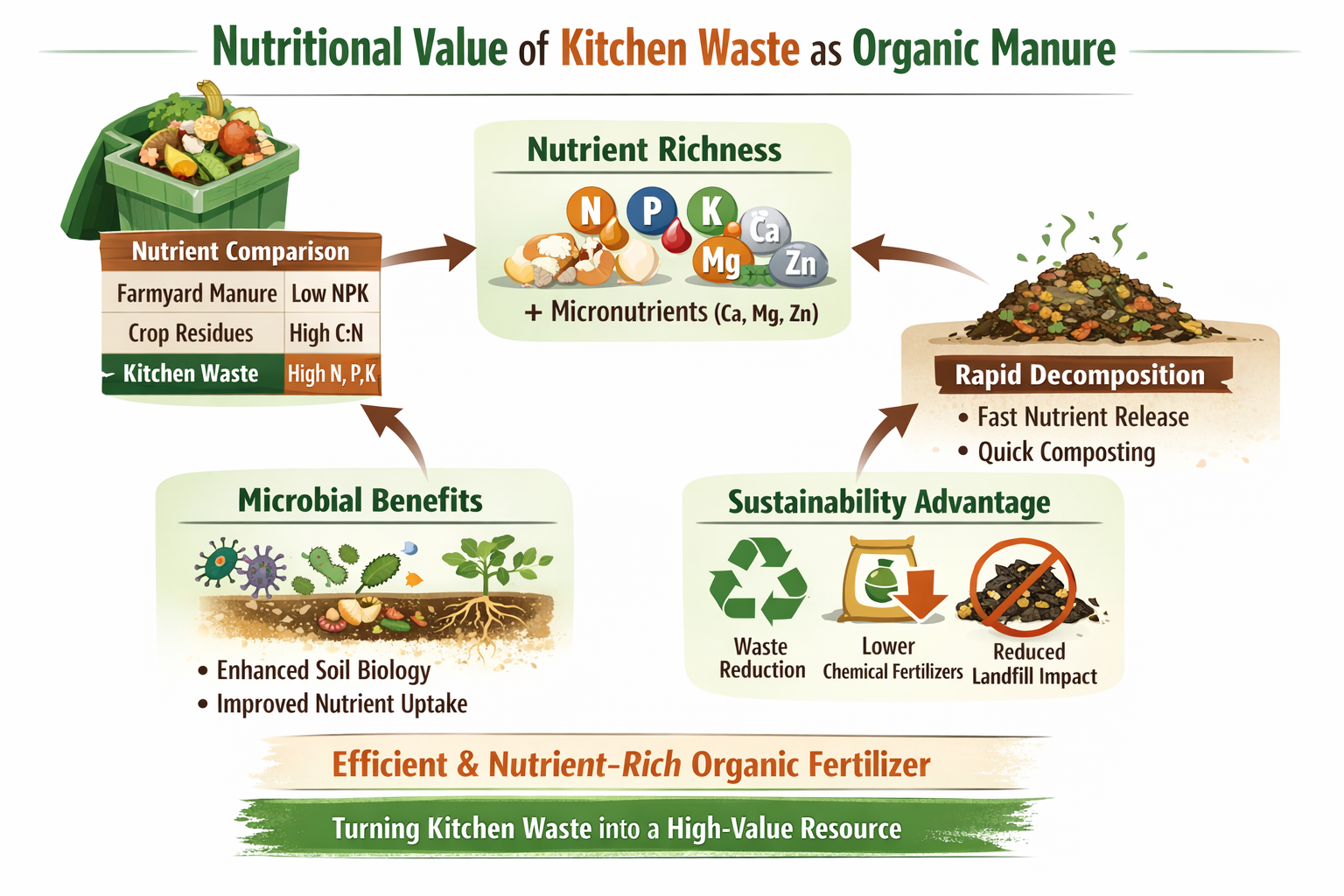
| Kitchen waste (composted) | 1.5–2.5 | 0.5–1.5 | 1.0–2.0 |
Note: Nutrient contents vary with source material, decomposition method, and environmental conditions. Values represent commonly reported ranges on a dry weight basis.
Kitchen waste typically contains:
- Higher nitrogen (N) due to protein residues
- Available phosphorus (P) from food grains and legumes
- Potassium (K) from vegetable and fruit peels
- Micronutrients such as Ca, Mg, Fe, and Zn
Faster Decomposition and Nutrient Release
Unlike straw-based or animal manures, kitchen waste has:
- Low lignin content
- Soft cellular structure
- Higher moisture
These properties result in rapid microbial breakdown, allowing nutrients to become available to plants much faster. When composted properly, kitchen waste transforms into a stable, humus-rich amendment within weeks rather than months.
This makes it particularly effective for:
- Short-duration vegetables
- Leafy greens
- Urban and peri-urban horticulture
- Container and rooftop gardening
Enhanced Microbial and Enzymatic Activity
Kitchen waste compost stimulates soil biological health more effectively than many traditional manures. The diversity of organic substrates encourages:
- Beneficial bacteria
- Actinomycetes
- Fungi and enzyme-producing microbes
These microbes:
- Improve nutrient solubilization
- Enhance soil aggregation
- Increase root–microbe interactions
Such biological activation leads to improved nutrient use efficiency and overall soil fertility.
Lower Carbon–Nitrogen Ratio: Better Nutrient Use Efficiency
Most kitchen waste has a narrow C:N ratio (15–25:1), which is ideal for microbial mineralization. In contrast:
- Crop residues often exceed 60:1
- FYM varies widely depending on bedding material
A balanced C:N ratio ensures:
- Minimal nitrogen immobilization
- Reduced nutrient losses
- Better synchronization between nutrient release and crop demand
Sustainability and Circular Economy Advantage
Beyond its nutrient value, kitchen waste contributes significantly to:
- Waste reduction at the source
- Lower greenhouse gas emissions from landfills
- Reduced dependence on chemical fertilizers
In urban ecosystems, kitchen waste composting bridges the gap between food consumption and food production, closing nutrient loops that are otherwise broken.
Precautions and Best Practices
To fully harness the benefits of kitchen waste:
- Avoid plastics, metals, and synthetic contaminants
- Ensure proper composting or vermicomposting
- Maintain aeration and moisture balance
- Prevent direct application of raw waste to soil
Proper processing ensures pathogen-free, odourless, and agronomically safe manure.
Conclusion
Kitchen waste is not merely biodegradable refuse—it is a high-value organic nutrient resource. Its superior nutrient composition, faster mineralization, microbial stimulation, and sustainability benefits make it more nutritious and efficient than many conventional organic manures.
Recognizing kitchen waste as a legitimate organic fertilizer can significantly contribute to sustainable agriculture, urban food systems, and environmental conservation—aligning perfectly with global goals for soil health and resource efficiency.
The future of nutrient management may already be in our kitchens—waiting to be reused, not discarded.

I am currently serving as an Assistant Professor at the Meerut Institute of Technology, Meerut. I have also served as a peer reviewer for reputable scientific journals, reviewing three manuscripts in agriculture and plant sciences. I hold a Ph.D. in Horticulture with a specialization in Floriculture and Landscaping Architecture, reflecting a strong academic foundation and a commitment to advancing agricultural sciences.
With a distinguished academic and research profile, I have received three prestigious international awards recognizing my scientific contributions, and I hold three patents that demonstrate my innovative approach and dedication to developing practical horticultural solutions. My scholarly output includes 24 research and review papers published in reputed national and international journals, 27 popular science articles, 11 book chapters, and authorship of 8 books—collectively showcasing my expertise and passion for knowledge dissemination.
Beyond publications, I have actively participated in 15 national and international conferences, where I presented my research, shared insights, and collaborated with experts from across the world. My commitments also extend beyond academics, as reflected in my Course on Computer Concepts (CCC) certification, 6 Month DLC (diploma in Landscaping in CAD), and National Service Scheme (NSS) participation, highlighting both my technical proficiency and dedication to community service.