How Rainfall Sustains Multi-Year La Niña
Published in Earth & Environment and Mathematics





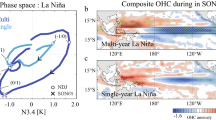

La Niña—a climate phenomenon characterized by unusually cool sea surface temperatures in the central and eastern tropical Pacific Ocean—can persist for multiple years, with significant worldwide climate impacts. When these multiyear La Niña events occur, they often trigger extreme weather patterns across the globe. The recent 2020–2023 triple-year La Niña, for example, contributed to historic flooding in eastern Australia, catastrophic rainfall in Pakistan and northwestern India, and persistent severe droughts in South China, the U.S. Southwest, and East Africa, where drought conditions escalated into a food crisis.
In recent decades, such prolonged La Niña events have become more frequent, and climate projections indicate they may increase further by 2100. However, the mechanisms that sustain these multiyear cooling episodes have remained unclear.
Now, a Chinese research team has uncovered a critical feedback loop involving rainfall and ocean salinity that helps sustain multiyear La Niña conditions. The study, jointly led by Dr. Feng Tian of the Institute of Oceanology, Chinese Academy of Sciences (IOCAS), Professor Rong-Hua Zhang of Nanjing University of Information Science and Technology, and Professor Chuanyu Liu of IOCAS, in collaboration with Professor Cong Guan of Hohai University, was published on January 14 in Nature Communications.
In the vast western equatorial Pacific, sustained reduction in rainfall driven by multiyear La Niña leads to a steady increase in upper-ocean salinity. This rise in salinity destabilizes the upper layers of the ocean, which in turn triggers a series of ocean wave processes—ultimately causing cooling in the eastern equatorial Pacific, over 10,000 kilometers away. When this positive salinity anomaly persists for two years, slower ocean circulation kicks in, promoting cooling across the entire tropical Pacific. Quantitative analysis shows that this rainfall-linked cooling boosts the intensity of multiyear La Niña by 14% in the first year and a further 32% in the second year. This effect enables reduced rainfall to play a key role in maintaining the sustained cooling of multiyear La Niña events.
“We have demonstrated, for the first time, that multiyear rainfall and salinity feedbacks regulate the persistence of La Niña, reshaping our understanding of ocean-atmosphere interactions during these prolonged events” said Dr. Feng Tian, the first author of the paper.
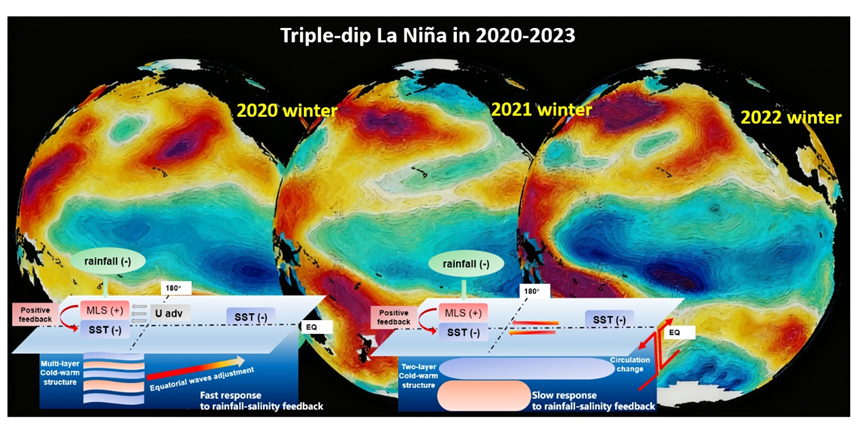
The role of salinity feedback caused by reduced rainfall in sustaining multi-year La Niña events (the background image shows the sea surface temperature anomaly during the 2020-2023 triple La Niña period)
Follow the Topic
-
Nature Communications
An open access, multidisciplinary journal dedicated to publishing high-quality research in all areas of the biological, health, physical, chemical and Earth sciences.

Related Collections
With Collections, you can get published faster and increase your visibility.
Women's Health
Publishing Model: Hybrid
Deadline: Ongoing
Tumor Microenvironment Crosstalk and Therapeutic Implications
Publishing Model: Hybrid
Deadline: Nov 02, 2026