How We Built PANGEA-SMM to Predict Progression to Myeloma
Published in Cancer and General & Internal Medicine




The Spirit of Connectivity: behind "PANGEA"
Long ago, Pangea stood as a single, vast supercontinent: a symbol of everything connected, unified, and moving together. In that same spirit, we created the PANGEA project to bring the community of Myeloma researchers together by combining data from patients across the globe living with monoclonal gammopathies, including smoldering multiple myeloma (SMM). Just as the ancient supercontinent merged disparate lands, this global effort enables us to form one clear, unified view of how key blood markers change over time, rather than relying on a single, isolated test. By drawing strength from a worldwide collaboration, PANGEA helps assess each person’s precise risk of progressing to active disease. It provides patients and doctors with a clearer and more confident path forward by looking at the "whole world" of their clinical data.
The Challenge: Assembling the Global Puzzle
Building a model that tracks "dynamic" changes over time is a massive data challenge. You can't just look at one point in time; you need longitudinal data: months and years of follow-up for thousands of patients. The success of this study is a testament to this global collaboration: we brought together data from six leading centers across the U.S. and Europe, creating a diverse dataset that allowed us to see how biomarkers change over up to 10 years of follow-up for 2,344 patients. One of the most rewarding parts of the process was seeing researchers from different institutions align on a single goal: creating a tool that is not just accurate in a high-tech lab, but useful for a doctor in a small clinic anywhere in the world.
The Breakthrough: Simplicity in Complexity
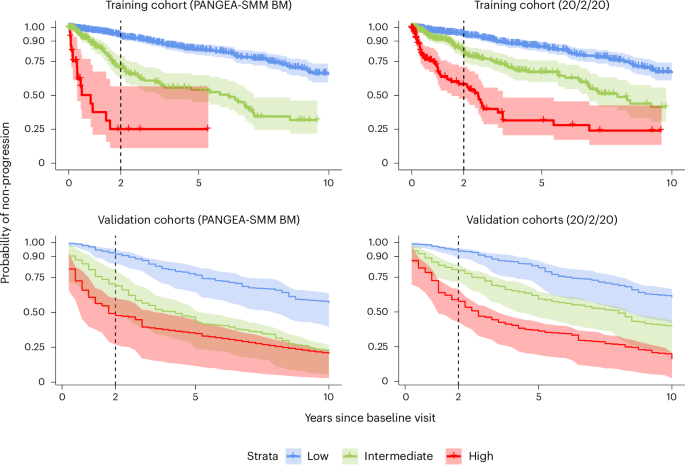
In the current research landscape, there is a visible race toward high-end, specialized assays, from mass spectrometry to advanced molecular profiling. While these technologies hold great promise, we still have limited long-term data on their performance, and their complexity often limits worldwide availability. We were convinced that routine biomarkers, namely M-protein, light chain ratio, hemoglobin, and creatinine, could offer much more than we realized if analyzed through an innovative dynamic approach. Our breakthrough wasn’t about finding a new, expensive biomarker; it was about demonstrating that we can extract significantly more information from the time-tested variables we already track every day. By analyzing the trajectories of these four routine markers, we showed that we can markedly improve patient stratification. This means that even before turning to specialized or costly assays, we can achieve higher predictive precision using data that is already widely available and low-cost. Importantly, our approach remains perfectly compatible with future innovative methods; adding new biomarkers to this score may refine stratification even further. Ultimately, our work provides both a tool for today and a solid foundation to build the future of smoldering myeloma surveillance.
Toward Personalized Shared Decision-Making
One of the most exciting implications of this work is its potential for personalized shared decision-making. Historically, patients with SMM have been categorized into broad "low, intermediate, or high-risk" groups. While helpful, these "buckets" often fail to reflect an individual’s unique disease trajectory. PANGEA-SMM changes the conversation. By leveraging a dynamic approach, a patient and their physician can now make more personalized decisions, choosing whether to initiate therapy or continue "watch and wait" based on their own personal risk of progression at 2, 5, or 10 years.
A Tool for Everyone
We wanted to ensure that PANGEA-SMM reached the clinic, where it can be most useful to patients and doctors. That’s why we launched pangeamodels.org, a free, open-access calculator. Working on this tool wasn't just about the statistics or metrics; it was about giving clinicians a better compass to navigate the uncertainty of SMM. We hope this tool helps turn "Watch and Wait" into "Watch and Intervene" at exactly the right moment, powered by a global community of data.

Follow the Topic
-
Nature Medicine
This journal encompasses original research ranging from new concepts in human biology and disease pathogenesis to new therapeutic modalities and drug development, to all phases of clinical work, as well as innovative technologies aimed at improving human health.

Related Collections
With Collections, you can get published faster and increase your visibility.
Clinical Research in Respiratory Medicine
Publishing Model: Hybrid
Deadline: Feb 18, 2027
Cancer Prevention and Control
Publishing Model: Hybrid
Deadline: Feb 19, 2027