Hydrogen‑Bonded Interfacial Super‑Assembly of Spherical Carbon Superstructures for High‑Performance Zinc Hybrid Capacitors
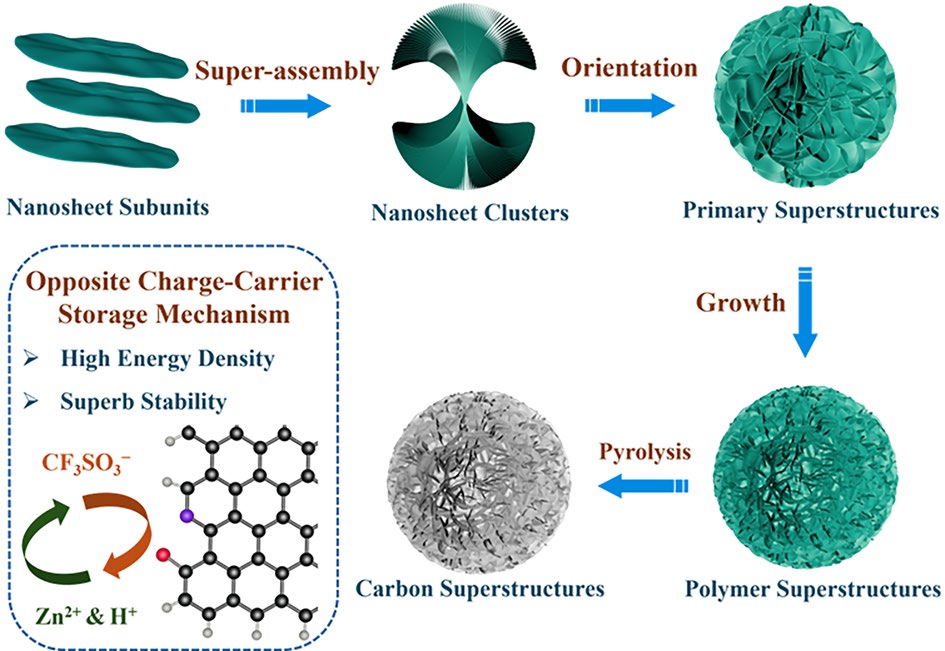
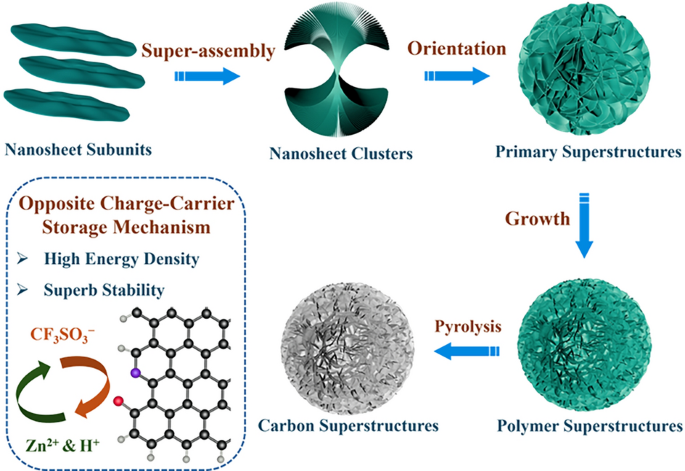

As the demand for high-performance energy storage systems intensifies, aqueous zinc-ion hybrid capacitors (ZHCs) have emerged as a promising technology due to their high safety, low cost, and environmental friendliness. Now, researchers from Tongji University, led by Prof. Ziyang Song and Prof. Lihua Gan, have developed a novel hydrogen-bond-guided interfacial super-assembly strategy to construct spherical carbon superstructures (SCS-6) with exceptional energy storage performance. This work offers valuable insights into the design of advanced carbon cathodes for next-generation energy storage.
Why Spherical Carbon Superstructures Matter
- Ultrahigh Energy Density: The SCS-6 cathode delivers an outstanding energy density of 166 Wh kg-1, outperforming most reported carbon-based ZHCs.
- Ultra-Long Cycle Life: The Zn||SCS-6 device maintains 95.5% capacity retention after 500,000 cycles, demonstrating exceptional durability.
- Fast Ion Transport: Unique surface-opening pores and interconnected channels enable rapid Zn2+ diffusion and high-rate performance.
- Dual-Ion Storage Mechanism: A proton-assisted opposite charge-carrier storage mechanism maximizes spatial charge utilization and boosts capacity.
Innovative Design and Features
-
Hydrogen-Bond-Driven Assembly:
Tetrachlorobenzoquinone (H-bond acceptor) and dimethylbenzidine (H-bond donor) self-assemble into 2D nanosheet modules, which are then compacted into 3D spherical superstructures via N–H···O hydrogen bonding. -
Hierarchical Porous Architecture:
The resulting SCS-6 features micropores (~0.8 nm) and mesopores (2–12 nm), with a specific surface area of 2530 m2 g-1, ensuring high accessibility of active sites and efficient electrolyte infiltration. -
Rich Heteroatom Doping:
N/O co-doping introduces zincophilic sites (e.g., carbonyl, pyridine groups) that enhance Zn2+ adsorption and redox activity.
Applications and Future Outlook
-
High-Performance Zn-Ion Hybrid Capacitors:
The Zn||SCS-6 device achieves 246 mAh g-1 at 0.2 A g-1 and 172 mAh g-1 at 20 A g-1, with 99.8% Coulombic efficiency over half a million cycles. -
Proton-Assisted Charge Storage:
A dual-ion mechanism involving Zn2+/H+ co-storage via physical adsorption and chemical redox reactions significantly enhances capacity and kinetics. -
Scalable and Tunable Synthesis:
The solvent-adaptable super-assembly process enables morphology control (e.g., flower-like, curly flake), offering flexibility for diverse energy storage applications. -
Challenges and Opportunities:
Future research will focus on mass-loading scalability, electrolyte optimization, and mechanical flexibility for wearable and grid-scale energy systems.
This comprehensive study provides a roadmap for hydrogen-bond-guided carbon superstructure design, highlighting the importance of interfacial engineering, hierarchical porosity, and heteroatom doping in advancing high-energy, long-life energy storage technologies.
Stay tuned for more groundbreaking work from Prof. Ziyang Song and Prof. Lihua Gan at Tongji University!

Editor of Nano-Micro Letters, which is an Open-Access, peer-reviewed journal reported papers that have at least one dimension ranging from a few sub-nanometers to a few hundreds of micrometers. The journal is published by Springer Nature and indexed by SCI, EI, SCOPUS, Pubmed, etc. The 2025 JCR Impact Factor is 38.5. The 2025 CiteScore is 58.9.
Follow the Topic
-
Nano-Micro Letters
Nano-Micro Letters is a peer-reviewed, international, interdisciplinary and open-access journal that focus on science, experiments, engineering, technologies and applications of nano- or microscale structure and system in physics, chemistry, biology, material science, and pharmacy.