In the Glow and Shadow of Nighttime Lights
Published in Earth & Environment








The idea for this study began during the early months of the COVID-19 pandemic, when cities around the world seemed to change almost overnight. Streets emptied, mobility declined, and many businesses closed or reduced their operations. Yet one aspect of this urban transformation remained visible from above: the glow of cities at night. We began wondering whether changes in nighttime illumination could reveal something about how different parts of urban economies were responding to such an unprecedented shock. Nighttime lights have long been used to study human activity and economic development, but most large-scale analyses treat a city as a single unit. That seemed particularly limiting during the pandemic. Commercial districts, industrial areas and retail centres serve different functions and faced very different restrictions and possibilities for adaptation. So rather than simply asking whether a city became darker, we asked what happened within the city: which sectors maintained their observable activity, which declined temporarily and recovered, and which remained changed after lockdowns ended?
That question became the basis of our study. We analysed monthly satellite-derived nighttime lights from 2018 to 2023 for 105 city–sector combinations across 48 cities worldwide, focusing on commercial, industrial and retail areas. We combined nighttime-light observations with spatial information on where these activities were located and whether they were classified as essential during the pandemic (Figure 1).
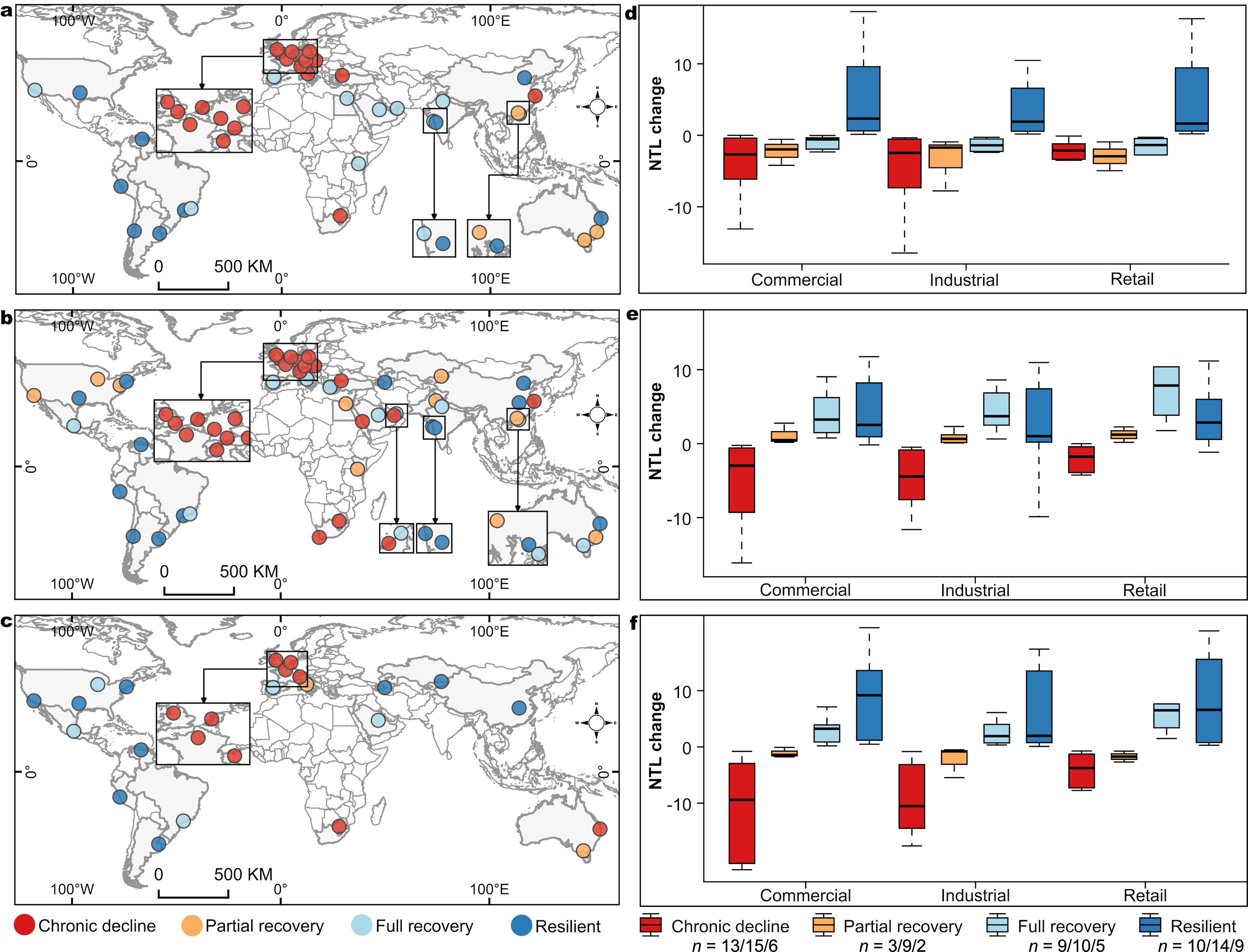
Figure 1 | Global distribution of the study cities and the commercial, industrial and retail areas included in the analysis.
The basic idea sounded simple: follow the light before, during and after lockdown and see what happened. In practice, it was much more difficult. Lighting varies across places and urban functions, while satellite observations are affected by seasonality, spatial resolution and processing choices. Economic activities also rarely occupy perfectly separated parts of a city. Much of the work therefore involved building a consistent time-series framework, accounting for seasonal variation, mapping comparable areas for each sector and testing whether the resulting trajectories remained robust under different analytical choices. Just as importantly, we had to think carefully about how those trajectories should be interpreted.
What emerged was more interesting than we initially expected. The pandemic did not simply make cities darker before they returned to a common recovery path. Instead, four recurring trajectories emerged: Chronic Decline, where nighttime-light brightness remained below its pre-pandemic trajectory; Partial Recovery; Full Recovery; and Resilient, where brightness was maintained or increased through the disruption. These trajectories were distributed unevenly across both geography and economic structure. European cities showed a particularly high prevalence of Chronic Decline, especially in commercial and retail areas, whereas cities in Latin America and Asia more frequently exhibited Resilient or Full Recovery trajectories. Activities classified as essential during lockdown were more frequently associated with Resilient trajectories, while Chronic Decline was more common among non-essential activities. Industrial areas also more often followed Resilient or Full Recovery trajectories than commercial and retail areas. One of the clearest patterns was that very different trajectories could coexist within the same city.
This was also where the limitations of nighttime lights became especially important. A darker commercial district may suggest reduced activity, but it does not necessarily mean an equivalent decline in economic output. An office-based sector, for example, may remain productive while its workplaces are less illuminated because employees are working remotely. Conversely, an essential facility may remain brightly lit without any proportional increase in economic output. Nighttime lights therefore capture the part of urban activity that leaves a visible nighttime footprint, rather than providing a direct measure of productivity or employment. The geographic differences we observed may also relate to lockdown policies, mobility, energy conditions, urban form or the ability of particular activities to operate remotely, but our analysis was not designed to establish which of these mechanisms caused the observed trajectories. We therefore see nighttime lights as a complementary perspective rather than a substitute for conventional economic or mobility data. Their particular value lies in providing a consistent and spatially detailed view across many cities, including places where comparable sector-level information may otherwise be difficult to obtain.
Although COVID-19 motivated the study, the broader question extends beyond the pandemic. Cities will continue to experience disruptions from extreme weather, natural hazards, energy crises and other shocks. Combining nighttime lights with mobility records, energy consumption, climate indicators and more detailed economic information could help distinguish between activity that has genuinely declined and activity that has been displaced or reorganised, and help explain why different parts of the same city respond differently to the same disruption. For us, that is the main lesson of the study: looking only at city-wide averages can hide very different trajectories unfolding within an urban system. The city does not recover as one. It recovers sector by sector, place by place, and in very different ways. Nighttime illumination gives us one way of seeing those differences from above.
Follow the Topic
-
Communications Earth & Environment
An open access journal from Nature Portfolio that publishes high-quality research, reviews and commentary in the Earth, environmental and planetary sciences.

Related Collections
With Collections, you can get published faster and increase your visibility.
Ecological resistance and resilience under global change
Publishing Model: Open Access
Deadline: Apr 07, 2027
Hazards in Mountain Regions
Publishing Model: Open Access
Deadline: Nov 02, 2026