Increasing Global Threat of Outburst Floods from Overlooked Small Alpine Lakes
Published in Earth & Environment and Sustainability



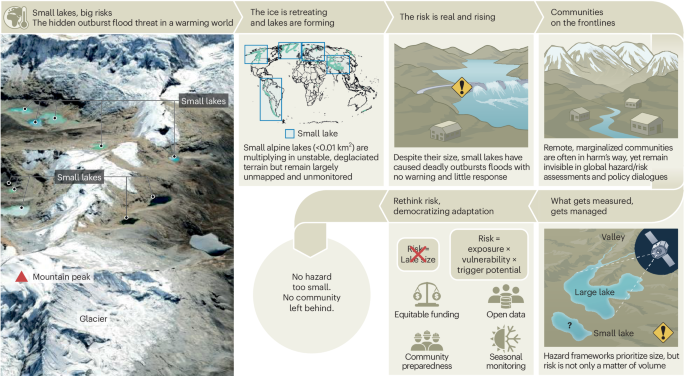

For decades, glacial lake hazard research has largely focused on one idea: larger lakes pose greater risks. It is a logical assumption. Larger lakes store more water, are easier to identify from satellite imagery, and have been responsible for many of the world's best-known glacial lake outburst floods.
As researchers working on cryospheric hazards, we also viewed the problem through this lens. Most inventories, monitoring programmes and hazard assessments naturally concentrated on larger lakes. Small alpine lakes rarely entered the discussion.
That changed as we began reviewing the literature and examining glacial lake inventories from different mountain regions.
One thing quickly became apparent. Thousands of small alpine lakes were missing from inventories, not because they did not exist, but because they fell below the minimum size thresholds commonly used in mapping and hazard assessments. At first, this did not seem particularly surprising. These thresholds were originally introduced because older satellite imagery made mapping very small lakes difficult and because larger lakes were assumed to represent the greatest threat.
The more we explored the evidence, however, the less convincing that assumption became.
We found documented examples where relatively small lakes had produced destructive outburst floods, damaging infrastructure, affecting livelihoods and threatening downstream communities. These events appeared across different mountain regions, yet they were often discussed individually rather than being recognised as evidence of a broader pattern.
That observation led us to ask a simple question.
Have we been overlooking an important component of cryospheric risk simply because these lakes are small?
That question became the foundation of our Perspective published in Nature Sustainability.
One aspect that surprised us during the writing process was how much hazard assessment has evolved scientifically while many operational approaches still rely on size-based screening. Advances in remote sensing, artificial intelligence and geospatial analysis now allow us to detect and monitor lakes that were almost impossible to identify only a decade ago. Yet many regional inventories and hazard frameworks continue to exclude these lakes before any assessment even begins.
As we brought together studies from different parts of the world, another theme became increasingly clear. Lake size alone tells only part of the story.
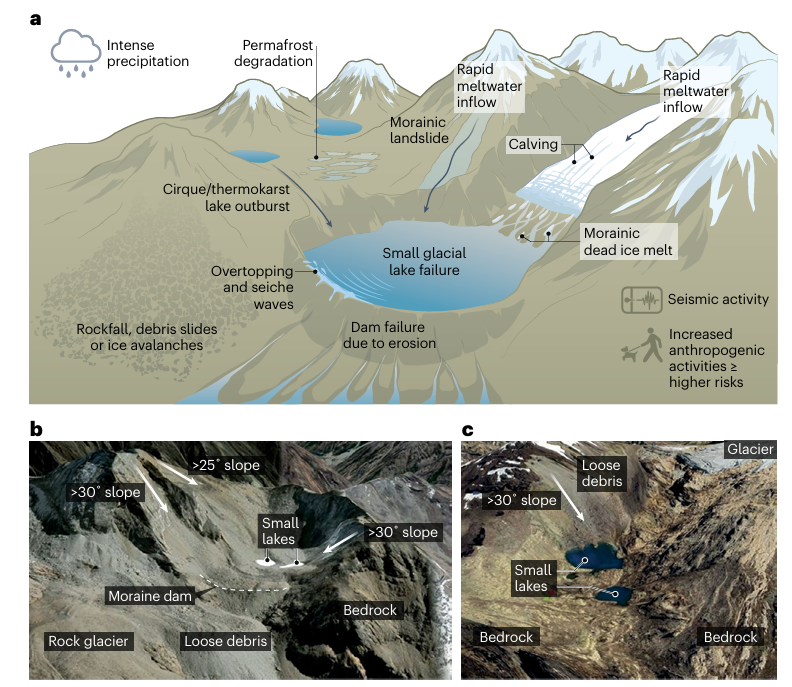
Whether a lake becomes hazardous depends on many interacting factors, including terrain instability, dam characteristics, surrounding slopes, potential triggering mechanisms and the vulnerability of downstream communities. A relatively small lake located in steep, unstable terrain can sometimes present greater local risk than a much larger lake situated in a more stable environment.
Recent events further reinforced this perspective. Small alpine lakes in Nepal and Peru generated destructive floods despite being absent from many inventories because of their limited size. These cases highlighted an important gap between what current science tells us and how hazard assessments are often implemented in practice.
Another point that stayed with us throughout the writing process was the human dimension of these hazards.
Many of the communities exposed to small alpine lake outbursts live in remote mountain regions where monitoring is limited and preparedness resources are scarce. When a lake is excluded from an inventory, it is often also excluded from monitoring, early warning efforts and, ultimately, from broader conversations about climate adaptation and disaster risk reduction. This makes the issue much larger than simply improving lake inventories. It is about ensuring that emerging hazards are recognised before they become disasters.
Writing this Perspective (https://www.nature.com/articles/s41893-026-01873-0) also reminded us how valuable it is to question long-standing assumptions. Scientific progress does not always come from discovering something entirely new. Sometimes it comes from looking again at what has always been there and asking whether our methods and priorities still make sense.
Our Perspective is not suggesting that every small alpine lake is dangerous. Many remain stable throughout their existence. Instead, we argue that lake size should no longer be used as the primary criterion for deciding which lakes deserve attention. Risk is shaped by a combination of physical processes, environmental conditions and societal vulnerability, and our assessment approaches should reflect that complexity.
As mountain landscapes continue to change under a warming climate, small alpine lakes are likely to become increasingly common. We hope this Perspective encourages researchers, practitioners and policymakers to reconsider how these lakes are identified, monitored and incorporated into hazard assessments.
Sometimes the biggest scientific questions emerge from the smallest features in the landscape. In this case, looking more closely at the smallest alpine lakes revealed a blind spot that deserves much greater attention.
Follow the Topic
-
Nature Sustainability
This journal publishes significant original research from a broad range of natural, social and engineering fields about sustainability, its policy dimensions and possible solutions.

What are SDG Topics?
An introduction to Sustainable Development Goals (SDGs) Topics and their role in highlighting sustainable development research.
Continue reading announcement




Please sign in or register for FREE
If you are a registered user on Research Communities by Springer Nature, please sign in