Increasing successive sudden stratospheric warmings linked to Arctic sea ice decline
Published in Earth & Environment




In winter, the Arctic stratosphere is usually dominated by a strong polar vortex, a large-scale westerly circulation that helps isolate cold air over the polar region. Sudden stratospheric warmings, or SSWs, represent a dramatic breakdown of this circulation. During an SSW, the Arctic stratosphere warms rapidly and the polar vortex is rapidly weakened or disrupted. Although SSWs unfold tens of kilometres above the surface, their influence is not confined to the stratosphere. The associated circulation anomalies can propagate downward into the troposphere and alter large-scale circulation for several weeks.
This downward influence gives SSWs particular importance for winter climate prediction. After an SSW, the Northern Hemisphere circulation often shifts toward patterns that favor cold-air outbreaks over midlatitude land regions, especially parts of Eurasia and North America (Figure 1). These cold anomalies can be associated with low-temperature extremes, heavy snowfall, increased energy demand, transport disruption and broader weather-related risks. In recent winters, SSWs have not only occurred more frequently, but have also appeared successively within the same winter. This raised the central question of our study: what has contributed to the recent increase in SSWs and multi-SSW winters, and what does this mean for cold anomalies over Northern Hemisphere continents?
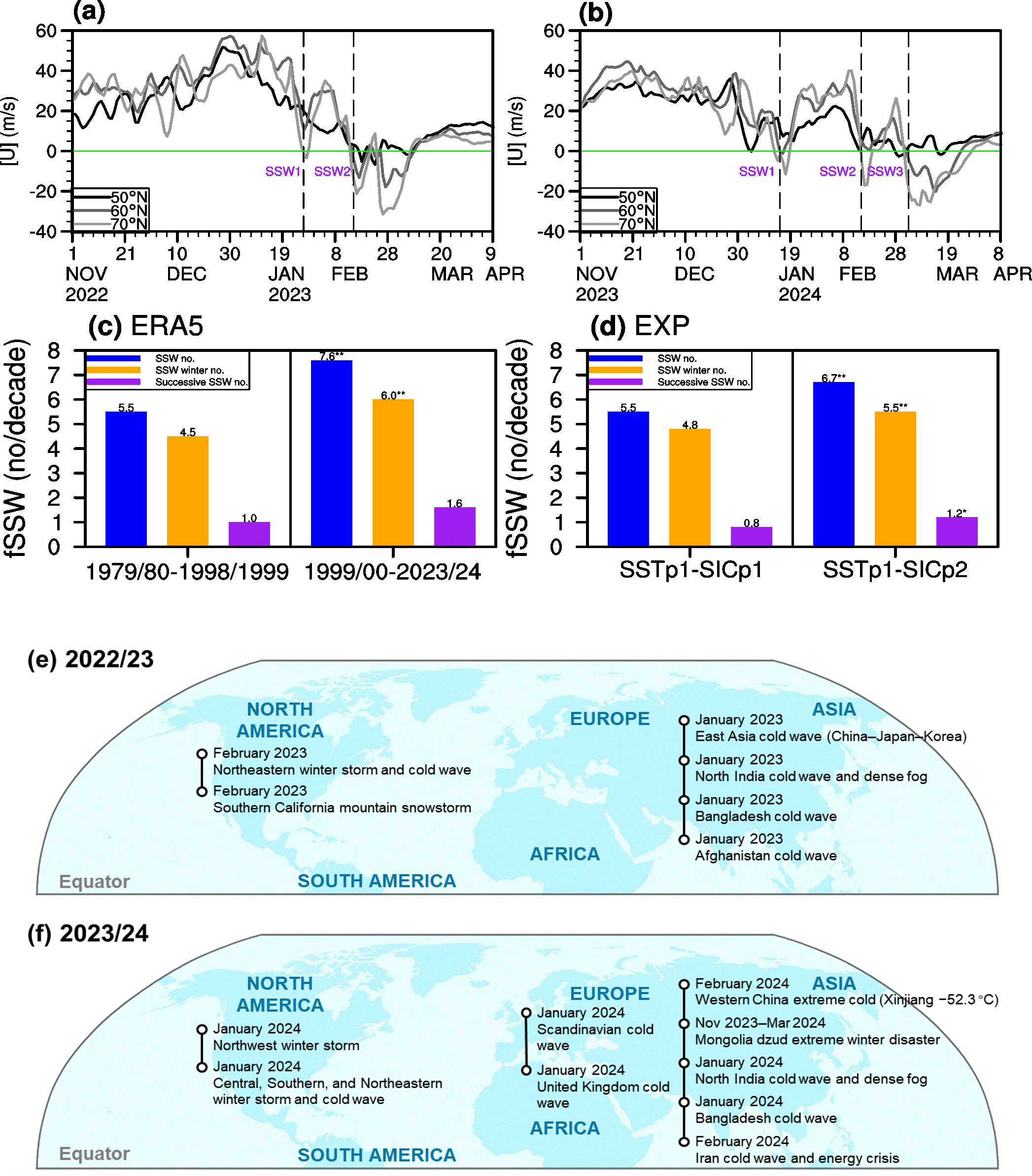
Figure 1. Northern Hemisphere land cold waves in two recent multi-SSW winters. Cold waves over Northern Hemisphere land during the 2022/23 and 2023/24 winters, respectively, when successive sudden stratospheric warmings occurred.
The puzzle of successive SSWs
The starting point of a study from Nanjing University of Information Science and Technology was the recent increase in SSW activity. By comparing period 1979/80–1998/99 with 1999/00–2023/24, the scientists found that total SSW frequency, the frequency of winters with at least one SSW, and the frequency of winters with successive SSWs all increased in the latter period. Multi-SSW winters are still rare, however, and the observational record alone is too limited to robustly separate forced changes from internal atmospheric variability.
For this reason, the researchers combined reanalysis data, sea ice observations, targeted sensitivity experiments, mutimodel polar amplification experiments, and multimodel historical simulations to build a more complete picture. This multi-source datasets give us an opportunity to examine not only whether SSWs have become more frequent, but also whether their increase is linked to a changing boundary condition in the Arctic climate system.
Why Arctic sea ice became the key suspect
Arctic sea ice decline is one of the clearest manifestations of global warming in the polar climate system. Its influence is not simply limited to the Arctic, because reduced sea ice changes exchanges of heat and moisture between the ocean and atmosphere and can alter large-scale circulation in remote regions. One important pathway involves changes in the wave guide, through which planetary waves can propagate upward from the troposphere into the stratosphere and disturb the polar vortex.
To examine this possibility, the scientists first used atmospheric reanalysis and sea ice observations to analyze observed changes since 1979. In the targeted model sensitivity experiment, the background conditions were kept broadly consistent, but the Arctic sea ice state was changed from the 1979/80–1998/99 climatology in a control experiment to the lower sea ice state of 1999/00–2023/24. The reduced sea-ice sensitivity experiment produced more SSWs and more multi-SSW winters, indicating that Arctic sea ice decline might be responsible for the increased SSWs.
They further tested the robustness of this relationship using polar amplification experiments and historical simulations from different models. Polar amplification experiments allow researchers to compare different sea ice states in a controlled framework, while historical simulations from different models can test whether the same relationship emerges across climate models. Both lines of evidence suggest lower Arctic sea ice concentration is generally associated with more frequent SSWs and successive SSWs.
Tracing the dynamical pathway
The dynamical mechanism lies in the environment through which planetary waves propagate. Scientists found that Arctic sea ice decline reduces the refraction of planetary waves in the mid-to-high latitude stratosphere. This weakens a waveguide that normally favors equatorward planetary wave propagation. As this waveguide weakens, planetary waves are more likely to propagate poleward and disturb the Arctic stratosphere.
As a consequence, SSWs more likely to occur. The researchers also decomposed the refraction of waves into different mathematical terms to identify the dominant physical contribution. The main contribution came from changes in the meridional gradient of quasi-geostrophic potential vorticity, while changes in atmospheric static stability played a much smaller role. Sea ice influence is not simply seen as lower-atmospheric thermal response. It also deeply involves a dynamical reorganization of the stratospheric waveguide and wave–mean flow interaction.
Cold anomalies still persist following SSWs
The final part of the study examined whether these stratospheric changes still matter for near-surface weather under reduced sea ice conditions. SSWs and successive SSWs still produce strong and persistent downward impacts. Composite surface temperature anomalies during days 10–55 after SSW onset show broad cold anomalies over Northern Hemisphere continents relative to the corresponding climatology.
These cold anomalies appear over parts of Eurasia and North America. In several simulations, the North American cold anomalies extend farther southward under lower sea ice conditions. This indicates that Arctic sea ice decline can reshape stratospheric variability in a way that allows SSW-related cold anomalies over some Northern Hemisphere land spots to persist.
What this means for winter prediction
This study provides a coherent pathway linking Arctic sea ice decline, changes in stratospheric wave propagation, polar vortex disturbance, successive SSW occurrence, and cold anomalies over Northern Hemisphere continents (Figure 2). By combining observations, targeted sensitivity experiments, and multimodel simulations, it is revealed that Arctic sea ice decline can favor more frequent SSWs and successive SSWs through changes in the stratospheric waveguide.
The broader implication is that Arctic sea ice decline can influence winter circulation beyond the polar region through planetary waves and the stratospheric polar vortex. Better representing this Arctic sea ice–stratosphere pathway in climate models may help improve subseasonal-to-seasonal prediction of winter circulation anomalies and cold-air outbreaks even in a warmer climate world.
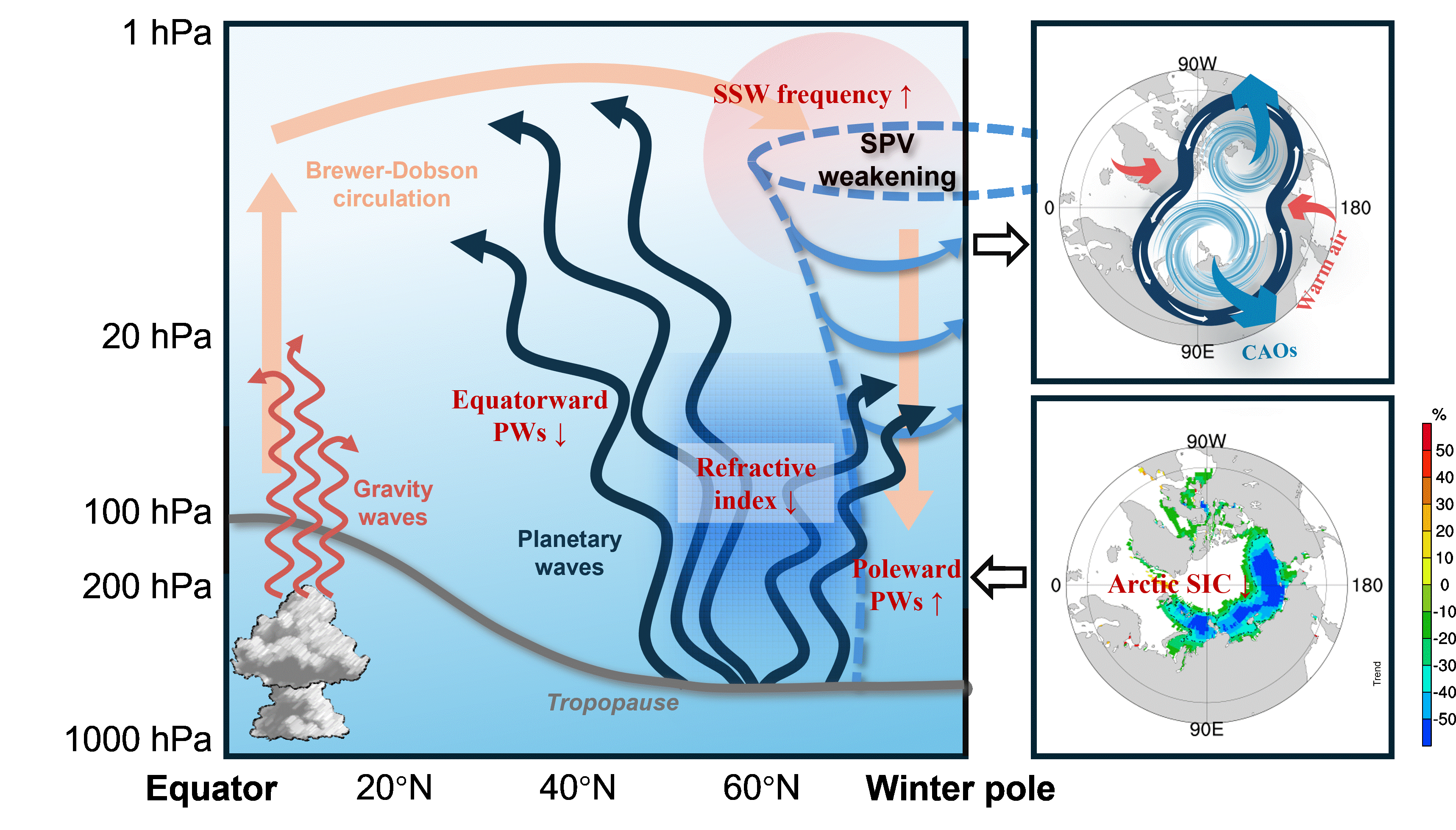
Figure 2. Schematic chart for Arctic sea ice decline, SSWs, and cold air outbreak. As the Arctic sea ice declines, the Arctic warms and the refractive index decreases, which leads to enhanced poleward propagation of planetary waves. As a consequence, the stratospheric polar vortex is more easily disturbed in a world with less Arctic sea ice, explaining the increased successive SSWs. The displaced, distorted or split vortex carries cold air southward. The anomalous coldness covered regions are projected to shift farther southward especially in North America.
For details, refer to:
Rao, J.*, Garfinkel, C. I., Cohen, J., Wang, Y., Zhang, X., Ren, R., and Zhang, P., 2026: Arctic Sea Ice Decline, Increasing Successive Sudden Stratospheric Warmings and Cold Northern Hemisphere Continents. Communications Earth & Environment, https://doi.org/10.1038/s43247-026-03604-x
Follow the Topic
-
Communications Earth & Environment
An open access journal from Nature Portfolio that publishes high-quality research, reviews and commentary in the Earth, environmental and planetary sciences.

Related Collections
With Collections, you can get published faster and increase your visibility.
Climate extremes and water-food systems
Publishing Model: Open Access
Deadline: May 31, 2026
Drought
Publishing Model: Hybrid
Deadline: Jun 30, 2026




Please sign in or register for FREE
If you are a registered user on Research Communities by Springer Nature, please sign in