Inorganic High‑Performance Fiber‑Based Materials for Electromagnetic Interference Shielding: Fundamentals, Fabrications, and Emerging Applications
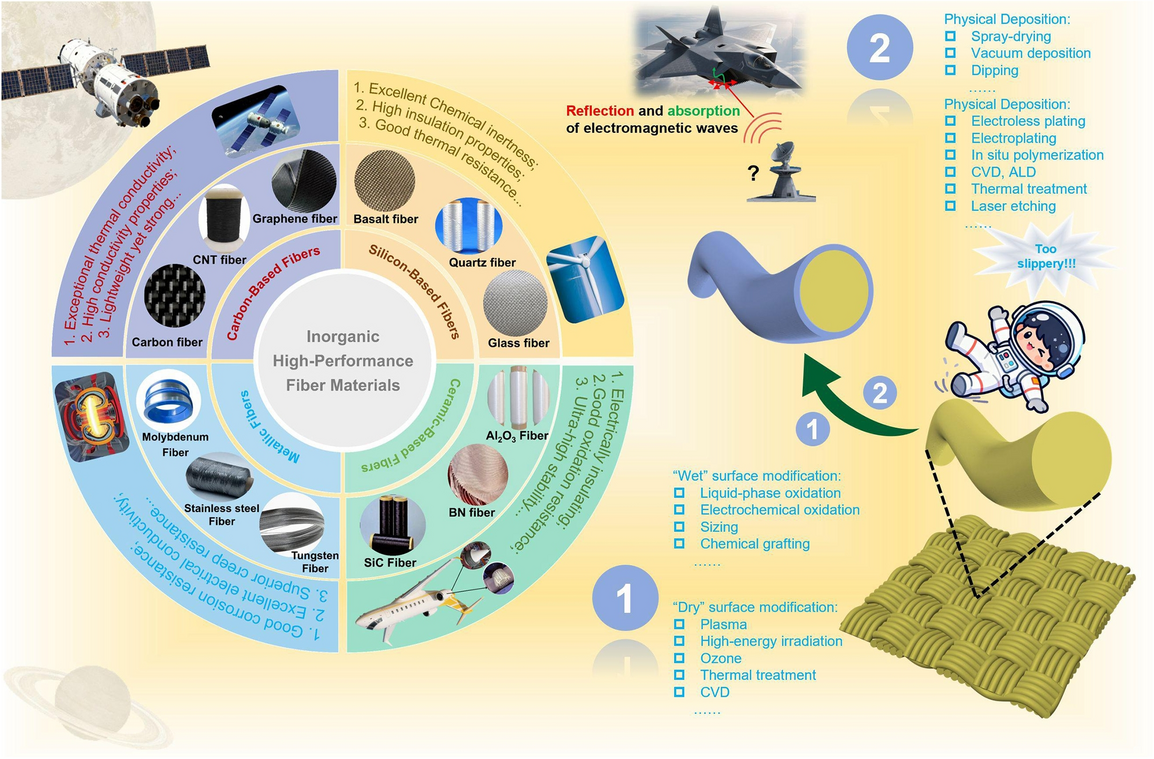

As electromagnetic interference (EMI) and electromagnetic radiation pollution become increasingly severe in industrial, military, and aerospace applications, the development of novel materials that combine high shielding efficiency with excellent comprehensive performance has become a research hotspot. Now, researchers from the State Key Laboratory of New Textile Materials and Advanced Processing at Wuhan Textile University, led by Professor Yan Jun, Professor Ya-Lan Tan, and Professor Fengxiang Chen, in collaboration with Jiangnan University and China Coal Technology & Engineering Group, have presented a comprehensive review on inorganic high-performance fiber (IHPF)-based materials for electromagnetic interference shielding. This work offers valuable insights into the development of next-generation lightweight, durable, and multifunctional EMI shielding materials.
Why IHPF-Based EMI Shielding Materials Matter
- Lightweight and High Strength: IHPFs possess exceptional mechanical properties with high strength-to-weight ratios, making them ideal for aerospace and defense applications where weight reduction is critical.
- Environmental Stability: These fibers exhibit outstanding thermal stability, chemical inertness, and corrosion resistance, ensuring reliable performance under extreme conditions.
- Structural-Functional Integration: IHPFs serve as ideal substrates for constructing lightweight, durable, and structurally functional integrated EMI shielding systems.
Innovative Design and Features
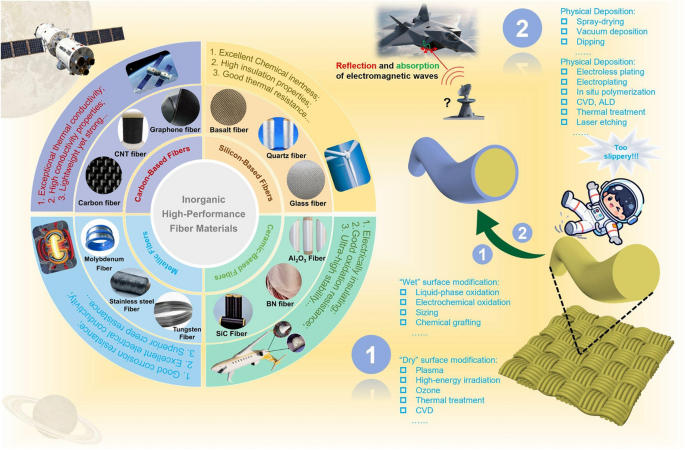
- Fiber Categories: The review covers various types of IHPFs, including carbon-based fibers (carbon fiber, CNT fiber, graphene fiber), silicon-based fibers (glass fiber, quartz fiber, basalt fiber), ceramic-based fibers (SiC fiber, Al₂O₃ fiber, BN fiber), and metal fibers (molybdenum fiber, tungsten fiber, stainless steel fiber). Each type has unique properties suitable for different applications.
- Surface Modification Strategies: "Dry" methods (plasma treatment, ozone treatment, thermal treatment, CVD) and "wet" methods (liquid-phase oxidation, electrochemical oxidation, surface sizing, chemical grafting) are systematically discussed to address the intrinsic surface inertness challenge of IHPFs.
- Functional Layer Construction: Physical deposition (spray-drying, vacuum deposition), chemical treatment (electroless plating, electroplating, in situ polymerization, CVD, thermal treatment), and emerging technologies (ALD, laser etching) are reviewed for fabricating EMI shielding functional layers.
Applications and Future Outlook
- EMI Shielding Textiles: Functionalized IHPF fabrics provide excellent electromagnetic protection for protective clothing, shielding curtains, and flexible shielding layers, combining structural stability with flexibility and environmental robustness.
- Radar-Absorbing Stealth: By combining magnetic particles, carbon-based nanomaterials, or dielectric materials with IHPFs, lightweight, broadband wave-absorbing structures can be achieved for EM stealth in fighter aircraft, drones, and naval vessels.
- Precision Equipment Protection: Multilayer shielding structures based on modified IHPF fabrics can simultaneously achieve lightweight design, high-temperature stability, and strong EM protection for satellites, missiles, and avionics systems.
- Specialized Cables: IHPF-based fabrics serve as ideal skeleton materials for flexible shielding sleeves, effectively reducing EM leakage and signal interference while maintaining stable performance under extreme conditions.
- Challenges and Opportunities: The review highlights challenges including interfacial stability, mechanical-EM property coupling, multifunctional integration, scalable manufacturing, and green sustainability. Future research will focus on multiscale interface regulation, atomic-level interface design, and absorption-dominated green shielding strategies.
This comprehensive review provides a roadmap for the development and application of IHPF-based EMI shielding materials. It highlights the importance of interdisciplinary research in materials science, electronics, and manufacturing to drive innovation in this field. Stay tuned for more groundbreaking work from Professor Yan Jun, Professor Ya-Lan Tan, and Professor Fengxiang Chen at Wuhan Textile University!

Editor of Nano-Micro Letters, which is an Open-Access, peer-reviewed journal reported papers that have at least one dimension ranging from a few sub-nanometers to a few hundreds of micrometers. The journal is published by Springer Nature and indexed by SCI, EI, SCOPUS, Pubmed, etc. The 2025 JCR Impact Factor is 38.5. The 2025 CiteScore is 58.9.
Follow the Topic
-
Nano-Micro Letters
Nano-Micro Letters is a peer-reviewed, international, interdisciplinary and open-access journal that focus on science, experiments, engineering, technologies and applications of nano- or microscale structure and system in physics, chemistry, biology, material science, and pharmacy.