Institutional Intelligence: Evidence, Judgment and the Capacity to Act
Published in Social Sciences, Research Data, and Law, Politics & International Studies


Why better decisions require more than better data
Across my recent work on cultural indicators, creative ecosystems, museums and the economic dimensions of culture, one question has steadily come into focus: how do institutions decide what they need to know, interpret different forms of knowledge and translate them into justified action?
This article offers an initial synthesis of those strands. Drawing on my previous research, it examines how institutions connect evidence production, organisational knowledge, professional expertise, authority, implementation and learning, while accounting for the growing role of emerging technologies.
The question emerged from the practical work of building and using cultural evidence in a rapidly developing policy environment, where international standards, local realities, professional knowledge and strategic priorities must be brought into relation. I use Institutional Intelligence as an emerging framework for examining this capability.
- Institutional Intelligence concerns an institution’s capacity to determine what needs to be known, produce and interpret relevant evidence, and move from competing forms of knowledge to justified, authorised, implementable and revisable action.
The concept grows from evidence-informed cultural policy practice, but applies wherever organisations must interpret incomplete evidence, weigh competing forms of knowledge and act under uncertainty.
Measurement is an institutional process
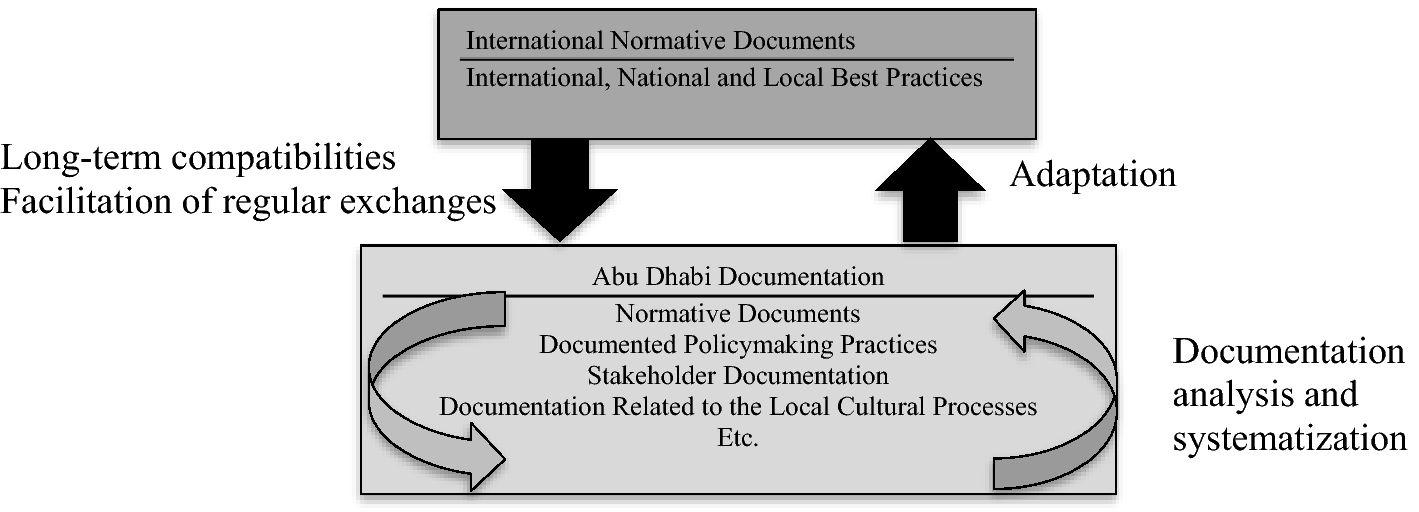
My earlier work on cultural indicators in Abu Dhabi began with a methodological question: how could international statistical frameworks be adapted to a distinct historical, legal and administrative context? International standards were essential, but applying them required attention to the local meanings and institutional realities that made the categories relevant.
Administrative records reflect the purposes for which they were created, while existing classifications may absorb culturally significant activity into broader categories. In one early example, artistic disciplines were embedded within general educational classifications, limiting their visibility as distinct cultural activities. Before new data could be collected, the concepts, scope and appropriate level of detail had to be defined.
International definitions make comparison possible, but local policy also requires categories that correspond to how cultural practices are understood and organised in context. My cultural indicators research therefore proposed moving between local legal and administrative definitions and international statistical frameworks rather than treating either as sufficient on its own. The aim was to develop indicators that were locally meaningful while remaining compatible with international comparison.
Indicator construction involves choices about definitions, boundaries, proxies, weighting and relevance. These choices depend on collaboration among policymakers, researchers, statisticians and cultural professionals. Measurement does not simply describe a cultural system; it helps determine what institutions are able to see, compare and discuss.
Producing evidence is already an interpretive act.
Different forms of knowledge must meet
CultureSTATS-AD gradually expanded beyond baseline statistics. Its economic work brought together administrative, expenditure, employment, trade and household consumption evidence, while making limitations in classification, coverage and granularity more visible. Such limitations do not invalidate the evidence; they clarify what can and cannot responsibly be inferred from it.
Qualitative ecosystem research therefore became equally important. My work on Abu Dhabi’s performing arts examined how cultural production depends on relationships among institutions, educators, practitioners, intermediaries and communities. It identified gaps in professional training, communication and career pathways, as well as the need to connect less visible cultural practices with formal systems of education and research.
That research also showed that ecosystem resilience cannot be understood through individual organisations alone. It depends on locally embedded relationships, knowledge flows, intermediaries and the interaction of institutional, market and community practices. Cultural professionals may also disagree over priorities and institutional forms, reminding us that ecosystem knowledge is plural rather than automatically coherent.
The forthcoming museum-ecosystem research extends this mixed approach. It combines interviews with cultural professionals and policymakers, population evidence, previous economic research, policy documents, observation and press analysis. These sources are brought together to examine the social, economic and environmental dimensions of museum sustainability and connect them to recommendations on accessibility, financing, partnerships, technology and institutional capacity.
Across this work, it became clear that relevant knowledge is distributed. Institutions need ways to recognise it, test it, connect it to other forms of evidence and determine how it should inform action.
From knowledge to action
The main difficulty often lies in the distance between evidence and action. Professional knowledge may remain dispersed across teams; departments may interpret the same findings differently; organisational memory may weaken through turnover. Even a sound recommendation may lack the mandate, resources or coordination required for implementation.
Institutional Intelligence concerns the capacity to manage this passage. It does not eliminate conflict among forms of knowledge; it makes disagreement and asymmetries of authority visible, and requires institutions to justify how competing claims inform the decisions that follow.
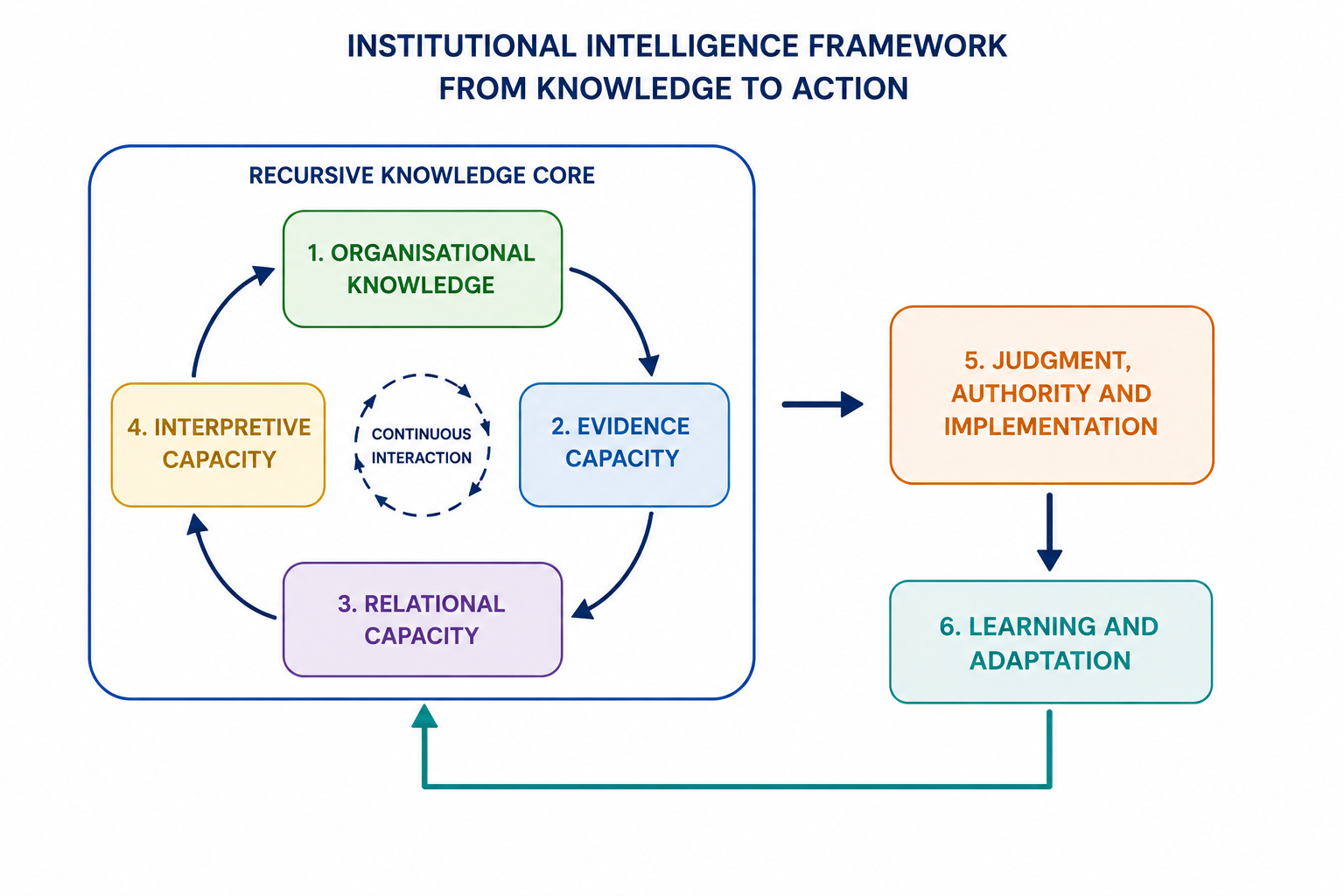
I currently understand the framework through six connected capabilities.
Organisational knowledge
Retain and make available institutional memory, accumulated experience, existing strategic commitments and tacit professional knowledge.
This capability reflects a recurring lesson from my ecosystem research: formal reports contain only part of what institutions know. Experience also resides in professional practice, organisational routines, relationships and lessons from previous decisions.
Evidence capacity
Define the problem or decision to be informed; determine what must be known; generate, assess and govern evidence; establish baselines; and identify gaps requiring further inquiry.
My cultural indicators work demonstrated that evidence production cannot be separated from defining the concepts to be measured. Data collection, indicator construction and the identification of missing information develop through mutual adjustment rather than as isolated technical stages.
Relational capacity
Engage with organisations, professions, communities and networks to bring distributed knowledge into the inquiry, understand differing priorities, reveal interdependencies and identify blind spots in the available evidence.
The performing arts research provides the clearest foundation for this capability. It showed that knowledge and capacity circulate through educators, practitioners, cultural institutions, private organisations, intermediaries and less formal networks. It also revealed differences in priorities, gaps in communication and the importance of connecting local practices with institutional systems of research and education.
Interpretive capacity
Bring evidence, organisational knowledge and ecosystem perspectives into relation; assess what they mean, where they converge or conflict, what remains absent and how context shapes their relevance.
This capacity is central to the cultural indicators research, which examined the tension between international comparability and local relevance. Evidence that is valid in one setting cannot be transferred mechanically to another; its meaning depends on the legal, administrative, social and historical context in which it is produced and used.
These four capabilities operate recursively. Organisational knowledge shapes the questions institutions ask; evidence reveals gaps requiring wider engagement; ecosystem perspectives challenge or extend the evidence; and interpretation may require the institution to revisit the question, the evidence base or whose knowledge has been included.
Judgment, authority and implementation
Weigh evidence, uncertainty, competing values and likely consequences; set strategic direction and priorities; justify choices; authorise decisions; assign responsibility; establish targets; and mobilise the mandates, partnerships and resources required for implementation.
The museum research illustrates why these functions must remain connected. Recommendations concerning accessibility, professional development, SME participation, financing, digital engagement and environmental practice depend on actors with different responsibilities, mandates and resources. Evidence may support a recommendation, but implementation still requires authority, coordination and delivery capacity.
Within this framework, evidence-informed policymaking becomes operational through judgment, authority and implementation. Evidence contributes to policy choices alongside organisational and ecosystem knowledge, competing values, uncertainty and practical constraints.
Learning and adaptation
Monitor delivery; use KPIs and evaluation to assess progress, consequences and unintended effects; retain lessons; update organisational knowledge; and revise evidence needs, strategy, targets or action.
The longitudinal structure of CultureSTATS-AD provides part of the empirical basis for this capability. Repeated research can reveal where classifications remain insufficient, where new questions emerge and where assumptions or data requirements need to be revised. The developing culture satellite account and related research instruments connect evidence and indicators to future strategic planning while preserving their proper role: tools for institutional learning, not substitutes for judgment.
The framework therefore combines a recursive knowledge core with an action-and-learning loop. Organisational knowledge, evidence, relationships and interpretation shape judgment and authorised action; learning from implementation then revises the knowledge base and what follows.
How Institutional Intelligence differs from knowledge management
Knowledge management organises, retains and circulates information. Institutional Intelligence concerns the wider passage through which institutions determine what needs to be known, interpret competing forms of knowledge, justify, authorise and implement action, and learn from its consequences.
This distinction matters because evidence production is not external to institutional capability. Institutions must identify which questions require evidence, determine which categories are meaningful, recognise gaps and decide what should be collected. They must then connect the resulting knowledge to judgment, authority and implementation.
Institutional Intelligence concerns how institutions produce and contest knowledge, translate it into action, and revise it through learning.
Why AI increases the stakes
Artificial intelligence can organise information, detect patterns and make institutional knowledge easier to access. Its value, however, depends on the categories, evidence and governance through which it operates.
Recent research on large language models under institutional pressure suggests that AI may reinforce prevailing norms rather than generate strategic divergence. This sharpens a central concern of Institutional Intelligence: AI can optimise what institutions choose to measure, but judgment begins with recognising what data excludes, distorts or cannot represent—including competing values and strategic diversity.
The issue is therefore whether machine-supported analysis is embedded within contextual interpretation, professional expertise, legitimate authority and review. Technology can extend institutional capability; it cannot assume responsibility for deciding what matters.
The forthcoming museum research illustrates this dual role. Digital and immersive technologies can widen access and support new forms of engagement, while their use remains connected to questions of inclusion, trust, skills, sustainability and institutional responsibility.
Culture as a stress test
Culture makes the limits of conventional institutional reasoning unusually visible. Its value is plural—economic, social, environmental, symbolic and institutional—and some effects accumulate over decades through the skills, relationships and creative capacity that enable future activity. These longer-term effects form part of culture’s infrastructural value, yet often escape routine measurement.
This creates a demanding test for Institutional Intelligence. International standards remain essential, but require local interpretation. Communities, professionals, businesses and public institutions may disagree over what should be protected, developed or prioritised. More information does not remove these tensions; it increases the responsibility to exercise judgment well.
My cultural indicators research examined how comparable evidence could remain grounded in local contexts. The performing arts work showed that resilience depends on relationships, professional pathways and local capacity. The forthcoming museum study brings social, economic and environmental value into the same analysis, while my more recent work on culture as infrastructure considers how these forms of value accumulate and sustain future cultural activity.
These studies do not yet constitute a completed theory of Institutional Intelligence; so far they provide the empirical and conceptual problems from which it has emerged: how institutions recognise long-term value, connect evidence to judgment and action, and sustain the capabilities on which cultural resilience depends.
Testing the framework
Institutional Intelligence is my analytical synthesis of recurring gaps between evidence production and institutional action. It does not replace evidence-informed policymaking, organisational learning, knowledge management or institutional capacity. Instead, it asks how these capabilities come together when institutions must decide and act.
The underlying work was developed collectively through institutional programmes and research undertaken with colleagues, partner organisations and cultural professionals. Institutional Intelligence is my subsequent synthesis of recurring questions encountered through that work. The framework draws on earlier projects without retrospectively claiming that they were originally designed to demonstrate it.
Institutional Intelligence must now be tested against concrete decisions and organisational settings. Where does the knowledge-to-action process hold, where does it break, and who bears the consequences? Can the framework explain differences in allocation, coordination, implementation and learning without reducing judgment, legitimacy and disagreement to another set of performance metrics?
Its wider relevance also remains to be established comparatively. Cultural policy is a revealing first setting, not proof of universal applicability. Future research will need to test the framework across institutions, sectors and specific decision episodes, while distinguishing the effects of evidence from those of leadership, authority, politics and resources.
Institutions become more intelligent by identifying what they need to know, bringing different forms of knowledge into judgment, assigning responsibility for action and retaining the capacity to revise what follows.
* The views expressed are my own and do not necessarily represent those of my employer or any affiliated institution.

My work examines how public institutions can make better strategic decisions by combining evidence, expertise, organisational knowledge, human judgement, and emerging technologies.
Since 2019, I have led the development of CultureSTATS-AD, the MENA region’s first government-led cultural evidence programme. Built with institutional partners, it supports cultural policy, planning, resource allocation, sector development, and investment across Abu Dhabi’s cultural ecosystem.
Although grounded in cultural policy, this work addresses a broader question: how can institutions evaluate different forms of knowledge, manage competing priorities, and make decisions that are transparent, implementable, and aligned with long-term objectives?
I use Institutional Intelligence as a practical framework for examining this capability. It concerns not only collecting information, but interpreting evidence, mobilising expertise, exercising judgement, and translating knowledge into action within political, administrative, financial, and regulatory constraints.
Through CultureSTATS-AD, I have led the establishment of Abu Dhabi’s cultural evidence infrastructure, including metrics supporting the development of its cultural satellite account and heritage policy, as well as foundational sector datasets. I also contribute to OECD, UNESCO, ENCATC and WCCF working and advisory groups.
My current work explores how stronger institutional capabilities can improve the quality, accountability, and strategic value of public sector decisions.
🔗 LinkedIn: Dr. Elena Raevskikh on LinkedIn
🎓 Academia.edu: Elena Raevskikh on Academia.edu
🆔 ORCID: ORCID Profile (0000-0002-2836-0345)




Please sign in or register for FREE
If you are a registered user on Research Communities by Springer Nature, please sign in