Intelligent Breathing Electronic Skin Inspired by Nepenthes for Active Sweat Management, Multimodal Sensing and High‑Fidelity Electromyographic Teleoperation Using Machine Learning
Published in Healthcare & Nursing, Bioengineering & Biotechnology, and Computational Sciences
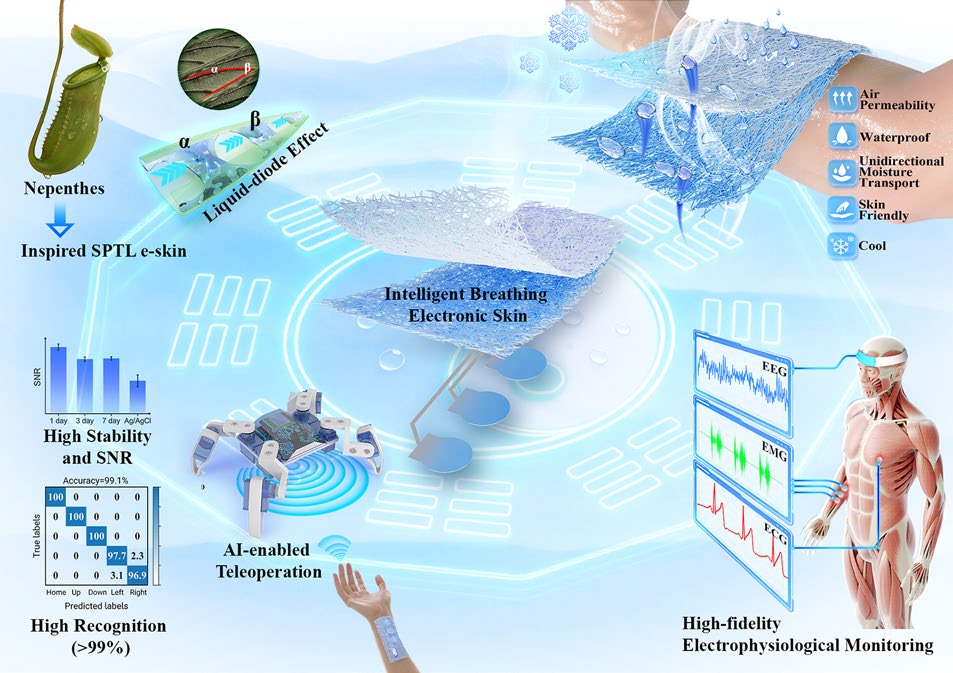

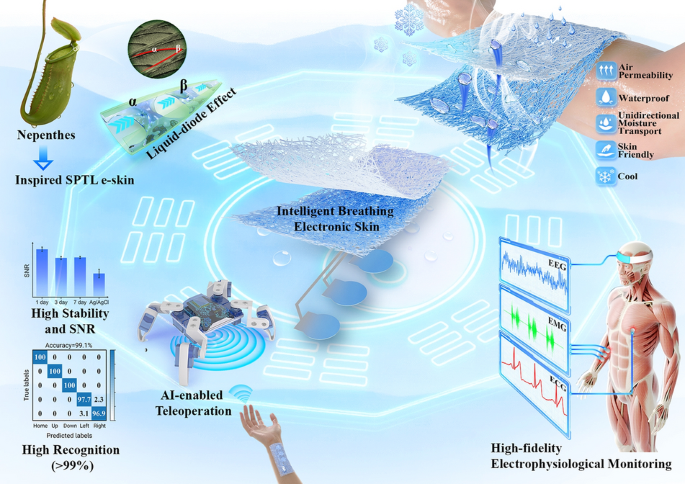

As wearable electronics and human-machine interfaces (HMI) proliferate from clinical diagnostics to daily health monitoring, the persistent challenge of sweat accumulation at the skin-device interface has emerged as a critical bottleneck. Conventional electronic skins (e-skins) suffer from conductivity degradation, interfacial adhesion failure, and signal artifacts caused by trapped perspiration, while hydrogel-based solutions degrade through dehydration over time. Existing breathable devices rely on passive evaporation through pores—a mechanism insufficient under profuse perspiration, leading to liquid backflow, short circuits, and compromised signal fidelity. Now, researchers from Beijing Institute of Technology, led by Professor Ran Cai and Professor Bin Hu, have presented a breakthrough intelligent breathing e-skin that transcends these limitations by translating nature's liquid-management mastery into a multimodal bio-integrated platform.
Why This E-Skin Matters
Traditional unidirectional water transport (UWT) strategies remain confined to passive textiles or air filters, lacking deep integration with high-performance flexible circuits necessary for complex HMI. The novel Nepenthes-inspired Janus e-skin (SPTL) overcomes this limitation by constructing a "liquid diode" effect that actively pumps sweat away from the skin interface while maintaining waterproofness, breathability, and biocompatibility for prolonged wear. This bioinspired architecture bridges the gap between biological intelligence and robotic execution, enabling high-fidelity electrophysiological monitoring and AI-driven teleoperation even under extreme perspiration conditions.
Innovative Design and Mechanism
The device is fabricated through a synergistic integration of sequential electrospinning and liquid metal (LM) screen printing. The bilayer Janus substrate comprises a hydrophobic styrene-butadiene-styrene (SBS) inner layer (skin side) and a hydrophilic polyacrylonitrile (PAN)/thermoplastic polyurethane (TPU) outer layer. This asymmetric wettability gradient generates a liquid-diode effect: when sweat contacts the hydrophobic SBS layer, the upward hydrophobic force is overcome by the dominant capillary force from the superhydrophilic PT nanofibers, driving directional transport even against gravity. When flipped, the hydrophilic layer's omnidirectional capillary force saturates first, while the hydrophobic SBS layer acts as a robust energy barrier preventing backflow and external moisture penetration.
The conductive circuitry is patterned via screen printing of PVP-stabilized EGaIn liquid metal ink onto the Janus membrane. The wave-structured electrode design (SPTL-1) accommodates macroscopic tensile deformation by unfolding to dissipate localized stress, complementing the intrinsic ultrahigh stretchability of the substrate. Density functional theory-inspired geometric modeling confirms that the wave architecture inherently provides larger effective capacitance than planar configurations, enhancing sensitivity across both contact and non-contact sensing modes.
Outstanding Performance
The SPTL e-skin achieves a remarkable cumulative one-way transport index of 956.36—significantly outperforming reported benchmarks—while maintaining a dry skin interface even under profuse perspiration. The device exhibits exceptional mechanical resilience with a tensile strain of 627%, superior air permeability of 20.02 mm s-1, and moisture permeability of 890.46 g m-2 day-1, satisfying physiological requirements for thermoregulation. Pressure sensitivity reaches 7.39 kPa-1 in the low-pressure regime, with ultrafast response/recovery times of 20–30 ms.
Multimodal sensing capabilities are demonstrated through resistive strain monitoring (SPTL-3), capacitive pressure sensing with real-time Morse code transmission, and non-contact capacitive detection resolving directional movement along x, y, and z axes with distance-dependent amplitude discrimination. The SPTL-1 sustains stable performance over 10,000 pressing cycles with less than 3% capacitance decay, and reliably detects micro-forces as light as 0.15 g.
As a bio-integrated electrode, SPTL enables high-fidelity acquisition of electroencephalogram (EEG), electromyogram (EMG), and electrocardiogram (ECG) signals that significantly surpass commercial Ag/AgCl electrodes. EMG signal-to-noise ratio reaches 24.25 dB versus 15.02 dB for Ag/AgCl, with stable high-fidelity capture during 30-minute intensive spinning and 15-minute continuous dumbbell lifting despite profuse natural sweating. The device captures clear PQRST ECG complexes and weak neural activities including 10 Hz EEG alpha rhythms, with no observable skin irritation during 2-day adhesion tests.
Applications and Future Outlook
When integrated with a lightweight Transformer encoder and transfer learning algorithms, the SPTL-based EMG sensing system achieves over 99% accuracy for gesture classification ("up", "down", "left", "right", "home") after merely 50 epochs, enabling precise teleoperation of a quadruped robot in unstructured environments with low-latency wireless control. Handwritten letter recognition (A–D) achieves over 95% accuracy, supported by clear t-SNE clustering of high-dimensional latent features.
This work establishes a versatile strategy for constructing next-generation breathable, robust, and intelligent bio-integrated interfaces. By translating the Nepenthes peristome's anti-backflow architecture into a transmembrane fluidic design synergized with liquid metal circuitry and machine learning, it opens promising avenues for healthcare robotics, telemedicine-oriented cardiac monitoring, and immersive human-machine interaction in extreme physiological conditions.
Stay tuned for more groundbreaking research from this collaborative team at Beijing Institute of Technology!

Editor of Nano-Micro Letters, which is an Open-Access, peer-reviewed journal reported papers that have at least one dimension ranging from a few sub-nanometers to a few hundreds of micrometers. The journal is published by Springer Nature and indexed by SCI, EI, SCOPUS, Pubmed, etc. The 2025 JCR Impact Factor is 38.5. The 2025 CiteScore is 58.9.
Follow the Topic
-
Nano-Micro Letters
Nano-Micro Letters is a peer-reviewed, international, interdisciplinary and open-access journal that focus on science, experiments, engineering, technologies and applications of nano- or microscale structure and system in physics, chemistry, biology, material science, and pharmacy.