International Women´s Day 2026: A Gender Perspective on Data Publishing for a More Inclusive Science. Evidence from the Journal Ecosistemas
Published in Social Sciences and Sustainability



Ecosistemas is the scientific journal of the Spanish Association for Terrestrial Ecology (AEET) and serves as a platform for the dissemination of ecological research, particularly within the Ibero-American scientific community. The journal promotes free (diamond open access), rigorous peer review, transparency in editorial processes, and open scientific dialogue, while also encouraging reflection on how the processes of scientific production, evaluation, and collaboration shape research. Ecosistemas is aware that editorial practices can help advance more inclusive, ethical, and equitable scientific publishing. The current editorial team consists of 29 members, including 4 editors-in-chief and 25 associate editors, with a near gender-balanced composition (15 women and 14 men). Among the editors-in-chief, three are women, reflecting the journal’s effort to promote gender balance. However, there is still much more to be done.
Every March 8, on the occasion of International Women’s Day, the scientific community has an opportunity to reflect on gender equality and on how research and academic publishing can contribute to a fairer and more inclusive society. In this spirit, Ecosistemas continues to strengthen its commitment to transparency, responsible editorial practices, and the analysis of editorial data that help move scientific publishing toward greater equity. Understanding who publishes, who reviews, and how editorial processes evolve is a valuable step toward building a more open and diverse scientific community.
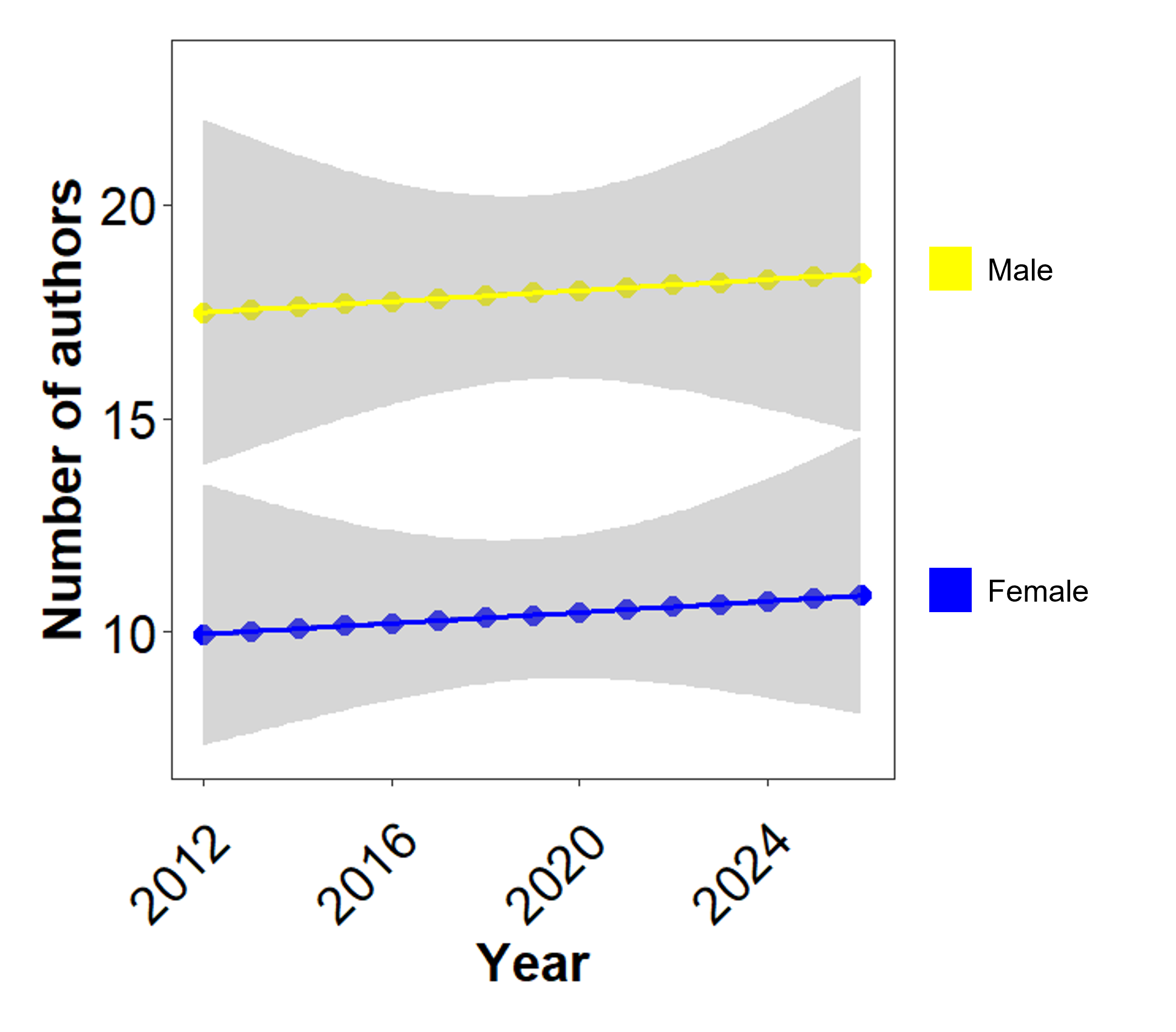
Figure 1. Temporal trends in the number of lead authors by gender in manuscripts submitted to Ecosistemas. Submissions to Ecosistemas show a persistent gender gap in lead authorship that persists over time, manuscripts led by men still predominate. This pattern reflects broader structural gender imbalances that remain present across many areas of academic research.
These observations are particularly relevant in the context of the recommendations of the Spanish Foundation for Science and Technology (FECYT), which encourages scientific journals to publish gender-disaggregated statistics and to promote balanced participation in editorial teams and peer-review systems. Incorporating a gender perspective into editorial policies is therefore an important component of ethical and responsible scientific publishing, helping to foster diversity, transparency, and fairness.
Based on the Ecosistemas’s available editorial data from 2012 to 2026, 425 submitted manuscripts and 2,526 review invitations were analyzed. The diversity of the submitting community highlights the journal’s role as a meeting point for ecological research across the Ibero-American region. Spain accounts for the largest number of submissions (165), followed by Mexico (57), Ecuador (26), Argentina (25), Colombia (24), and Peru (23). This geographical distribution reflects the strong collaborative network of ecological research across Spanish-speaking countries.
Looking at authorship from a gender perspective provides further insight into the evolution of the scientific community. Among the manuscripts analyzed, 269 have a male lead author (63%), while 156 have a female lead author (37%). Although these figures reflect gender imbalances that still exist in many scientific fields, they also highlight a substantial participation of women leading ecological research.
Figure 2. Temporal trends in the number of published and rejected articles in Ecosistemas by gender of the lead author. Both published and rejected manuscripts reflect the same underlying gender imbalance in submissions. Because more manuscripts are submitted by men, they also appear more frequently among both accepted and rejected papers. These patterns highlight that differences in publication outcomes may often reflect disparities in submission rates rather than editorial bias alone.
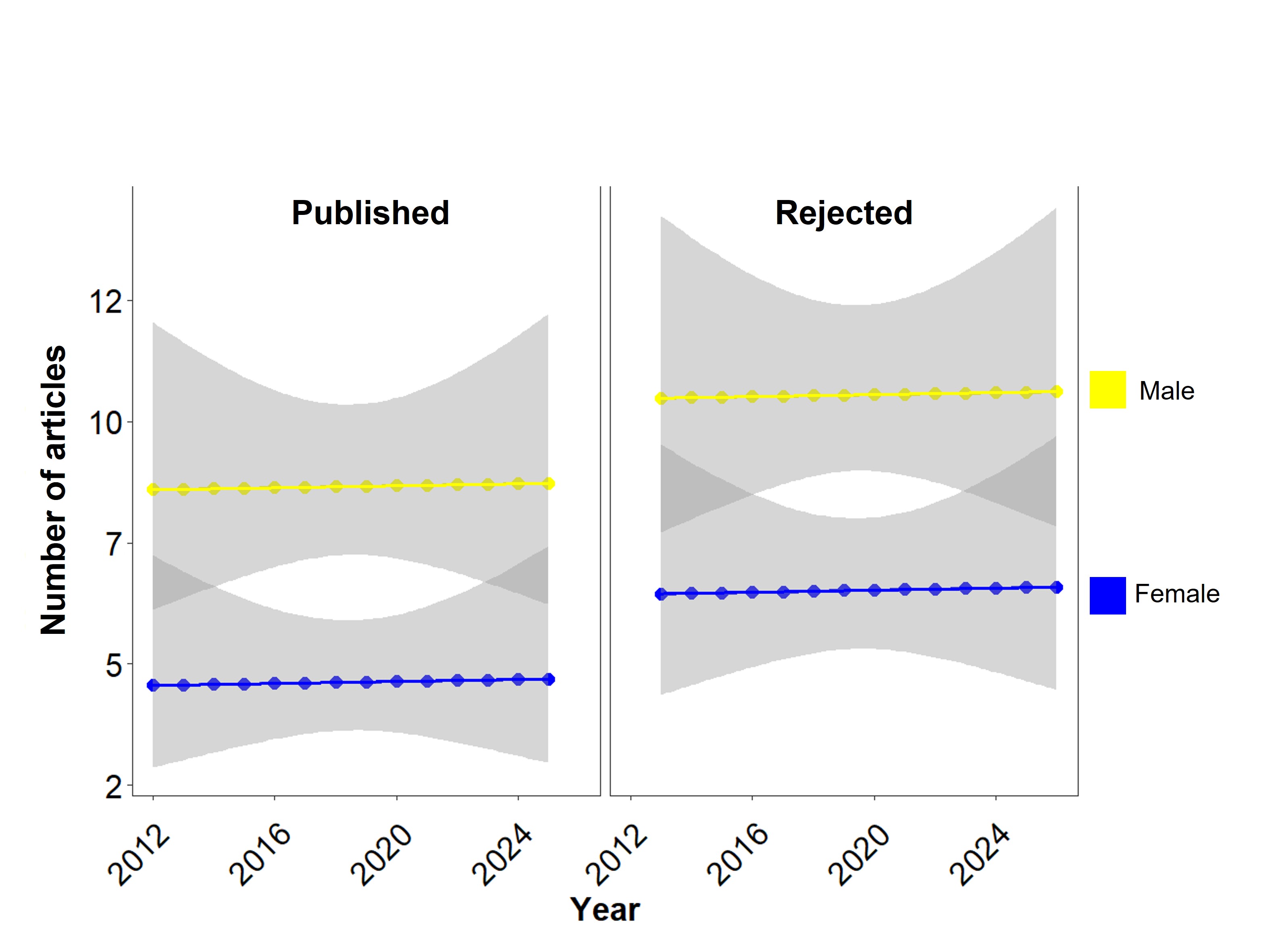
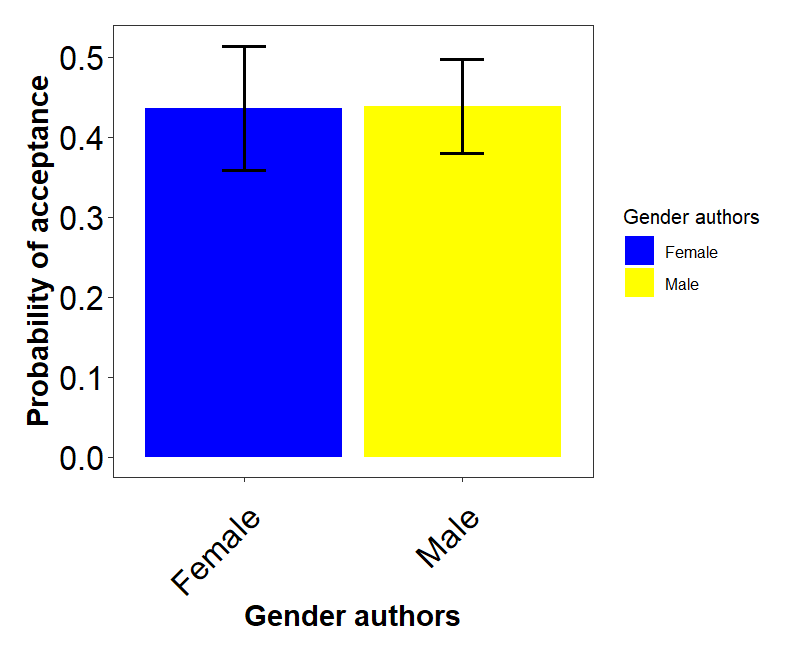
Figure 3. Probability of manuscript acceptance in Ecosistemas according to the gender of the lead author. The probability of acceptance appears very similar for manuscripts led by male and female lead authors. This suggests that, within the available data, editorial decisions in Ecosistemas are not strongly associated with the gender of the lead author. However, equal acceptance probabilities do not necessarily eliminate broader structural inequalities that influence who submits manuscripts in the first place.
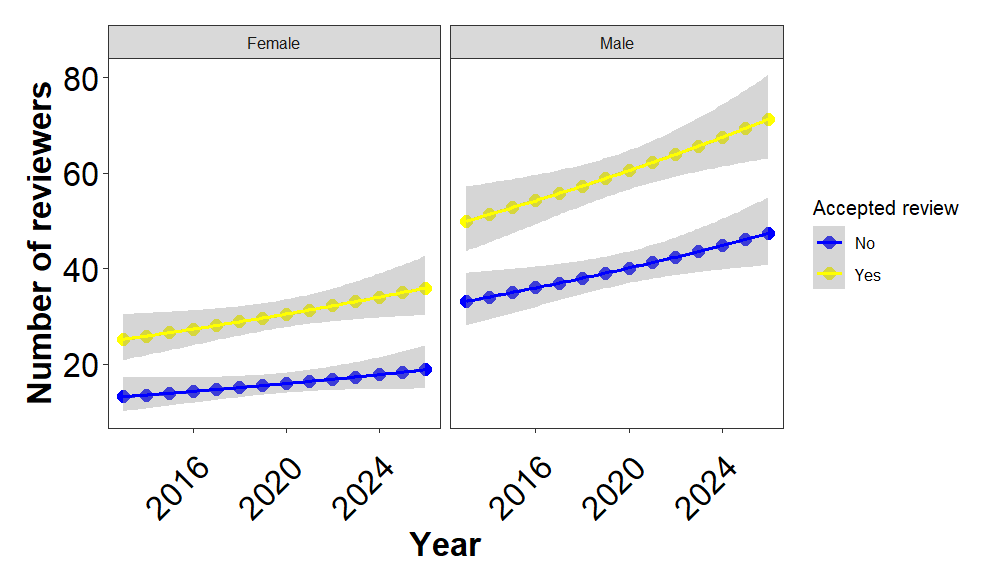
The peer-review process also reflects the collective effort that sustains scientific publishing. A total of 2,526 review invitations were recorded. The temporal trends in reviewer participation, illustrated in the accompanying figures, provide additional insight into how the editorial process has evolved. The graphs show the number of review invitations over time, distinguishing between accepted and declined invitations and separating the results by gender.
Taken together, these patterns show that both women and men actively contribute to peer review, and that men still participate as reviewers in greater numbers, reflecting broader structural gender imbalances that persist across many areas of academic research. However, these results must be interpreted with caution when designing strategies to address this imbalance. For example, aiming to invite reviewers in equal proportions (e.g., 50% women and 50% men) could unintentionally increase the reviewing burden on women in academia, given that the overall pool of available reviewers is not gender-balanced. In contexts where women are underrepresented in certain research fields or career stages, strict parity targets in reviewer invitations may lead to a disproportionate number of requests being directed to the same individuals. Therefore, efforts to promote equity in peer review should consider both representation and workload distribution, ensuring that initiatives aimed at improving gender balance do not inadvertently reinforce existing inequalities.
Figure 4. Temporal trends in accepted and declined reviewer invitations in Ecosistemas by reviewer gender. Peer review in Ecosistemas relies heavily on the contribution of the research community. While both women and men participate as reviewers, men are invited and participate more frequently. This pattern mirrors well-documented gender disparities in academic networks and workload distribution, raising important questions about how peer-review responsibilities are allocated across the scientific community.
Disclaimers: It is important to note that these 425 manuscripts represent only part of the articles handled by the journal, as complete editorial information was not available for all submissions across the entire period analyzed. Therefore, the results presented here should be interpreted as a representative snapshot rather than a full analysis of all manuscripts processed by the journal. At the same time, it is important to acknowledge that gender is not a binary category. The analysis presented here relies on the limited gender information available in the dataset, which only allowed classification into male and female categories. Because the dataset did not include self-identified gender information beyond these categories, it was not possible to represent the full diversity of gender identities within the scientific community.
On the occasion of 8M 2026, sharing and reflecting on these data offers an opportunity to celebrate the progress already made while continuing to work toward a more inclusive research culture. In the case of Ecosistemas, the data highlight an active and engaged scientific community, a transparent editorial process, and a clear commitment to responsible and equitable publishing practices. In the future, the Ecosistemas editorial board will further strengthen its editorial policy and commitment to transparent and rigorous reporting on gender diversity and inclusivity in scientific publishing by expanding the collection and report of information from users.
By examining editorial data and continuing to promote equity, openness, and feminist-informed ethics in publishing, we can help build a scientific environment in which all researchers can have the opportunity to contribute, collaborate, and flourish.
Laura Hernandez Mateo, Mercedes Molina, Ignasi Bartomeus, Leyre Jiménez-Eguizábal, María Losada and Mar Sobral
I am an associate professor specializing in ecology and evolution in the Department of Geography at USC, Spain. I also have the pleasure of serving as the associate editor-in-chief of Ecological Monographs, Biogeography and Ecosistemas. Previously, I had the opportunity to work in the U.S. (Stanford) and France (CNRS).
My research is driven by a passion for two main areas: evolutionary ecology, particularly the role of plasticity, and understanding how global change affects biodiversity, especially in relation to the carbon cycle. Beyond research, I love engaging in science outreach (enjoy this video) and advocating for gender equality in academia through initiatives like WISE