Invisible Markets: How Bacteria Strategically Allocate Resources
Published in Microbiology, Cell & Molecular Biology, and Biomedical Research






Bacterial extracellular vesicles (EVs) are widely recognised as mediators of communication, virulence, and immune modulation. Since EVs are quite laborious to collect, the question that prompted this study was actually a very practical one:
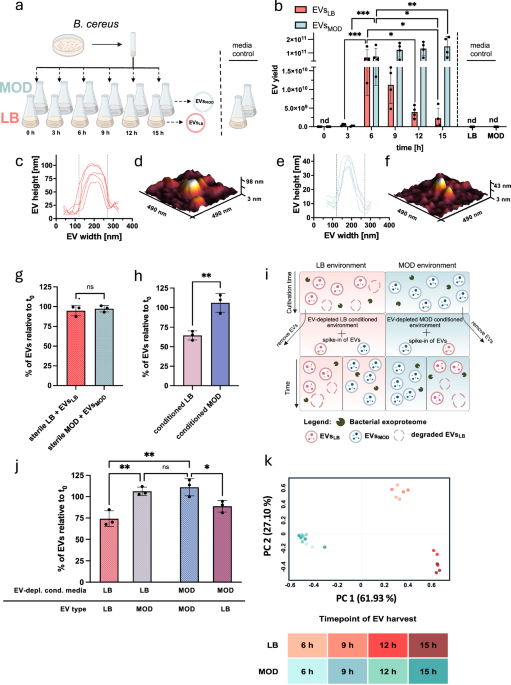
At what time point do we get the maximum yield of bacterial EVs?
Thus, we started to map EV release over time, expecting a typical “more time, more vesicles” pattern. We did find a clear peak in EV release. But what surprised us was what happened next: instead of plateauing, EV levels declined. At first, we treated this as a technical problem to be solved—something to optimise away. Only when we saw that this decline was reproducible and condition-dependent did we begin to suspect that the system itself was telling us a story.
And that’s where our story began: We used Bacillus cereus as a model organism to study how EVs behave in different environments. What we observed challenged a long-standing assumption in the field. Rather than simply accumulating over time, EVs progressively disappeared in nutrient-rich environments, whereas under nutrient-limited conditions they remained stable and continued to accumulate. The vesicles behaved very differently depending on the bacteria's metabolic context.
This observation became the turning point of our study, transforming a protocol optimisation exercise into a biological question: We became curious whether EVs might play a more active role than we had thought; not just as carriers of information, but as functional components of bacterial adaptation.
To disentangle the intrinsic properties of EVs from environmental influences, we stepped out of standard protocols and conducted unconventional experiments. We changed growth media mid-culture, and we transferred EVs between nutrient-rich and nutrient-poor conditions to see how they behave. These experiments helped us separate what belongs to the vesicle’s architecture from what is imposed by the surroundings.
Beyond the mechanistic insight, our findings expand the conceptual framework of EV biology. They show how the interaction between lipid architecture and enzymatic activity can determine the fate and function of EVs in a context-dependent way. Under certain conditions, EVs effectively serve as recyclable nutrient reservoirs rather than just delivery vehicles.
Looking back, the turning point of this study was the decision not to dismiss the loss of EVs over time as merely a technical issue. By treating a bothersome inconsistency as a biological signal, we ended up expanding the way we think about bacterial EVs.
Ultimately, this study is a reminder that revisiting assumptions can lead to new directions. By looking beyond the established roles of EVs, we uncovered a previously unrecognised bacterial strategy—one where EVs are not only messengers, but dynamic components of a resource economy that supports survival in changing environments.
Follow the Topic
-
Nature Communications
An open access, multidisciplinary journal dedicated to publishing high-quality research in all areas of the biological, health, physical, chemical and Earth sciences.

Related Collections
With Collections, you can get published faster and increase your visibility.
Women's Health
Publishing Model: Hybrid
Deadline: Ongoing
Tumor Microenvironment Crosstalk and Therapeutic Implications
Publishing Model: Hybrid
Deadline: Nov 02, 2026