Mathematics and Contexts: Didactic Issues in Postcolonial Settings
Published in Education and Mathematics

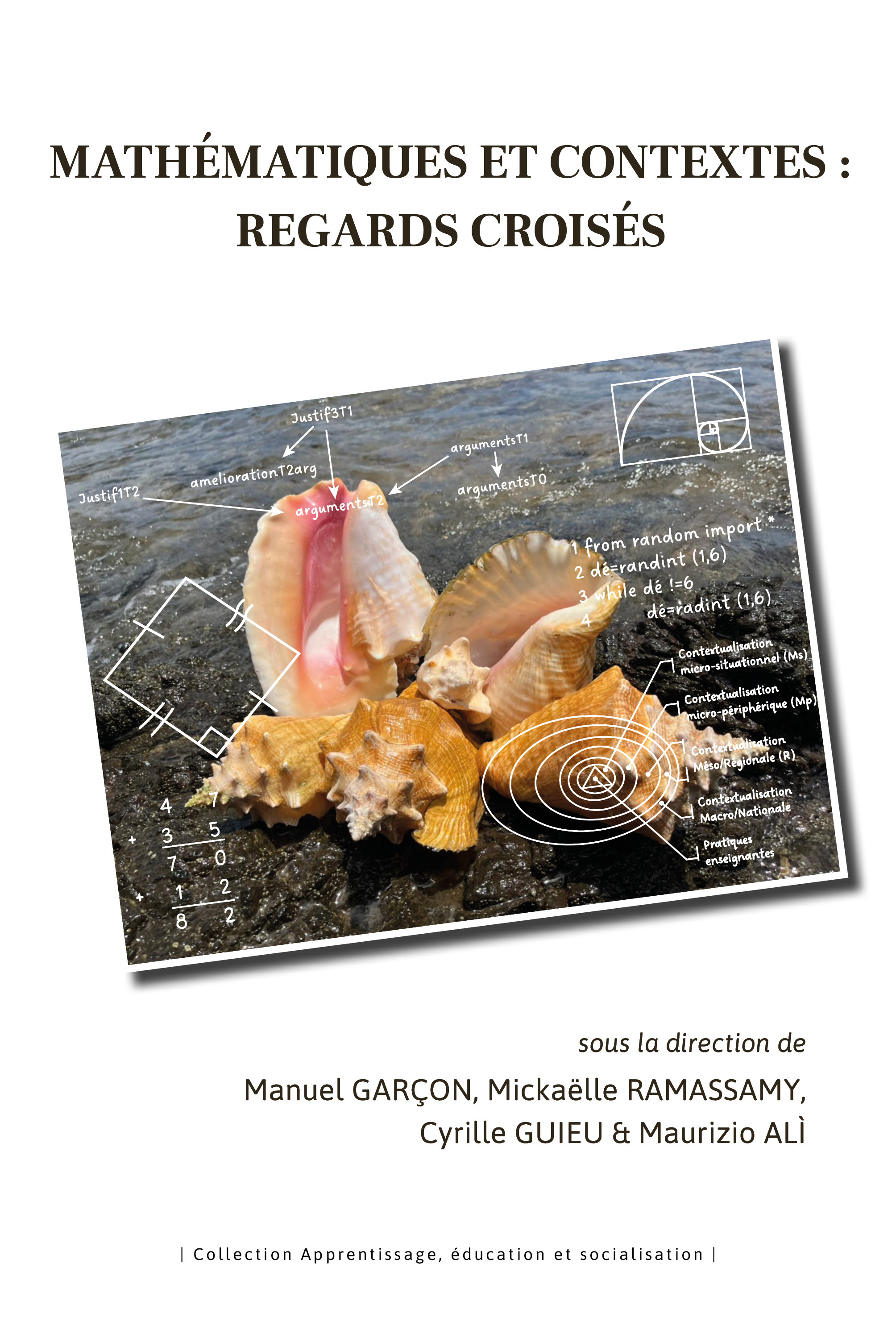

In France, mathematics occupies a central place in the education system, and French excellence in fundamental mathematical research is internationally recognized. However, the performance of French students in this discipline remains below international standards, particularly in the overseas territories. These gaps can be explained by social norms, structural and ideological obstacles inherited from the colonial situation and perpetuated in the postcolonial context, but also by the persistence of an "indifferent to differences" approach within the educational system. It is precisely these extracurricular dynamics that most often generate difficulties in the transmission of mathematical knowledge and continue to have a significant impact on the quality of learning for students in French overseas territories. These territories have been constitutionally integrated into the Republic since 1946, but their colonial history continues to weigh heavily on their educational ecosystem. Numerous studies have shown that the school policies in place in these territories reproduce a logic inherited from the colonial period: that of a school system that imposes its categories without recognizing the legitimacy of local knowledge.
The University Press of the Antilles has just released a research anthology (edited by Manuel Garçon, Mickaëlle Ramassamy, Cyrille Guieu, and Maurizio Alì, with a preface by Antoine Delcroix) presenting the most current research in the field of mathematics education: these works are inspired by a contextual approach, examining educational practices and systems, as well as the perceptions and experiences of teachers and learners in France's overseas territories, in order to describe and analyse the complex relationships between contexts and teaching methodologies and to identify avenues for action, epistemological reflections, and methodological proposals. The book devotes several chapters to the crucial and highly political issue of academic performance. The results obtained by the contributors converge on the same conclusion: the students' socioeducational environment and their mental representations of mathematics predict their performance far better than their raw cognitive ability. Mathematical skills are not abstract and disconnected from any cultural grounding: they are also constructed in and through situated practices. Many contributions in the book also discuss the issue of inequality and systemic factors influencing success in learning mathematics. Comparing data obtained in the French overseas territories with data available at the national level reveals specific characteristics that deserve attention (for indeed, the overseas academies show smaller gender gaps than those in European France). The book clearly demonstrates the impact of the social determinism that characterizes the French system on student performance: the effect of social background on success in mathematics is more pronounced in the overseas territories than in metropolitan France. The economic structure of these territories (highly polarized, which has allowed the persistence of phenomena such as poverty, unemployment, and crime), and the lack of resources allocated to education combine to amplify the impact of social inequalities on the learning process: an explosive cocktail whose ingredients are common to other territories that share the same postcolonial situation. This observation also shows us that educational inequalities are not inevitable: they are the product of specific contexts, and therefore transformable.
The solution to this problem requires a joint political and educational effort: the State and the territorial administrations responsible for education must guarantee the necessary means and resources to improve the school system in the French overseas territories, whose weaknesses and dysfunctions have been highlighted by organizations such as UNICEF and CNCDH. Furthermore, it is important to support efforts to contextualize teaching methods and differentiate instruction in schools and universities to ensure that local specificities and the needs of all students are considered.
The French public school system rests on an admirable ideal: the same rights, the same knowledge, the same diplomas for all. But treating fundamentally different situations identically is not equality: it is an epistemic injustice disguised as neutrality. Mathematics is universal, which is precisely why its teaching deserves to be adapted to each educational context.
The book:
- Garçon, M., Ramassamy, M., Guieu, C. et Alì, M. (dir.) (2026). Mathématiques et contextes : regards croisés. Presses Universitaires des Antilles. https://presses.univ-antilles.fr/collections/apprentissage-education-et-socialisation/mathematiques-et-contextes-regards-croises.
Bibliography
- Alì, M. et Delcroix, A. (2022). Contextes éducatifs, contextualité des savoirs, contextualisation didactique : regards pluriels et perspectives transdisciplinaires. Contextes et Didactiques, 20. https://doi.org/10.4000/ced.4091.
- Alì, M. (2020). The Education System of the French Overseas Departments of America. Dans S. Jornitz et M. Parreira do Amaral (dir.), The Education Systems of the Americas. Global Education Systems (pp. 583–606). Springer. https://doi.org/10.1007/978-3-030-41651-5_9.
- Alì, M. (2023a). Autochtonie et question éducative dans les Outre-mer : Une enquête comparative en Guyane et en Polynésie française. Presses Universitaires des Antilles. https://doi.org/10.3917/pua.ali.2023.01.
- Alì, M. (2023b). Cultures, savoirs et identités : Questions vives en anthropologie de l'éducation. Presses universitaires des Antilles. https://doi.org/10.3917/pua.ali.2023.02.
- Garçon, M. (2022). Challenges of teaching mental arithmetic and school performances in a post-colonial context: a case study in Senegalese primary schools. Italian Journal of Health Education, Sport and Inclusive Didactics, 6(4). https://doi.org/10.32043/gsd.v6i4.742.
- Garçon, M. (2023). L'apprentissage du calcul mental en contexte postcolonial : représentations et performances des élèves de l’enseignement primaire en Martinique. Contextes et Didactiques, 21. https://doi.org/10.4000/ced.4144.
- Garçon, M., Alì, M. et Fundora Cruz, R. (2024). El cálculo mental en la escuela primaria: una encuesta socio-psicométrica en los establecimientos educativos públicos de las Antillas francesas. Revista Eletrônica de Educação, REVEDUC, 18(1). https://doi.org/10.14244/reveduc.v18i1.6956.
- Guieu, C. (2021). Introduction du langage Python au lycée. : une étude de cas dans le contexte d'un cours de mathématiques. Journées de la recherche en éducation, Université de la Polynésie française, 28-29 avril. https://hal.science/hal-04929813.
- Guieu, C. (2023). Une séquence d'algorithmique au collège pour introduire les variables. Repères IREM, 122, 5-14. https://hal.science/hal-04912982.
- Guieu, C. (2024). Genèse didactique d'un jeu sérieux : le site PyRates. MathémaTICE, 90. https://hal.science/hal-04914204.
- Ramassamy, M., Alì, M. et Delcroix, A. (2023). Apprentissage de la preuve au supérieur aux Antilles. Dans Carole Atem et Zehra Gabillon (dir.), Contextualiser l'éducation en milieux plurilingues et pluriculturels (p. 299-324). Berne : Peter Lang. https://doi.org/10.3726/b20935.
- Weiss, P.-O., Alì, M. et Vilieva, K. (2022). Visions périphériques. Éduquer et former en temps de crise. Dans P. Weiss et M. Alì (dir.), L’éducation aux marges en temps de pandémie : Précarité, inégalité et fractures numériques (p. 13-38). Presses universitaires des Antilles. https://doi.org/10.3917/pua.weiss.2022.01.0013.

Please sign in or register for FREE
If you are a registered user on Research Communities by Springer Nature, please sign in