Willing, But Boxed In: What 383 Nigerian Pharmacists Told Us About Preventing Disease Before It Starts
Published in Social Sciences, Public Health, and Behavioural Sciences & Psychology



The pharmacist you walk past every day
Picture the pharmacy nearest to you. Maybe it's a small shop on a busy street corner, or a counter inside a hospital. Chances are, you've been there for one reason: to pick up a prescription. In and out. Transactional.
But what if that same pharmacist could do more such as screen you for high blood pressure while you wait, talk you through quitting smoking, or catch early warning signs of diabetes before it becomes a crisis? In many countries, this is already happening. In Nigeria, it mostly isn't. Not because pharmacists don't want to but because almost everything around them makes it hard.
That gap, between what pharmacists are willing to do and what the system lets them do, is what our team set out to measure.
Why this matters right now
Nigeria is dealing with a health burden most countries only face one side of at a time. Infectious diseases like malaria and tuberculosis haven't gone away, but on top of that, non-communicable diseases such as hypertension, diabetes, cancer, heart disease are climbing fast. Hospitals and clinics are stretched thin trying to treat both.
Health promotion is one of the most cost-effective tools available anywhere in the world. And pharmacists are, in theory, perfectly placed to deliver it. They're everywhere. People trust them. And unlike a doctor's appointment, walking into a pharmacy doesn't require booking weeks in advance.
The problem is that no one had really asked, at a national level, Nigerian pharmacists themselves: are you doing this work? Do you want to? And what's standing in your way?
What we did
Between December 2024 and April 2025, we surveyed 383 community and hospital pharmacists from across Nigeria. We asked about the health promotion activities they were already doing, how they felt about that role, and what got in the way.
Pharmacists across all six of Nigeria's geopolitical zones took part, giving us a rare, genuinely national picture.
What we found
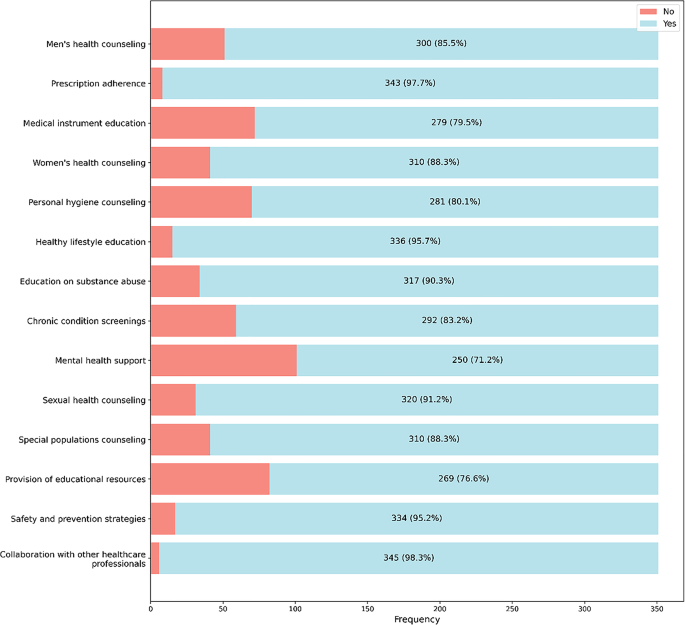
Pharmacists are already showing up. 91.6% of the pharmacists we surveyed said they were actively involved in some form of health promotion, mostly counselling patients on taking their medication correctly (97.7%) and working alongside doctors and nurses (98.3%). This isn't a profession waiting to be convinced. It's a profession already leaning in.
They believe in the work. Almost everyone we surveyed — 97.9% — had a positive perception of health promotion, and 96.9% had a positive attitude toward doing it. Most rejected the old idea that prevention is "a doctor's job" or "a nurse's job." Many specifically pointed out that screening people in the pharmacy for things like high blood pressure or diabetes could meaningfully reduce heart disease down the line.
But the system isn't built for it. Here's where the story turns. Despite all that enthusiasm:
- 61.1% said they simply hadn't been trained to do it properly.
- 65.5% had no private space to have these conversations with patients.
- 70.8% said patients themselves didn't have time to engage.
- 72.9% cited a lack of funding, and 74.7% pointed to medicine or supply shortages getting in the way.
In other words, the will is there. The infrastructure isn't.
One quiet gap stood out. While pharmacists were confident talking about medication and lifestyle changes, only 71.2% were involved in mental health support noticeably lower than almost every other activity we measured. That's worth paying attention to, given how much unmet mental health need exists globally, and how often a pharmacy visit might be someone's only regular contact with the health system.
Who you are shapes how you see the role. A few patterns emerged that surprised us. Younger pharmacists (21–30) felt more confident in the idea of health promotion but were less sure of their readiness to actually deliver it almost the opposite of what you might expect. Pharmacists with more years of experience, by contrast, felt more ready, even if their initial enthusiasm had mellowed. And pharmacists working in rural areas had a more guarded view of the role overall, yet a stronger personal motivation to do it anyway, suggesting real grit in the face of harder working conditions. Interestingly, whether someone worked in a community pharmacy or a hospital pharmacy made almost no difference at all, as the barriers and the willingness cut across both settings.
Why this matters beyond pharmacy
This isn't just a study about pharmacists. It's a study about an underused resource sitting in plain sight. If a country wants to get serious about preventing disease rather than only treating it, it needs to invest in the people patients already trust and already visit not just build new programs from scratch.
Concretely, that means incorporating practical health-promotion training into pharmacy education; giving pharmacies the physical space and tools (even something as simple as a blood pressure cuff and a private corner) to have these conversations; and having national bodies like the Pharmacy Council of Nigeria formally build pharmacists into disease-prevention strategy.
The takeaway
The pharmacists in this study are ready. The barrier is training, space, time, and policy. Fix those, and Nigeria has an army of accessible, trusted health workers already standing in every neighborhood, ready to help people stay well rather than only treating them once they're sick.
Read the full open-access paper here: [https://doi.org/10.1186/s12913-026-14217-7]

Follow the Topic
-
BMC Health Services Research
An open access, peer-reviewed journal that considers articles on all aspects of health services research, focusing on digital health, governance, policy, system quality and safety, delivery and access, financing and economics, implementing reform, and the workforce.

Related Collections
With Collections, you can get published faster and increase your visibility.
Patients' knowledge of the indications for their medications
BMC Health Services Research is calling for submissions to our Collection on Patients' knowledge of the indications for their medications.
Understanding the indications for prescribed medications is crucial for patient safety and effective healthcare delivery. Many patients lack adequate knowledge about their medications, which can lead to non-adherence, adverse drug reactions, and suboptimal health outcomes. This Collection invites research that examines the extent of patients' medication knowledge, the factors influencing their understanding, and the implications for healthcare practice. By exploring these aspects, we aim to illuminate the gaps in medication literacy and the importance of patient engagement in their treatment regimens.
Enhancing patients' knowledge of their medications is vital for fostering informed decision-making and promoting adherence to treatment plans. Recent advances in medication counseling, patient education programs, and digital health technologies have shown promise in improving medication awareness. These interventions not only empower patients but also support healthcare providers in delivering personalized care. By fostering a culture of medication literacy, healthcare systems can enhance patient outcomes and reduce the burden of medication-related issues.
Topics for submission:
Assessing medication literacy in diverse populations
Barriers and facilitators to understanding medication indications
Impact of patient education and other related interventions on medication adherence
Tools, interventions and strategies for enhancing patient medication knowledge
Understand how, why for whom and under what circumstances interventions to enhance medication knowledge work or not
This Collection supports and amplifies research related to SDG 3 (Good Health and Well-being).
All manuscripts submitted to this journal, including those submitted to collections and special issues, are assessed in line with our editorial policies and the journal’s peer review process. Reviewers and editors are required to declare competing interests and can be excluded from the peer review process if a competing interest exists.
Publishing Model: Open Access
Deadline: Sep 30, 2026
Strengthening health system resilience: from emergency preparedness to response and recovery
Health systems worldwide are increasingly facing the dual challenges of rising health demands and the unpredictability of emergencies. Recent and ongoing polycrises—whether the COVID-19 pandemic, sporadic outbreaks of emerging or reemerging diseases, or increasingly frequent emergencies resulting from natural hazards—have highlighted the urgent and compelling need for enhanced health system preparedness and resilience. Effective emergency preparedness involves not only robust planning and response strategies but also the capability to adapt and recover quickly from disruptions. This Collection aims to explore the multifaceted aspects of strengthening health systems to ensure they can effectively prepare for, respond to, and recover from emergencies and maintain continuity of care.
Addressing the resilience of health systems is crucial for safeguarding public health and ensuring that healthcare providers can deliver effective services during crises. Recent advancements have included the integration of technology in health management, improved supply chain logistics, and enhanced workforce training. Furthermore, frameworks for assessing health system resilience have been developed, offering valuable insights into best practices. However, ongoing research is needed to evaluate the effectiveness of these strategies and to implement innovative solutions that can be adapted to various contexts and crises.
Topics for submission but are not limited to:
- Governance, leadership, and policy approaches for resilient health systems
- Frameworks and metrics for assessing and strengthening health system preparedness and resilience
- Financing mechanisms and economic resilience of health systems in emergencies
- Community engagement and locally led strategies in crisis preparedness, response and recovery
- Workforce training, surge capacity, and capability building for emergency response
- Supply chain management and essential resource security during emergencies
- Digital technologies and data-driven innovations for emergency preparedness, response and recovery
- Health system resilience in underserved, vulnerable, or fragile settings
This Collection supports and amplifies research related to SDG 3: Good Health and Well-being.
All manuscripts submitted to this journal, including those submitted to collections and special issues, are assessed in line with our editorial policies and the journal’s peer review process. Reviewers and editors are required to declare competing interests and can be excluded from the peer review process if a competing interest exists.
Publishing Model: Open Access
Deadline: Mar 19, 2027