Less is more: Strategic reforestation achieves same cooling with less land
Published in Earth & Environment and Mathematics

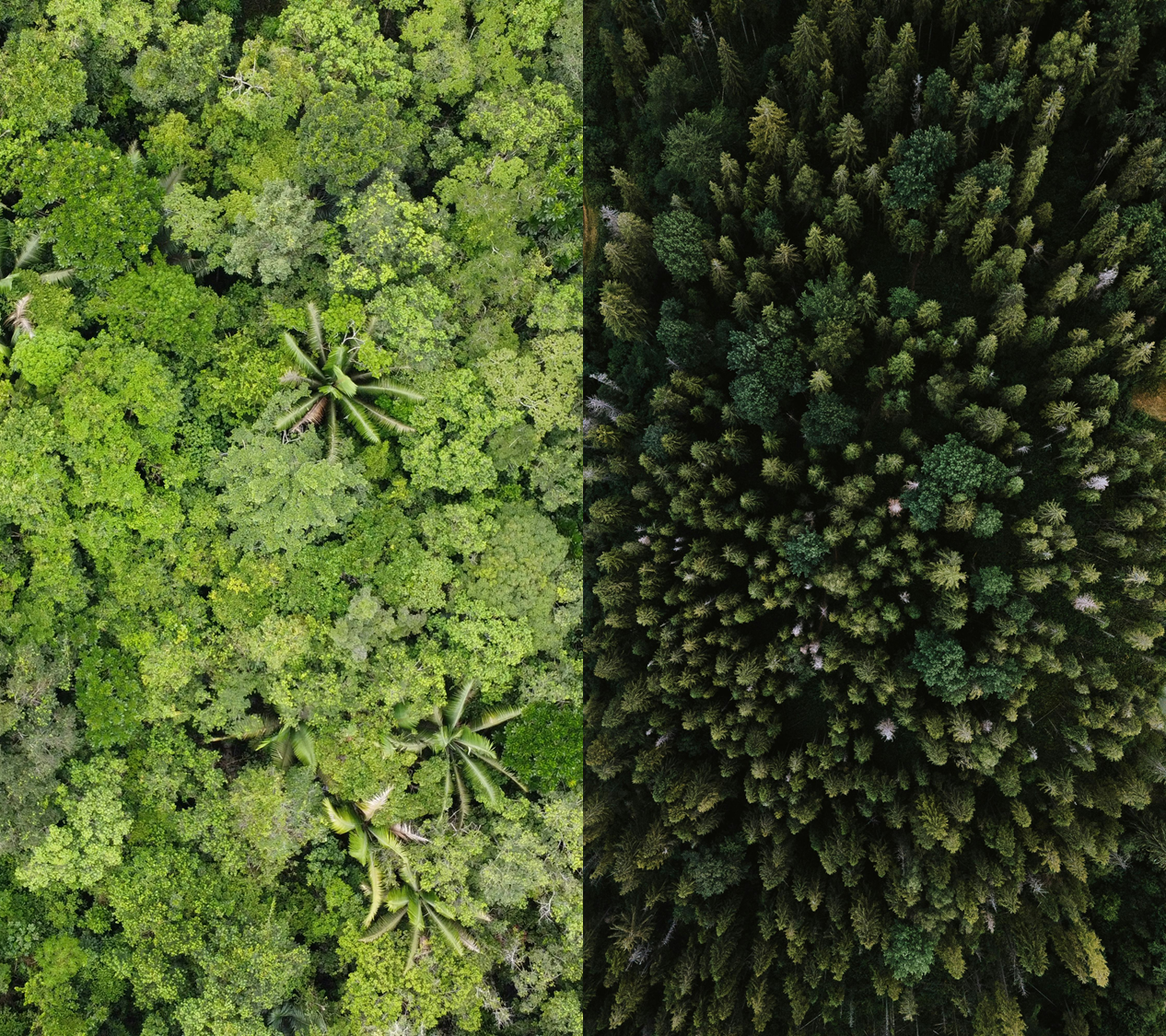





Why is the research valuable?
Limiting global warming to well below 2°C requires us to rapidly decarbonize our economies while simultaneously removing vast amounts of CO2 from the atmosphere. While high-tech carbon removal remains expensive and difficult to scale, reforestation is seen as a promising, ready-to-use solution for carbon uptake. It is cost-effective, supports biodiversity, and has gained immense public support and political traction (Seddon et al. 2020, Griscom et al. 2017), from the EU’s Nature Restoration Law to the Trillion Tree campaign.
As a researcher, I began to wonder: How would the Earth really respond if we were to implement these large-scale reforestation projects? Trees do not just take up carbon and cool the planet, but they also change how much sunlight the Earth reflects (albedo), how much water evaporates and even the roughness of the landscapes, which alters wind patterns (Bonan et al. 2008). So, could we unintentionally trigger warming in some places while trying to cool the planet? Thus, we wrote this paper to look at the projected climate outcomes of different reforestation scenarios.
What did we do?
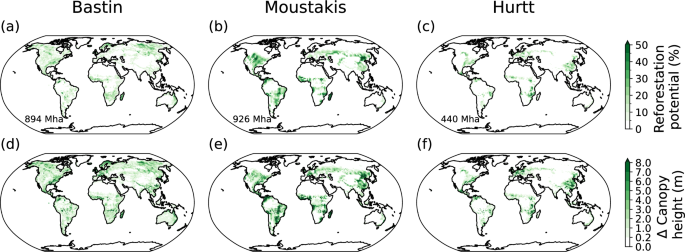
To find out, we performed reforestation simulations with an Earth System model (CESM2, Danabasoglu et al. 2020) to simulate the planet’s processes across the atmosphere, ocean, and land surface until the year 2100. We implemented three different reforestation scenarios in the model, from Bastin et al. 2019, Hurtt et al. 2020 and Moustakis et al. 2024, which include the maps informing international policies and that have sparked the Trillion Tree campaign.
Running these simulations was a test in patience: Our supercomputers ran for over four months continuously, requiring biweekly manual supervision to manage the data output. In the end, we generated a total of 300 terabytes of simulation data. Finally, came the time to actually look at the simulation results showcasing how reforestation impacts the local and regional climate.
We got some surprising results: We found that although the Hurtt reforestation scenario uses roughly half the land of the Bastin scenario—a difference of 450 million hectares, or the size of the European Union—it achieved almost the same global cooling at the end of the century (see Fig. 1). Why? Because the Bastin scenario had large reforestation in northern regions like central Canada and Siberia which created large albedo-driven warming that effectively cancelled out some of the cooling related to the trees’ carbon uptake.
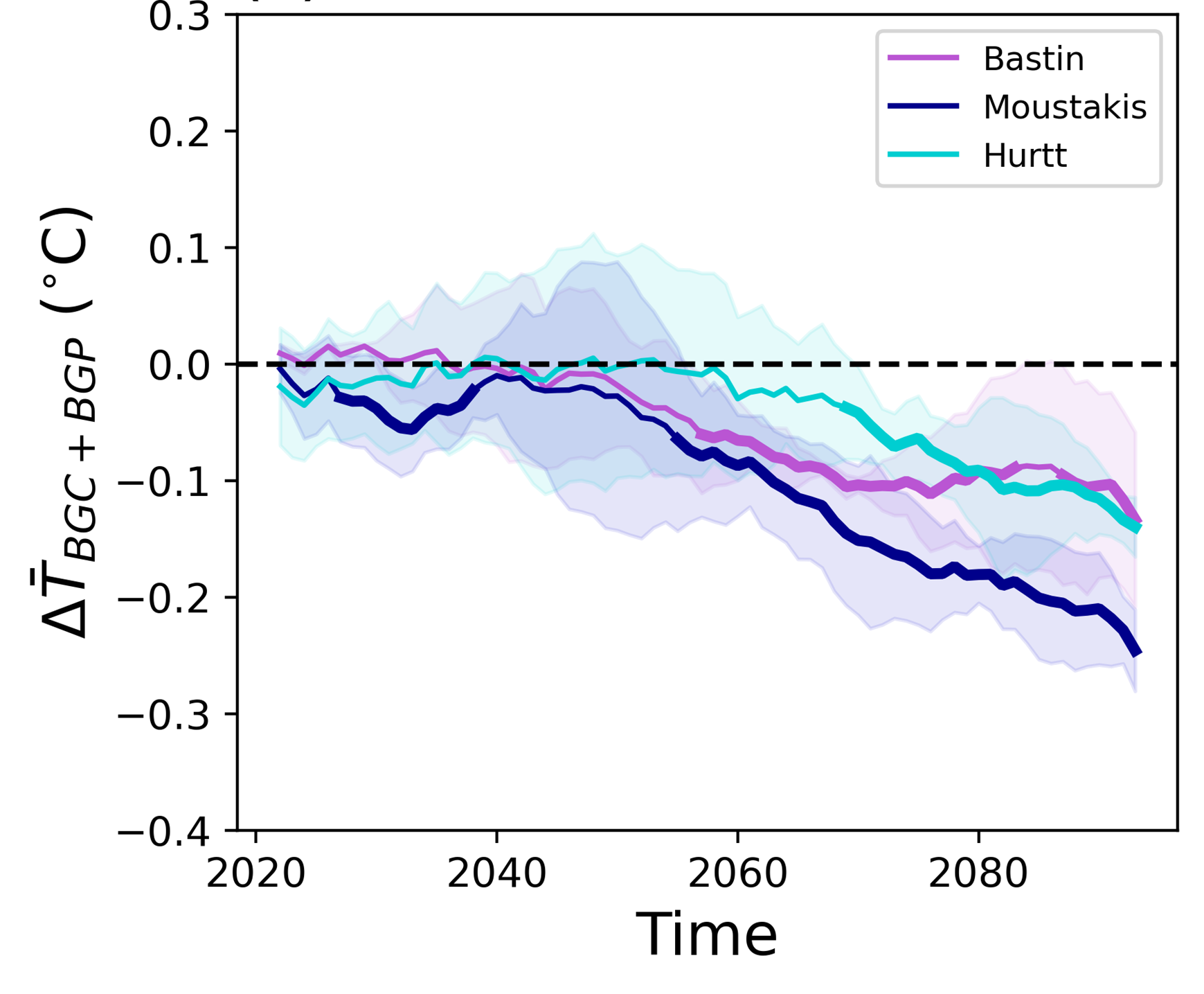
carbon uptake and physical changes of the surface following three
different reforestation scenarios (Bastin, Moustakis, Hurtt).
Furthermore, we found that a forest’s impact is not confined to its own borders. Using a method called moving window regression, we found that "non-local" effects—changes in regions far beyond the forest caused by shifts in atmospheric and oceanic circulation—often contributed more to regional temperature responses than the trees in the region itself. While local cooling dominates in the tropics, these non-local effects are the prominent temperature influence at high latitudes. Even more surprising, the non-local effects varied drastically depending on different reforestation locations.
What are the implications?
Our study provides a check for global policy. We found that even the most ambitious reforestation scenario only cools the Earth by 0.25°C by 2100. This shows that while reforestation can be an important supplement to reduce global warming, it cannot be a replacement for the urgent need to cut fossil fuel emissions.
Based on our findings, we believe it is time to move toward "climate-smart" reforestation policy:
- Prioritize reforestation in the tropics: Trees in the tropics provide the strongest cooling due to carbon storage and evapotranspiration, while reforestation in northern regions can unintentionally lead to a masking or potentially even exceeding of the carbon effect.
- Move beyond the “more is better” principle: Current policies like the UN REDD+ and Paris agreement focus exclusively on a “more is better” reforestation principle and only consider carbon effects of forests. Future policies must move beyond this carbon-focused view and should also account for the physical effects of forests on temperature to ensure that planting efforts truly cool the planet.
Ultimately, our study proves that where we plant trees matters just as much as how many we plant for the temperature effects. While we argue that non-carbon effects must be integrated into global climate policy, we recognize that a temperature-focused view is only the beginning. For reforestation to succeed in the long term, we must harmonize these climate priorities with the vital needs of local communities and the preservation of global biodiversity.
References
Seddon, N. et al. Global recognition of the importance of nature-based solutions to the impacts of climate change. Glob. Sustain. 3 (2020)
Griscom, B. W. et al. Natural climate solutions. P. Natl. Acad. Sci. USA 114, 11645–11650 (2017)
Bonan, G. B. Forests and climate change: Forcings, feedbacks, and the climate benefits of forests. Science 320, 1444–1449 (2008)
Danabasoglu, G. et al. The Community Earth System Model Version 2 (CESM2). J. Adv. Model. Earth Syst. 12 (2020)
Bastin, J. F. et al. The global tree restoration potential. Science 365, 76–79 (2019)
Hurtt, G. C. et al. Harmonization of global land use change and management for the period 850-2100 (LUH2) for CMIP6. Geosci. Model Dev. 13, 5425–5464 (2020)
Moustakis, Y., et al. Temperature 696 overshoot responses to ambitious forestation in an Earth System Model. Nat. Commun. 15 (2024)
Follow the Topic
-
Communications Earth & Environment
An open access journal from Nature Portfolio that publishes high-quality research, reviews and commentary in the Earth, environmental and planetary sciences.

Related Collections
With Collections, you can get published faster and increase your visibility.
Hazards in Mountain Regions
Publishing Model: Open Access
Deadline: Nov 02, 2026
Carbon Dioxide Removal
Publishing Model: Hybrid
Deadline: Jan 16, 2027





Please sign in or register for FREE
If you are a registered user on Research Communities by Springer Nature, please sign in