March 2026 Highlights from the Health & Clinical and Life Sciences Research Communities
Published in Genetics & Genomics, Plant Science, and General & Internal Medicine






While reviewing recent blog publications in the Health & Clinical Research and Life Science Communities this month, a number of awareness themes stood out. World Obesity Day and Brain Awareness Week both underscore the importance of advancing research, improving public understanding, and driving meaningful change in how we approach health and disease.
In this roundup, I’ve brought together a selection of posts spanning obesity research, alongside a new Nature Portfolio journal launch.

8 billion reasons to act on obesity
By 2035, half of the world’s population could be living with overweight or obesity, but the story of obesity goes far beyond individual lifestyle choices. In this World Obesity Day 2026 spotlight from @Tamara May, a collection of research from Springer Nature journals explores how factors like mental health, inequality, and environment shape obesity risk and outcomes across the life course. The research highlights both the complexity of the issue and the potential for meaningful, scalable solutions. Alongside this, featured collections and clinical studies point to emerging approaches that aim to create healthier, more supportive environments.
Read the full post to explore how research, policy, and innovation are coming together to reshape the global response to obesity and how collective action can help change the trajectory for future generations.
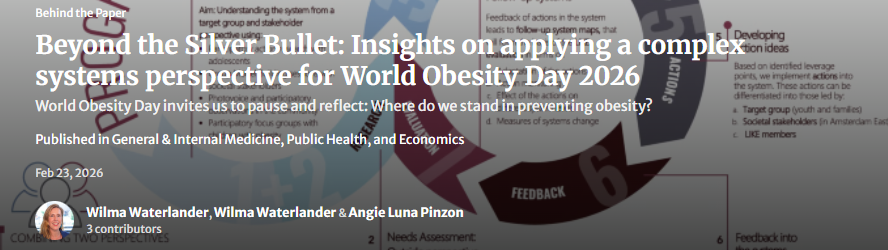
Beyond the silver bullet of obesity prevention
Obesity prevention is often framed as a matter of individual choice, but what if the real drivers lie in the systems around us? @Wilma Waterlander & @Angie Luna Pinzon explore why progress has stalled and what it truly means to move beyond ‘silver bullet’ solutions. Drawing on research published in Health Research Policy and Systems, they unpack how complex, shifting environments shape outcomes in ways traditional approaches fail to address. Through reflections from the LIKE project in Amsterdam, this Behind the Paper post offers a candid look at the realities of applying systems thinking in practice, highlighting the challenges of adaptation, stakeholder engagement, and governance in ever-changing contexts.
Read the full post for an insightful perspective on why embracing complexity may be key to achieving meaningful, lasting change in obesity prevention.

Q&A with obesity researcher, Eleonora Poggiogalle
Obesity is shaped by far more than diet alone, including biology and behaviour and wider social and environmental pressures. In this Q&A, @Eleonora Poggiogalle shares insights from their research into metabolism and modern lifestyles, and how these complexities are influencing approaches to obesity. The post explores how research is reshaping treatment and policy, tackles common misconceptions, and highlights challenges such as global disparities in care and the rise of GLP-1 use beyond clinical settings.
Read the full post for a concise look at the future of obesity research, including personalised treatments and a growing focus on prevention.
New Journal launch!
In time for Brain Awareness Week, a new addition to the Nature Portfolio has arrived. Nature Progress Brain Health is a multidisciplinary, open-access journal welcoming submissions across all areas of brain health including fundamental research and clinical and population studies. Read the full post to learn more about the journal’s scope, its collaborative editorial model, and how you can get involved from the outset.
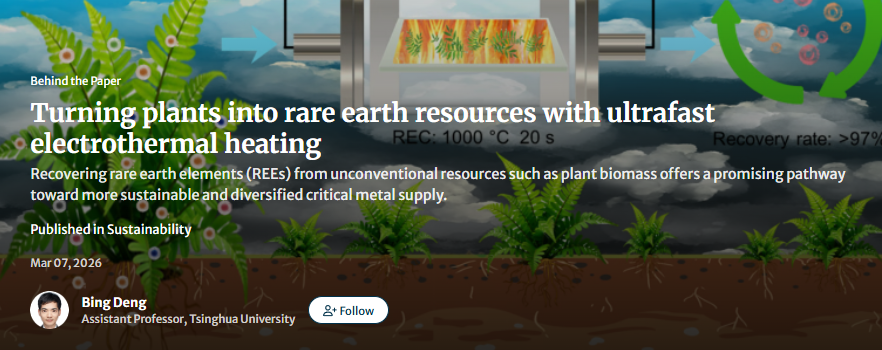
Turning plants into rare earth resources with ultrafast electrothermal heating
And finally, a green post for St Patrick’s Day This Behind the Paper post from @Bing Dengexplores how plants can be transformed into a sustainable source of rare earth elements, published in Communications Materials. By combining an eco-friendly, sustainable process called phytomining that uses hyperaccumulator plants to absorb heavy metals from low-grade ores or contaminated soil with ultrafast electrothermal heating, the research offers a novel way to recover critical materials more efficiently and with lower environmental impact.
This month’s posts, once again, highlight the breadth and impact of research across our Communities. Together, they showcase the latest scientific insights as well as the people, ideas, and collaborations driving progress forward.
If any of these stories spark your interest, I encourage you to explore the full posts and join the conversation, we look forward to seeing what the community shares next!
There is always an abundance of amazing research stories being showcased on the Research Communities. To explore more, visit the Behind the Paper Channel and learn what thoughts and ideas go on behind the scenes of research projects.
Interested in more content highlights on the Research Communities?

Helping researchers connect, collaborate, and communicate their work. Specialising in Medicine and Life Science and passionate about making science more visible and accessible.
Follow the Topic
-
Health Research Policy and Systems
This journal covers all aspects of the organisation and use of health research – including agenda setting, building health research capacity, and how research as a whole benefits decision makers, practitioners in health and related fields, and society at large.
-
Communications Materials
A selective open access journal from Nature Portfolio publishing high-quality research, reviews and commentary in all areas of materials science.


Related Collections
With Collections, you can get published faster and increase your visibility.
Advancing Research Prioritization: Monitoring, Evaluation, and Implementation Strategies
Despite the critical role of research prioritization in optimizing funding allocation and shaping research agendas, there remains a notable gap in the literature on how these processes are assessed and implemented in practice. This special series aims to bridge this gap by bringing together studies that examine the frameworks, methodologies, and real-world applications of monitoring, evaluation, and implementation in research prioritization. We encourage submissions that explore both theoretical and empirical perspectives, with a focus on identifying best practices, challenges, and innovations in priority-setting mechanisms. Contributions may range from methodological discussions to case studies and policy analyses that shed light on how research prioritization efforts are designed, executed, and measured.
All submissions in this collection undergo the journal’s standard peer review process. Similarly, all manuscripts authored by a Guest Editor(s) will be handled by the Editor-in-Chief. As an open access publication, this journal levies an article processing fee (details here). We recognize that many key stakeholders may not have access to such resources and are committed to supporting participation in this issue wherever resources are a barrier. For more information about what support may be available, please visit OA funding and support, or email OAfundingpolicy@springernature.com or the Editor-in-Chief.
Publishing Model: Open Access
Deadline: Oct 08, 2026
Orbitronics and unconventional spin-orbit torque for next-generation magnetic memory and spin logic devices
Publishing Model: Open Access
Deadline: Oct 31, 2026