Beyond the Silver Bullet: Insights on applying a complex systems perspective for World Obesity Day 2026
Published in General & Internal Medicine, Public Health, and Economics

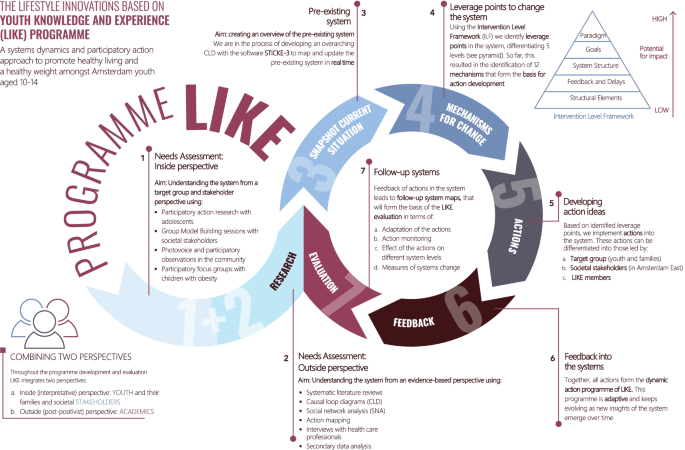

Unfortunately, we see little progress in obesity prevention in recent years. Global obesity levels are still rising, or at best flattening at a high level. Because of this stagnated progress, we see growing interest in taking a different path. Instead of relying on linear cause-and-effect approaches that focus on calories, diets or step counts, there is increasing attention on applying a complex systems approach. But what does such an approach really mean? And perhaps more importantly: what does it look like when you try to apply it in practice?
Why systems thinking matters
In 2022, the World Health Organization defined obesity as “a complex multifactorial disease” and emphasized that effective management requires tackling “obesogenic environments.” This framing reflects decades of prevention research arguing that obesity is not simply the result of individual choices, but of food and physical activity environments that shape and constrain those choices. Yet despite this recognition, progress in transforming these environments has been slow. The Lancet Commission on Obesity described this stagnation as “policy inertia”: a web of political reluctance, commercial interests, and institutional norms that sustains the status quo. Recent work applying complexity theory and political science has further shown how self-reinforcing feedback loops maintain the belief that obesity is primarily an individual responsibility, making structural policy change difficult to achieve.
A systems approach, the Commission argued, is therefore essential. Such an approach targets the underlying system dynamics that explain why our environments are so unhealthy. However, despite growing interest, there are still few obesity programmes that apply a complex systems perspective from start to finish.
From systematic to systemic
When we say “systems,” we’re not referring to tidy, bounded entities like a hospital system or a school system. That is systematic thinking. What we mean instead is systemic thinking: the messy, dynamic interplay of actors, norms, structures, and feedback loops that together produce the patterns we observe. Systems thinking is not a single, unified field; rather, it draws on diverse and evolving methods from general systems theory, complexity science, organizational learning and other disciplines; whereby methods have been applied and further developed in the study of natural, mechanical, and social systems.
In our recent paper describing reflections from the LIKE project, we describe how we applied system dynamics theory to a local obesity prevention approach in Amsterdam. Rather than evaluating a single intervention, we examined how a programme evolved within and in interaction with its broader context. Along the way, we learned three lessons that fundamentally reshaped how we think about “doing” systems work.
-
The interdependency between programme and context
Like many systems projects, we began with the ambition to “understand the system.” We organized Group Model Building sessions, developed Causal Loop Diagrams, engaged in Participatory Action Research, and conducted Social Network Analysis. What we underestimated, however, was the living, shifting and often hidden nature of context. Understanding the formal organizational structure of local government is one thing. Understanding who actually holds influence, where tensions lie, and where political momentum might suddenly emerge is something entirely different. Much of this context sits outside the public health domain and is hidden below the surface. And context does not sit still. Political coalitions change, crises erupt, and windows of opportunity open—and close—quickly. Applying a systems perspective, especially when trying to shift policy, therefore requires continuous adaptation to the context.
2. The dynamic and adaptive character
Instead of implementing a fixed, predefined intervention, we developed an adaptive action programme. Actions targeted different system levels: events, structures, goals and beliefs. During the initial phases of needs assessment, research questions were formulated exploratively, without a pre-specified focus on a particular part of the system. For example, we asked: “For those parts of the system that will be addressed by the action programme: what does the pre-existing system look like in terms of relevant stakeholders, power relations, and ongoing policies and activities?” This openness allowed the programme to evolve over time. For the same reason, we kept system boundaries broad.
But adaptability brings its own challenges. Participatory processes generate many ideas, yet not all of them are equally strategic. Low-hanging fruit is attractive: it delivers visible progress and keeps stakeholders motivated. Yet transformative change often requires reaching higher branches—targeting deeper leverage points that are politically sensitive and less tangible. Momentum becomes precious. When a window of opportunity opens, you need to act quickly. But this raises difficult questions: what happens to actions already underway that no longer align with the evolving systems strategy? And how do you work with stakeholders who have invested time, energy, and identity in activities that may no longer fit?
In the paper, we noted another important tension: determining the right timing for sharing insights. Researchers hesitated to communicate early findings before completing a thorough analysis, unsure whether preliminary interpretations would hold up under peer review. Similarly, local government partners were hesitant to involve their staff members, because they were already overcommitted and were unsure which expertise was required at each stage.
Systems thinking requires continually navigating these tensions - between inclusivity and focus, between participation and strategic coherence, and between seizing momentum and staying strategic.
3. Governance
We invested heavily in governance structure: building equal partnerships between academia, policy, and practice; organizing regular reflection meetings and embedding a participatory approach throughout. And yet, it was difficult to maintain a genuine systems perspective.
Why? Because institutions are wired for predictability. Budgets require predefined deliverables. Politicians need measurable outcomes. Researchers operate within funding cycles and publication pressures. This relates to the tensions described by Ison, describing a conflict between systemic thinking (which values fluidity, feedback, and emergence) and systematic practice (which relies on fixed plans, roles, and structures). Systems thinking requires repeatedly asking questions: Are we still addressing underlying dynamics? Or have we quietly reverted to business as usual? Are we measuring what is easy, or what actually matters?
In the paper we wrote: This type of governance is challenging because it requires equal partnership among science, policy, and practice, and oversight and leadership qualities across: (a) understanding and applying systems principles; (b) overseeing all ongoing activities and relevant stakeholders; and (c) applying an optimal approach to action navigation.
Conclusion
A complex systems perspective has a solid theoretical foundation, but applying these principles in a local context is not straightforward and requires a collective shift in thinking and working for all involved parties. It is not primarily about new methods. Challenges particularly relate to the many uncertainties that arise during such projects whereby everything continues to change over time, including the focus of the system under study; the involved stakeholders; and the momentum for change. It means accepting that there is no silver bullet. It means recognizing that programmes and contexts co-evolve. It means embracing adaptation without losing strategic direction. And it means investing in governance structures that can withstand the constant pull back to linearity.
Relevant papers:
- Luna Pinzon A, Stronks K, Verhoeff A, Vaandrager D, den Hertog K, Waterlander W. Applying a participatory system dynamics approach to childhood overweight and obesity in the local context: reflections from the LIKE project. Health Res Policy Syst. 2025;23(1):66
- World Health Organization (WHO). WHO European Regional Obesity Report 2022.
- Swinburn BA, Kraak VI, Allender S, Atkins VJ, Baker PI, Bogard JR, et al. The Global Syndemic of Obesity, Undernutrition, and Climate Change: The Lancet Commission report. Lancet. 2019;393(10173):791–846.
- Gadsby EW, Wilding H. Systems thinking in, and for, public health: a call for a broader path. Health Promot Int. 2024;39(4)
- Hagenaars LL, Schmidt LA, Groeniger JO, Bekker MPM, Ter Ellen F, de Leeuw E, et al. Why we struggle to make progress in obesity prevention and how we might overcome policy inertia: Lessons from the complexity and political sciences. Obes Rev. 2024;25(5):e13705
Follow the Topic
-
Health Research Policy and Systems
This journal covers all aspects of the organisation and use of health research – including agenda setting, building health research capacity, and how research as a whole benefits decision makers, practitioners in health and related fields, and society at large.