Memristor-based artificial sensory nervous system for efficient neuro-inspired robotics
Published in Bioengineering & Biotechnology and Materials






Driven by the rapid advancement of artificial intelligence (AI) and large language models (LLMs), robotics is also evolving at a remarkable pace and is increasingly becoming a key focus in future industrial applications. However, while software for robotic systems has advanced in parallel with AI development, hardware technologies enabling energy-efficient responses to external stimuli remain insufficient. Animals unconsciously filter and prioritize important stimuli among countless environmental signals, ignoring unimportant ones to minimize unnecessary energy consumption and quickly respond to critical stimuli. In contrast, current robotic systems must process large volumes of signals received from sensors, resulting in heavy processor workloads, reduced energy efficiency, and limitations in achieving rapid responses.
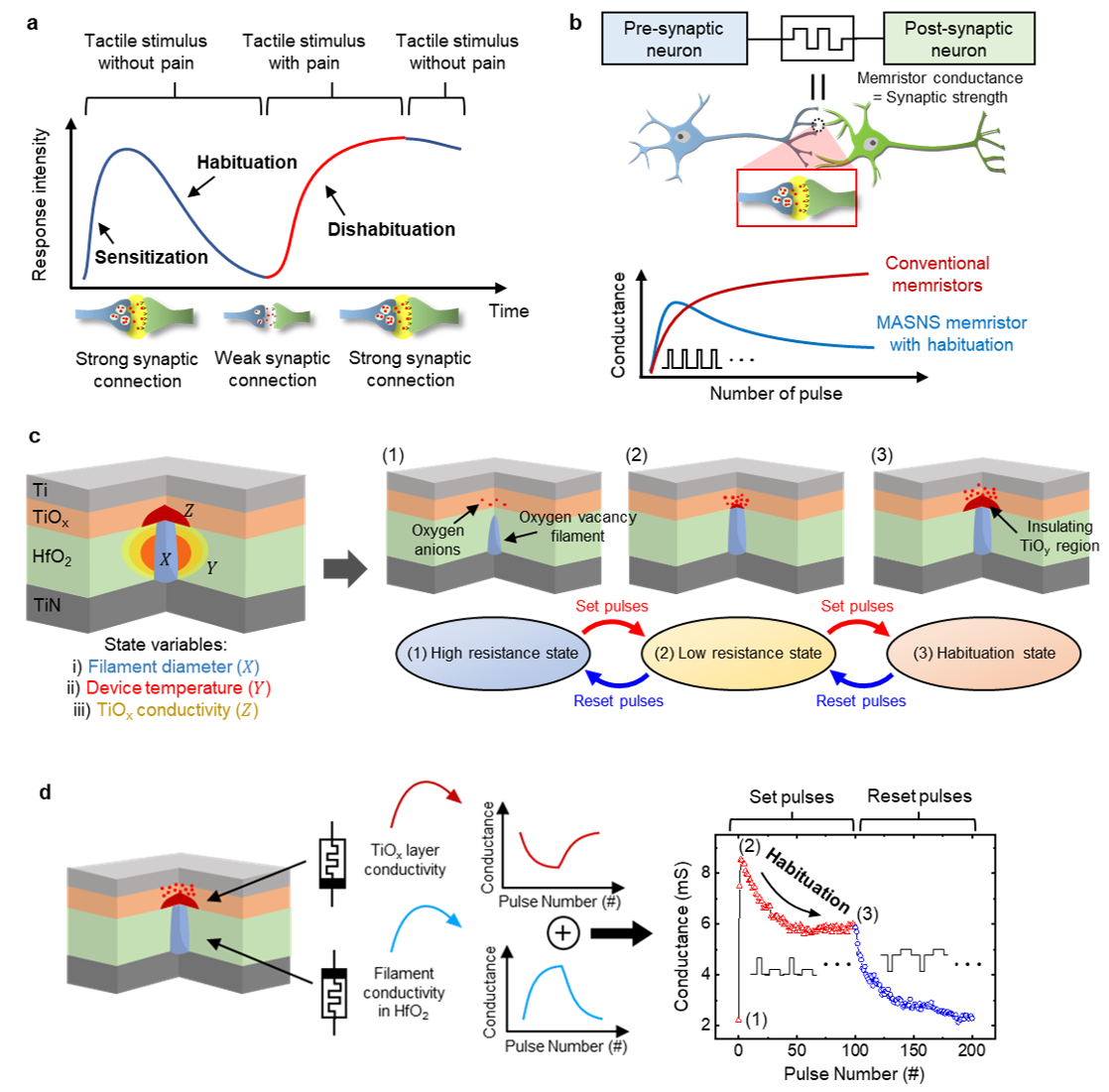
To address these challenges, researchers have attempted to develop memristor-based artificial sensory nervous systems that emulate the efficient biological sensory nervous systems found in animals. Nevertheless, replicating biological functions such as habituation and sensitization has typically required bulky peripheral circuitry. Furthermore, implementing such complex synaptic behaviors within a single device has proven difficult. Conventional memristors exhibit low-order characteristics in which resistance changes are governed by one or two state variables, such as the size of conductive filaments and the internal temperature of the device. This leads to simple monotonic conductance updates, making it difficult to replicate functions requiring non-monotonic updates in response to identical stimuli, such as habituation.
In this study, we report the development of a memristor device capable of implementing both habituation and sensitization behaviors within a single device. To overcome the limitations of conventional memristors in realizing habituation and sensitization, we introduced a third state variable by incorporating an additional resistive switching layer that exhibits resistance changes in the direction opposite to that of the conductive filaments. By combining filament diameter, internal temperature, and this additional layer, we developed a third-order memristor. Unlike conventional low-order devices, this memristor exhibited non-monotonic conductance updates, enabling us to successfully emulate biological habituation and sensitization functions. Notably, whereas previously reported memristors with habituation characteristics exhibited volatile habituation states that decayed over time, our device maintained a stable habituation state. This allowed learned information to be preserved even in the event of unexpected power loss, demonstrating its suitability for battery-powered robotic applications.
Based on the device, we constructed a memristor-based artificial sensory nervous system capable of receiving tactile stimuli and electrical shock (pain stimuli) and applied it to an actual robotic system (robot arm) to demonstrate energy-efficient neuro-inspired robotics. When repeatedly subjected to harmless tactile stimuli, followed by painful stimuli, we observed that the robotic arm gradually became less responsive to the harmless stimuli via habituation, while responding sensitively to the painful stimuli — closely mimicking animal-like sensory processing. This result confirms that, even without additional processor intervention, the system could selectively respond to important stimuli while ignoring unimportant ones, thereby reducing processor workload. Through this work, we experimentally demonstrated the feasibility of neuro-inspired robotics that replicate the efficient peripheral nervous systems of biological organisms, surpassing the limitations of conventional robotic systems.

For more details, please refer to the published article in Nature Communications:
https://doi.org/10.1038/s41467-025-60818-x

Emerging devices, Neuromorphic computing systems, Future electronics, Memristors, Biologically plausible electronics
Follow the Topic
-
Nature Communications
An open access, multidisciplinary journal dedicated to publishing high-quality research in all areas of the biological, health, physical, chemical and Earth sciences.

Related Collections
With Collections, you can get published faster and increase your visibility.
Women's Health
Publishing Model: Hybrid
Deadline: Ongoing
Tumor Microenvironment Crosstalk and Therapeutic Implications
Publishing Model: Hybrid
Deadline: Nov 02, 2026