Mixed-matrix membranes with molecular recognition windows for selective helium extraction from natural gas
Published in Chemistry, Physics, and Protocols & Methods

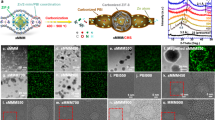

Mixed-matrix membranes (MMMs) with high chain packing density by incorporating soluble macrocycle compounds represent a promising class of materials for gas separation. However, achieving the ultra-high selectivity (He/CH4 > 1000) for helium extraction from natural gas with ultra-low helium content remains a formidable challenge, especially for Matrimid membranes, which are commercially available but exhibit relatively low permeability and moderate selectivity. Herein, the cyclic Cyclen with specific intra-ring dimensions was incorporated into Matrimid as a pore-structure modifier to enhance the He/CH4 selectivity. The strong hydrogen bonding interactions between Cyclen and Matrimid chains induced a denser chain stacking and modulation of the interchain gap structures, which enables rapid mass transfer of small He gas molecules while hindering the diffusion of large CH4 gas molecules across the membrane, thereby significantly enhanced He/CH4 molecular sieving capacity. Molecular dynamics simulations indicate that the MMMs prepared using Cyclen as a filler exhibited tunable microporous and more efficient He transport channels. Notably, the He/CH4 selectivity reached up to an impressive value of 6788 after physical aging for 110 days, which outperformed almost all reported polymer-based membranes and was even comparable to that of some advanced carbon molecular sieve membranes.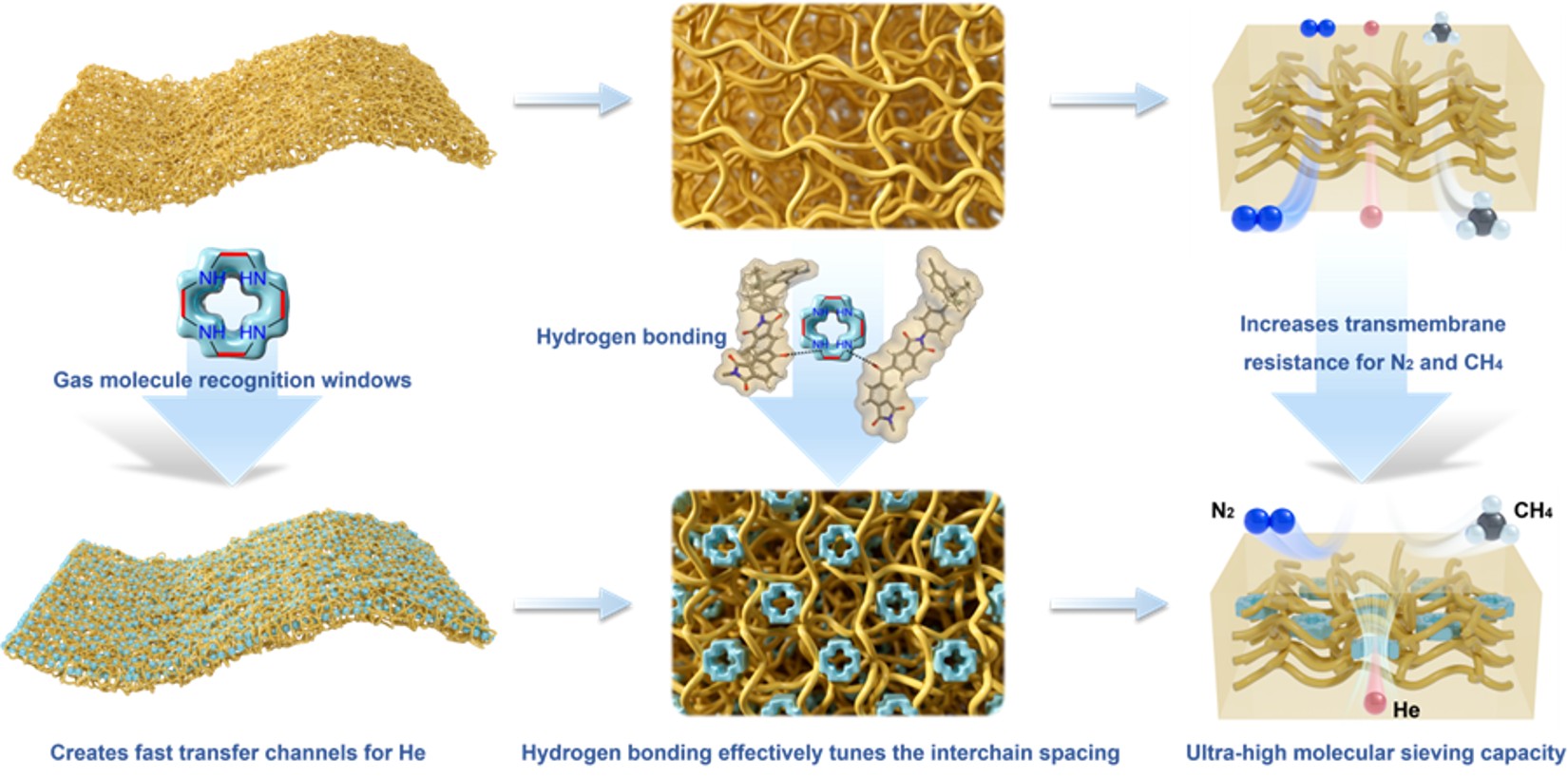
Cyclen was incorporated as nanofillers into the Matrimid polymer matrix, and the fortified hydrogen bonding interactions improved the interfacial compatibility between Cyclen and Matrimid polymer chains. The pore size of Cyclen (3.2-3.4 Å) creates a significant permeation cut-off between quick gases (He: 2.60 Å, H2: 2.89 Å, CO2: 3.30 Å) and slow gases (N2: 3.64 Å and CH2: 3.80 Å). The strong hydrogen bonding between the N-H groups from Cyclen macrocycle structure and the C=O groups from Matrimid chain effectively tunes the interchain spacing and blocks the transport ways for larger N2 and CH4 gas molecules. The Matrimid-Cyclen membranes achieve ultra-high He/CH4 selectivity of 1660 at an optimum Cyclen loading of only 5%. Strikingly, all the separation performance for H2/CH4, CO2/N2 and CO2/CH4 of Matrimid-Cyclen-5% membrane considerably exceed the 2008 Robeson upper bound line. Both He/N2 and He/CH4 separation performance far exceed the upper bound line even after physical aging for 110 days, which is on par with some CMS membranes and become one of the best He gas separation membranes. Therefore, the Matrimid-Cyclen membranes with gas molecule recognition windows possess great potential for high purity He acquisition, H2 purification and CO2 capture from natural gas.

Follow the Topic
-
Nature Communications

An open access, multidisciplinary journal dedicated to publishing high-quality research in all areas of the biological, health, physical, chemical and Earth sciences.
Related Collections
With Collections, you can get published faster and increase your visibility.
Women's Health
Publishing Model: Hybrid
Deadline: Ongoing
Biosensing
Publishing Model: Hybrid
Deadline: Jun 30, 2026



Please sign in or register for FREE
If you are a registered user on Research Communities by Springer Nature, please sign in
Nat Commun (2026). https://doi.org/10.1038/s41467-026-69768-4