Modulating Lattice Oxygen and Transport Kinetics of Li‑Rich Cathodes in All‑Solid‑State Batteries Through Multifunctional Li3ScF6 Protective Layer
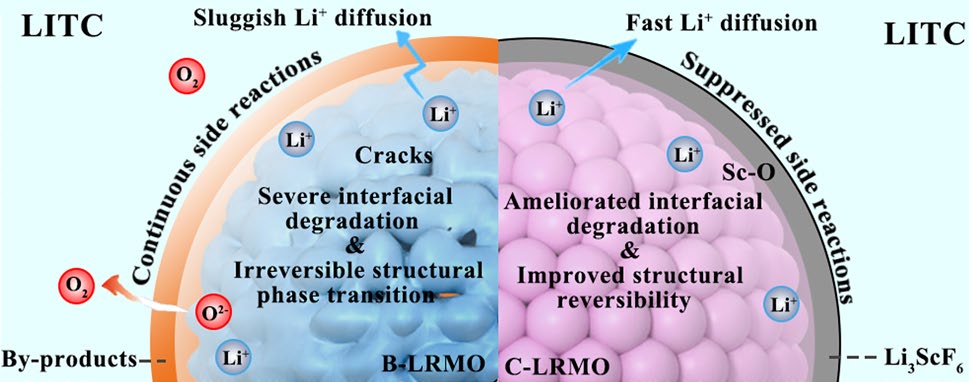

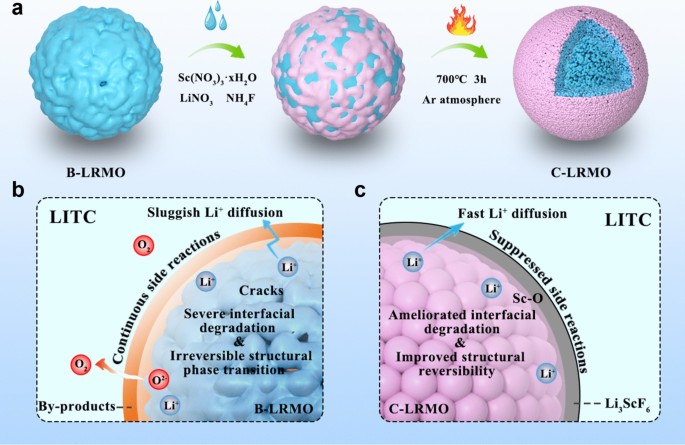

As the demand for next-generation energy storage systems with higher safety and energy density continues to escalate, all-solid-state lithium batteries (ASSLBs) have emerged as a particularly promising alternative to conventional lithium-ion batteries. Among high-capacity cathode candidates, Li-rich Mn-based oxide (LRMO) materials stand out for their unique cationic and anionic synergistic redox capabilities, delivering capacities exceeding 250 mAh g-1. However, their practical application in ASSLBs is severely hindered by irreversible lattice oxygen release, sluggish interfacial lithium-ion transport kinetics, and aggravated side reactions with solid electrolytes. Now, researchers from the University of Science and Technology Beijing, led by Professor Dan Zhou, Professor Li-Zhen Fan, and their collaborators including Peng Lei and Gang Wu, have presented a breakthrough multifunctional protective layer strategy that bridges the gap between high capacity and long-term stability in solid-state systems.
Why This Cathode Matters
Traditional LRMO cathodes in ASSLBs typically suffer from severe interfacial degradation and continuous oxygen loss during high-voltage cycling, which drives structural phase transitions and rapid capacity fading. The novel Li3ScF6 (LSF) protective layer overcomes these limitations by simultaneously modulating lattice oxygen stability and accelerating interfacial transport kinetics, combining battery-level energy density with solid-state reliability.
Innovative Design and Mechanism
The material is synthesized through a facile sol–gel method followed by thermal treatment, yielding a rationally designed interfacial architecture comprising a surface Li3ScF6 coating region (~4 nm) and a subsurface Sc doping region (~8 nm). DFT calculations and advanced spectroscopic analyses reveal that the LSF coating significantly enhances interfacial contact between the cathode and the halide solid electrolyte, suppresses parasitic side reactions, and facilitates fast Li⁺ diffusion across the interface. Concurrently, the strong Sc–O bonding—confirmed by XANES, EXAFS, and electron localization function analyses—stabilizes the lattice oxygen framework, suppresses oxygen evolution, and markedly improves the reversibility of the oxygen-anion redox reaction. The O 2p valence band shifts 0.321 eV toward lower energy, substantially reducing the tendency of lattice oxygen to evolve into O2 under high-voltage conditions.
Outstanding Performance
C-LRMO delivers a high initial discharge capacity of 242.6 mAh g-1 at 0.1C with an initial Coulombic efficiency of 82.6%, and the oxygen redox contribution reaches 60.9% during the first charge. The material exhibits exceptional fast-charging capability, maintaining 136.8 mAh g-1 at 1.0C. Notably, it achieves outstanding long-term cycling stability with 83.9% capacity retention after 500 cycles at 0.3C, and 80.4% retention even after 1,000 cycles at 1.0C. The voltage decay is suppressed to merely 0.32 mV per cycle, in stark contrast to 0.56 mV per cycle for the bare cathode. Furthermore, at a high cathode loading of 19.1 mg cm-2 and 60°C, the device achieves an ultrahigh areal capacity of 4.17 mAh cm-2 with 81.1% retention after 300 cycles.
Applications and Future Outlook
When integrated with a Li–In alloy anode and Li2.6In0.8Ta0.2Cl6 solid electrolyte in all-solid-state configurations, the modified LRMO cathode enables stable operation under practical, high-loading conditions that approach industrial standards. Despite scandium's relative scarcity, the ultrathin LSF interfacial coating (~1 wt%) minimizes overall Sc consumption and maintains practical feasibility for large-scale implementation. This work establishes a new paradigm for multifunctional interfacial engineering in solid-state batteries, opening promising avenues for next-generation high-energy-density and high-safety energy storage systems.
Stay tuned for more groundbreaking research from this collaborative team at the University of Science and Technology Beijing!

Editor of Nano-Micro Letters, which is an Open-Access, peer-reviewed journal reported papers that have at least one dimension ranging from a few sub-nanometers to a few hundreds of micrometers. The journal is published by Springer Nature and indexed by SCI, EI, SCOPUS, Pubmed, etc. The 2025 JCR Impact Factor is 38.5. The 2025 CiteScore is 58.9.
Follow the Topic
-
Nano-Micro Letters
Nano-Micro Letters is a peer-reviewed, international, interdisciplinary and open-access journal that focus on science, experiments, engineering, technologies and applications of nano- or microscale structure and system in physics, chemistry, biology, material science, and pharmacy.