Nanoplastic Toxicity Begins at the Interface, Not the Polymer
Published in Chemistry and Earth & Environment


The Bulk-to-Nano Collapse: Why Polymer Identity Fades
For decades, the environmental science and toxicology communities have operated under a flawed assumption: that a nanoplastic is simply a microscopically pulverized version of a macro-plastic. We classify these pollutants as polystyrene (PS), polyethylene (PE), or polyvinyl chloride (PVC), and we attempt to extrapolate their toxicological behavior based on the bulk properties of these materials.
This approach completely ignores the laws of physical chemistry. When a plastic particle degrades from a millimeter-sized microplastic into a sub-100 nanometer particle, classical bulk polymer physics collapses, and interfacial thermodynamics takes over.
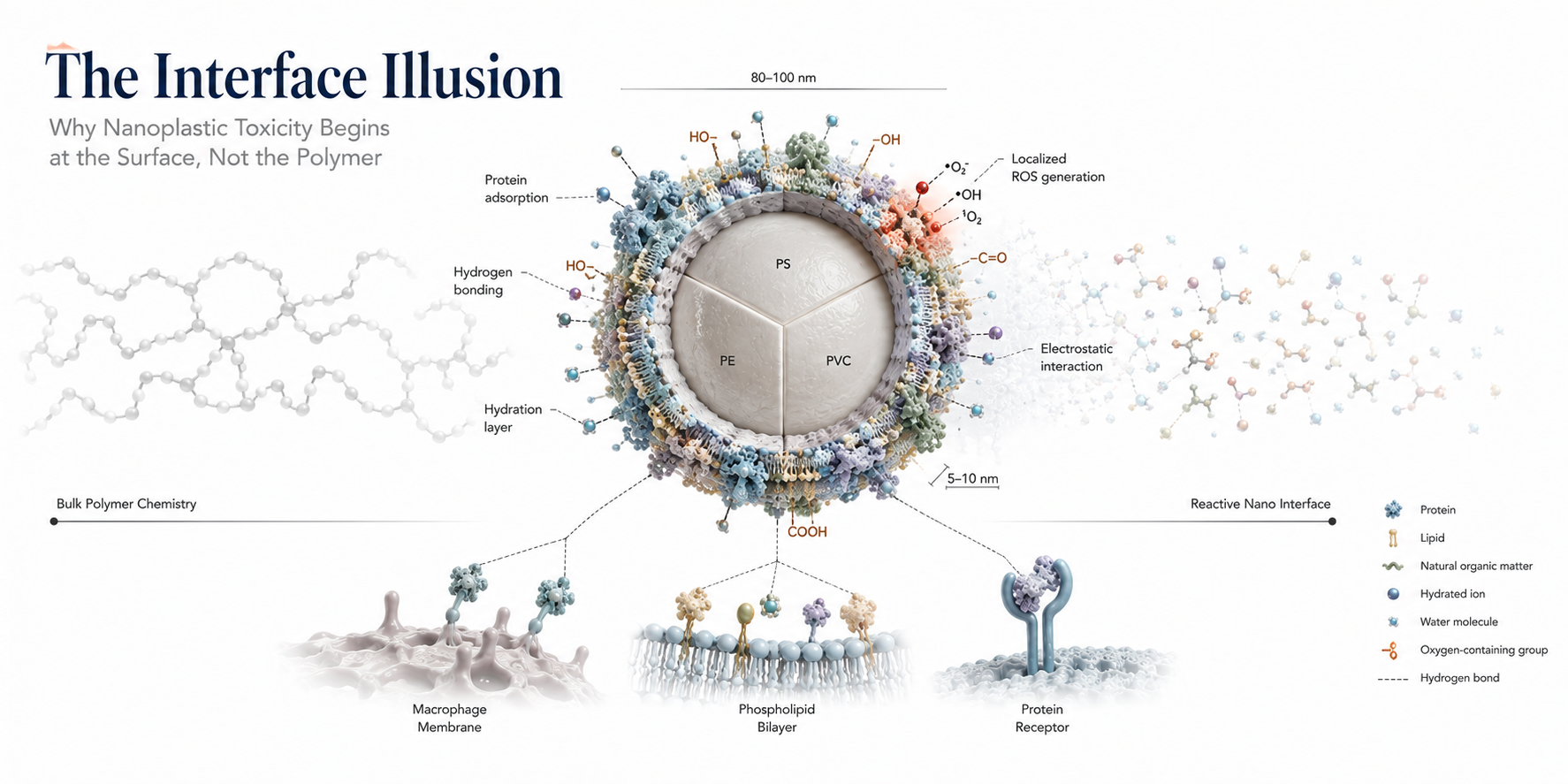
As a particle shrinks, its surface-area-to-volume ratio increases exponentially. In a true nanoplastic, a massive percentage of the constituent atoms reside directly on the surface rather than secured within the bulk polymer matrix. This creates a state of extreme surface free energy. The particle is no longer an inert piece of floating debris; it is a highly energized, thermodynamically unstable interface desperate to interact with its surroundings to lower its energy state.
Therefore, arguing whether PS is inherently more toxic than PE at the nanoscale misses the forest for the trees. The core polymer acts merely as a scaffold. The true driver of biological and ecological damage is the highly reactive boundary layer—the interface—where the plastic meets the fluid matrix.
The Thermodynamics of the Bio-Nano Interface
To understand the true mechanism of nanotoxicology, we must look at what happens the exact millisecond a nanoplastic enters a biological or environmental fluid.
Because most pristine plastics are highly hydrophobic, their insertion into an aqueous biological environment (like human blood plasma, lung surfactant, or river water) is thermodynamically highly unfavorable. The water molecules surrounding the plastic are forced into highly ordered, cage-like structures (clathrates) to avoid interacting with the hydrophobic surface, which drastically decreases the entropy of the system.
To restore thermodynamic equilibrium and minimize this surface free energy, the nanoplastic interface acts as a powerful, non-specific molecular magnet. It aggressively scavenges ambient biomolecules, natural organic matter, and surrounding ions, rapidly cloaking itself in a bio-corona (or eco-corona).
This is the exact moment the nanoplastic ceases to be a simple polymer. The toxicological fate of the particle—whether it is excreted, whether it crosses the blood-brain barrier, or whether it triggers an immune storm—is dictated entirely by the biochemical signature of this newly formed interface. The interface dictates the cellular uptake mechanisms, while the hidden polymer core merely dictates the particle's buoyancy and degradation timeline.
Lipid Bilayer Disruption: The Physical Toxicity of the Interface
The most immediate and dangerous consequence of this interfacial reactivity is how nanoplastics interact with cellular architecture—specifically, the phospholipid bilayer of human and animal cell membranes.
Traditional toxicology focuses on chemical leaching: the idea that plastics are toxic because they release bisphenol A (BPA) or phthalates. While leaching is a valid concern for macro- and microplastics, nanoplastics introduce a far more insidious threat: pure physical interfacial toxicity.
When a nanoplastic with a highly hydrophobic surface approaches a cell membrane, the thermodynamic drive to shield its surface from water forces it to embed directly into the hydrophobic core of the lipid bilayer. This physical insertion does not require a chemical reaction, nor does it require a specific cellular receptor. It is driven entirely by the energetic affinity of the interface.
Once embedded, the rigid nanoplastic interface disrupts the fluid mosaic model of the membrane. It alters membrane fluidity, induces localized membrane thinning, and distorts the conformational structure of embedded transmembrane proteins, such as ion channels and active transport pumps. This interfacial disruption leads to calcium ion leakage, the depolarization of mitochondrial membranes, and the generation of intracellular Reactive Oxygen Species (ROS). The cell dies not because it was poisoned by a leached chemical, but because its protective boundary was physically and thermodynamically compromised by the nanoplastic interface.
The Trojan Horse and Interfacial Catalysis
Beyond physical disruption, the nanoplastic interface acts as an active catalytic and sorptive boundary.
In environmental matrices, the high surface free energy of weathered nanoplastics turns them into hypersorbent chemical sponges. The surface undergoes continuous photo-oxidation, generating highly polar carbonyl and carboxyl functional groups. These groups create a localized electrostatic field at the interface that actively pulls heavy metals (Cd2+, Pb2+, Hg2+) and persistent organic pollutants (POPs) out of the water column.
This creates the heavily documented "Trojan Horse" effect. However, the true danger lies in the interfacial release kinetics. When an organism ingests a nanoplastic loaded with heavy metals, the particle transitions from a neutral aquatic environment into the highly acidic, enzyme-rich environment of the gut.
The interface immediately responds to this shift in pH and ionic strength. The electrostatic bonds holding the pollutants weaken, and the interface rapidly desorbs its toxic payload directly into the sensitive mucosal lining. Furthermore, the localized surface defects on the nanoplastic can act as catalytic sites, facilitating redox reactions that convert relatively benign chemical species into highly reactive free radicals directly within the tissue.
The nanoplastic is not just a carrier; its interface acts as a catalytic reactor that amplifies the toxicity of existing environmental pollutants.
The Analytical Blind Spot: Moving Beyond DLS and Pristine Beads
Acknowledging that nanoplastic toxicity is fundamentally an interfacial phenomenon demands a radical shift in how we conduct analytical chemistry and ecotoxicology.
Currently, the vast majority of peer-reviewed literature relies on dynamic light scattering (DLS) to measure particle size, and simple in vitro cell viability assays using pristine, perfectly spherical polystyrene beads purchased from a chemical supplier. These studies yield clean, reproducible data, but they represent a catastrophic analytical blind spot.
Pristine polystyrene beads possess a uniform, unweathered, artificially stabilized interface that bears zero resemblance to the jagged, oxidized, and corona-coated nanoplastics found in a coastal estuary or human bloodstream. Measuring the toxicity of a pristine bead tells us nothing about the interfacial dynamics of real-world nanoscale pollution.
To map the true risk profile of nanoplastics, the advanced materials and environmental science communities must transition to high-resolution interfacial characterization techniques. We must utilize Sum Frequency Generation (SFG) spectroscopy to probe the vibrational dynamics of water molecules directly at the plastic surface. We must rely on Quartz Crystal Microbalance with Dissipation (QCM-D) to monitor the viscoelastic properties and real-time binding kinetics of the bio-corona. And we must deploy Cryo-Electron Microscopy (Cryo-EM) to observe the physical distortion of lipid bilayers caused by the nanoplastic interface in a fully hydrated, native state.
Conclusion
We are wasting vital research hours and massive funding grants debating the hierarchical toxicity of different polymer backbones, while entirely ignoring the physical chemistry of the bio-nano boundary.
If we wish to fully comprehend and mitigate the escalating threat of nanoplastics, we must stop viewing them as inert, miniature pieces of garbage. We must recognize them for what they truly are: hyper-reactive, thermodynamically driven interfaces that hijack biological systems and catalyze environmental damage. The future of nanotoxicology will not be written by polymer chemists; it will be written by interfacial scientists.
#Nanoplastics #Nanotoxicology #BioNanoInterface #PhysicalChemistry #EnvironmentalScience #TrojanHorseEffect #SurfaceEnergy #Microplastics #AdvancedMaterials #SpringerNature

Dr. Akeem Adeyemi Oladipo is a globally recognized Research Professor of Materials and Environmental Chemistry at Eastern Mediterranean University. Ranked among the world's Top 2% Scientists, his expertise bridges nanotechnology, renewable energy, and electro-analytical chemistry. He specializes in advanced materials synthesis for wastewater treatment, highly sensitive electrochemical biosensors, and solar energy conversion. By integrating machine learning and artificial neural networks, his research drives scalable deep-tech innovations in environmental sustainability and energy storage.