One Metric, Many Meanings: Why Water Use Efficiency Needs a Common Language
Published in Earth & Environment, Ecology & Evolution, and Protocols & Methods

Some scientific papers generate new knowledge or confirm existing findings. Others bring together and synthesize what we already know. And then there are papers that, above all, seek to bring some order to existing knowledge.
In a new review, One Metric, Many Meanings: Reconciling Water Use Efficiency Definitions, published in Current Climate Change Reports, belongs to this last category.
Water Use Efficiency (WUE) is a fundamental concept in plant physiology, ecology, agriculture, and Earth system science. Broadly speaking, it describes the relationship between carbon gained by vegetation and water lost during physiological and ecosystem processes. This relationship is particularly important for understanding plant responses to increasing atmospheric CO₂, drought, and climate change.
The scientific interest in WUE is enormous. A bibliographic search conducted in September 2026 returned more than 7.4 million results in Google Scholar and over 320,000 records in Web of Science. However, behind this extensive literature lies a surprisingly persistent problem: researchers frequently use the same terminology to describe quantities that are not necessarily equivalent.
Over the decades, WUE has been defined using different combinations of carbon and water fluxes, measured or estimated at different spatial and temporal scales. From individual stomata and leaves to whole plants, forest ecosystems, and global vegetation, a multitude of mathematical formulations and acronyms has emerged, sometimes describing different aspects of the same physiological relationship and sometimes representing fundamentally different processes.
This conceptual fragmentation is not merely a matter of terminology. It can directly affect how scientific results are interpreted, compared, and ultimately incorporated into ecosystem and climate models.
Where the idea came from
Several years ago, while working on carbon and water dynamics in forest ecosystems, I became increasingly aware of the remarkable heterogeneity surrounding WUE terminology and its interpretation.
Studies using apparently identical terminology often relied on different variables, methodological assumptions, or temporal scales. In some cases, differences between reported WUE values reflected genuine physiological responses. In others, they were partly or entirely attributable to how WUE had been defined and calculated.
More recently, I asked Paulina F. Puchi to systematically revisit the scientific literature and help bring some conceptual and methodological order to this increasingly fragmented field.
Together with Matthias Saurer, this effort evolved into a comprehensive review of the definitions, formulations, and assumptions underlying the most commonly used WUE metrics.
Fourteen metrics, but are we measuring the same thing?
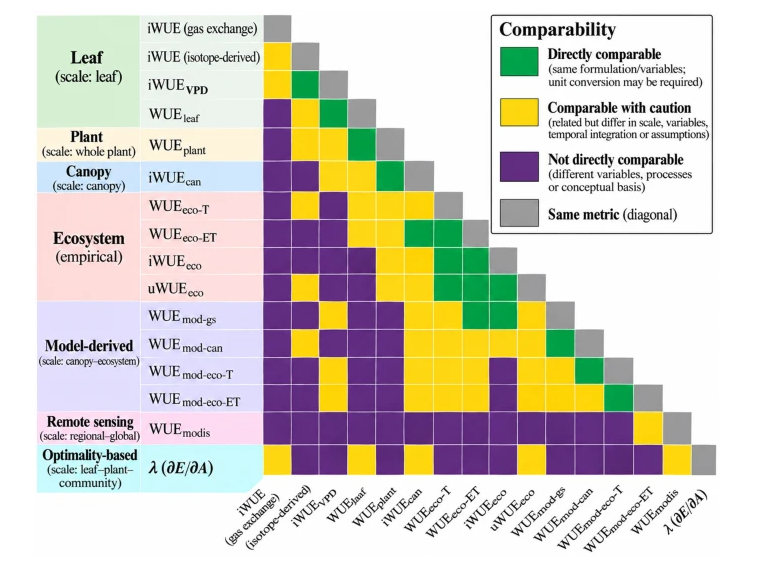
One of the central contributions of our review is the systematic comparison of 14 WUE-related metrics, covering empirical observations, stable isotope approaches, ecosystem flux measurements, remote sensing, process-based modelling, and optimality theory.
Consider a relatively simple example.
At the leaf scale, WUE is commonly expressed as the ratio between net CO₂ assimilation and transpiration (A/E). Intrinsic WUE, however, relates assimilation to stomatal conductance (A/gₛw). Although these metrics describe related physiological processes, they respond differently to environmental conditions, particularly atmospheric evaporative demand.
At the ecosystem scale, WUE is frequently calculated as gross primary productivity divided by evapotranspiration (GPP/ET). However, evapotranspiration includes not only plant transpiration but also evaporation from soil and intercepted water. Consequently, GPP/ET and GPP/T do not represent exactly the same processes and should not be treated as interchangeable.
Further complications arise when comparing instantaneous gas-exchange measurements with isotope-derived estimates, satellite products, or model simulations. Each approach integrates different processes, operates at different scales, and introduces its own methodological assumptions.
Importantly, an increase in WUE does not necessarily imply improved plant performance, higher productivity, or greater drought resistance. WUE can increase simply because water loss declines more strongly than carbon assimilation, even under conditions of increasing physiological stress.
Without understanding the underlying carbon and water fluxes, interpreting such changes can be misleading.
Towards a more consistent framework
Our objective was not to identify a single, universally superior definition of WUE. Such a definition would neither be scientifically justified nor particularly useful.
Instead, we sought to clarify what each metric actually represents, under which conditions it should be used, and whether comparisons across methods and scales are scientifically meaningful.
To this end, we developed a harmonized glossary of definitions, variables, abbreviations, and mathematical formulations, accompanied by a conceptual framework that distinguishes between directly comparable metrics, metrics requiring particular caution, and quantities that should not be directly compared.
We also provide a supplementary conversion guide identifying the assumptions required when translating between different formulations.
A central conclusion is that WUE should generally be interpreted as a context-dependent process metric rather than an intrinsic, environmentally independent plant functional trait.
This distinction matters because atmospheric CO₂, vapor pressure deficit, temperature, soil water availability, and temporal integration can all influence WUE without necessarily indicating changes in the underlying physiological strategy.
Why this matters for climate change research
Understanding how vegetation regulates carbon uptake and water loss is essential for predicting ecosystem responses to climate change.
However, if different observational approaches and models use non-equivalent definitions of WUE, comparisons may become misleading, potentially affecting our interpretation of long-term physiological trends and predictions of future ecosystem functioning.
The challenge is particularly relevant when integrating leaf-level measurements, tree-ring isotopes, eddy covariance observations, remote sensing products, and process-based ecosystem models.
These approaches provide complementary information, but their estimates cannot automatically be considered interchangeable.
Improving the consistency of WUE terminology and reporting is therefore not simply an academic exercise. It is a necessary step towards more reliable scientific synthesis, model evaluation, and interpretation of carbon-water interactions under changing environmental conditions.
Sometimes scientific progress means bringing order
Science advances not only by generating new observations, developing new models, or testing new hypotheses, but also by critically revisiting the concepts and definitions upon which existing knowledge is built.
With this review, our ambition is relatively simple: to provide researchers with a practical reference, a sort of scientific vademecum, for selecting, interpreting, reporting, and comparing WUE metrics.
We do not expect to eliminate methodological diversity, nor should we. Different scientific questions legitimately require different approaches.
What we hope to encourage is greater conceptual clarity, transparency, and consistency.
Because using the same terminology does not necessarily mean measuring the same process, and meaningful scientific comparisons begin with knowing exactly what we are comparing.
Follow the Topic

Related Collections
With Collections, you can get published faster and increase your visibility.
Hydrology, Ecosystems and Society in a Changing Climate
This section covers advances in understanding how climate change affects the terrestrial water cycle and its interactions with ecosystems and society. It includes forward-looking reviews on droughts, floods and other hydroclimatic extremes; soil moisture, groundwater and water availability; ecohydrological feedbacks; and the consequences of hydrological change for ecosystems, water resources and human communities. Particular attention is given to emerging observational, Earth observation, modelling and data-driven approaches for monitoring, prediction, adaptation and resilience.
Publishing Model: Hybrid
Deadline: Ongoing
Topical Collection on Snow Processes and Hydrologic Systems
Publishing Model: Hybrid
Deadline: Ongoing